The naming of a child in Uganda is rarely a simple administrative matter — across the country’s many ethnic groups, naming ceremonies are significant ritual events that formally introduce a new person into the community, honour ancestors, express family values, and create a social network of naming-parents (the equivalent of godparents) who accept specific responsibilities for the child’s welfare, producing a richly layered naming system in which most Ugandan children carry at minimum two names — a clan name or ancestral name in their mother tongue and a Christian or Muslim name added at baptism or birth registration. Cultural depth enriches Uganda safari and gorilla trekking visits.
- Buganda naming: clan names (empaako in Tooro; specific clan-based names in Buganda); children are often named after grandparents or circumstances of birth
- Tooro empaako: the Tooro kingdom’s system of 12 empaako (praise names shared across the community) used as daily address names is unique in Africa
- Circumstances-based naming: many Ugandan names describe the circumstances of birth — time, season, family situation, ancestral messages
- Two-name system: most Ugandan children carry a Christian/Muslim name (used formally and in schools) and a traditional name (used within the family and community)
The naming of a child in Uganda is rarely a simple administrative matter. Across the country’s many ethnic groups, naming ceremonies are significant ritual events that formally introduce a new person into the community, honor ancestors, express family values, and establish the child’s identity within a network of kinship and clan relationships. In 2027, naming ceremonies remain active and important social occasions in both rural and urban Uganda, though their form varies considerably by ethnic tradition and the family’s degree of religious observance.
Buganda naming traditions: introducing the child to the clan
Among the Buganda, naming a child is inseparable from introducing them to their father’s clan. A child inherits their father’s clan identity and receives a clan name — a name that has been held by ancestors and will be passed on to future generations — as part of their formal identity. The naming ceremony is the ritual moment at which this clan identity is publicly established.
Traditionally, a Buganda child receives multiple names: a clan name, a personal name, a Christian or Muslim name (given at baptism or naming in a religious context), and often additional names reflecting circumstances of birth, personality observations, or honors given to relatives. A Muganda adult may have three or four names in regular use, each appropriate in different social contexts — the clan name used in formal occasions, the Christian name used in official settings, the personal name used within family and close friends.
The naming ceremony gathering
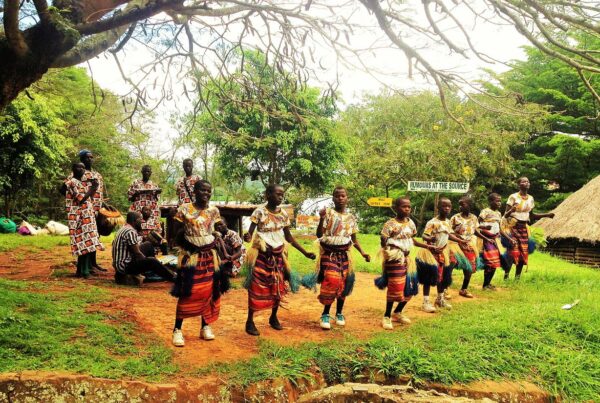
The Buganda naming ceremony — ekitiibwa ky’omwana — is typically held a few days to a few weeks after birth, once the mother and child are strong enough to receive visitors. Family members and clan elders gather at the family home. The paternal grandmother has a particularly important role in many traditions, officially giving the child its clan name. Food is prepared for all guests, gifts are presented for the child, and elders offer blessings and prayers for the child’s health, prosperity, and good character.
Acholi naming practices: names that tell stories
Among the Acholi of northern Uganda, names are highly descriptive — they tell the story of the circumstances of the child’s birth or reflect the family’s situation at that moment. An Acholi child born during a period of family difficulty might be named Opiyo (“the first of twins”), Ocen (“born in a season of hardship”), or Aber (“she is beautiful” — a name often given to a child born after a run of losses). These names carry meaning that the child will explain and inhabit throughout their life.
The gender conventions in Acholi naming are also distinctive: names beginning with “O” are typically male (Okello, Odong, Otim) while names beginning with “A” are typically female (Akello, Adong, Atim). These prefixes are not arbitrary — they reflect grammatical gender markers in the Acholi language. For outsiders encountering Acholi names, these patterns offer an immediate guide to gender that is useful in navigating social introductions.
Karamojong and the warrior name tradition
Among the Karamojong, names are intimately connected to age-set systems and the rites of passage that mark transitions between life stages. A young man who completes initiation receives a new name that signals his adult warrior status — his childhood name is set aside and the new name becomes his primary identity. This practice of name-changing at life transitions reflects the Karamojong understanding that identity is not fixed at birth but evolves as a person moves through the stages of life that the community recognizes.
Christian and Muslim naming in Uganda
Uganda’s majority Christian population typically combines traditional naming practices with Christian baptism ceremonies. The baptism gives the child a Christian (usually English or European) first name while traditional ceremonies establish clan identity and ethnic names. The two ceremonies are often held separately but are both considered necessary for the child’s full social identity.
Muslim naming practices follow Islamic convention: the aqiqah ceremony is performed seven days after birth, involving prayers, the shaving of the child’s head, and the giving of an Islamic name. Sacrifice of a goat or sheep and the distribution of meat to the poor accompanies the ceremony. As with Christian families, Muslim families often maintain ethnic naming traditions alongside Islamic ones, giving children names that fulfill both religious and cultural requirements.
Names as identity in Ugandan society
Names in Uganda carry more explicit social information than names in most Western contexts. A name can immediately signal a person’s ethnic background, religious affiliation, and sometimes even clan membership to anyone familiar with naming conventions. This social legibility of names creates both connection and occasionally the potential for prejudice — names mark membership in communities that carry their own historical relationships with other communities.
For visitors to Uganda in 2027, asking about the meaning of Ugandan names — done with genuine curiosity and respect — is one of the most appreciated gestures of cultural interest. Most Ugandans know the meaning of their name and are genuinely pleased when a visitor expresses interest in it. The conversation it opens typically reveals family history, ethnic identity, and personal story in ways that no guidebook can match.
What is the Tooro empaako naming system and why is it unique?
The empaako system of the Tooro, Bunyoro, and related kingdoms of western Uganda is one of the most unusual naming traditions in Africa and is UNESCO-listed as an Intangible Cultural Heritage. The empaako are a set of twelve praise names shared across the entire community: Abwooli, Adyeri, Araali, Atwooki, Akiiki, Abbala, Apuuli, Amooti, Acaali, Okaali, Ateenyi, Abooki. Every person in Tooro and Bunyoro communities — from the king to the youngest child — is given one of these twelve names in addition to their personal name. The empaako functions as the primary intimate address name: to greet a person by their empaako is to acknowledge them as a full member of the community. The name is given in a ceremony shortly after birth; the choice of which empaako to give is made by family consultation and has specific rules (some empaako are gender-specific; some require specific family circumstances). The UNESCO recognition specifically noted the empaako’s function as a social cohesion mechanism: because all community members share names from the same small set, the naming system creates horizontal community bonds that cut across clan and status lines. For visitors to the Fort Portal-Kibale area (near gorilla trekking country), learning a person’s empaako and addressing them by it is a gesture of cultural respect that will be warmly received.
How do Baganda clan names work and what do they mean?
Buganda has a clan system of approximately 52 clans (amasiga), each with a totem animal, specific responsibilities at the royal court, and a set of names traditional to that clan. Children are members of their father’s clan, not their mother’s (patrilineal descent). Clan names carry specific meanings connected to the clan history and totem. Names in Luganda very frequently describe the circumstances of the child’s birth: Nakato means “born the second of twins”; Babirye means “born the first of twins”; Wasswa means “first-born twin (male)”; Kizza means “born after twins”; Namuli means “born while travelling”; Kato and Babirye’ male counterparts are Nnakato and Babirye. Names can also describe the time of birth (Nagawa for a girl born in the dry season), the day of the week (Wassajja for a child born on a Saturday), or events happening at the time of birth. The practice of naming children after grandparents is widespread: it is common for a child’s name to be the name of a deceased grandparent, understood as giving the ancestor a continued presence in the world. In formal contexts, Ugandans are typically addressed by their Christian/Muslim first name; the traditional name is used within the family and among peers.
What happens at a Ugandan naming ceremony and who is involved?
Naming ceremonies in Uganda vary by ethnic group but share certain common features. In Buganda: the naming ceremony (okwasa omwana erinnya) typically takes place when the child is a few days to a few weeks old. The ceremony is hosted at the home and attended by family from both the maternal and paternal sides, plus neighbours. Specific roles: the paternal grandmother often plays a central role in presenting the name chosen from the paternal clan; the maternal uncle (kojja) may present a name from the maternal side. The child is formally given its names in front of the assembled family; prayers (Christian or Muslim) are said; the child is blessed. Food is prepared and shared: the ceremony is also a celebration of the new child and the occasion for the extended family to meet. In the Banyankole tradition of southwestern Uganda: a similar gathering format; the omutiko ceremony for the first child has specific protocol. Across all traditions: the naming ceremony establishes the child’s social identity — its clan membership, its ancestors, and its place in the community — in a public and witnessed way that the birth registration document alone does not.
Why do many Ugandans have both an African name and a Western name?
The two-name system in Uganda — African/traditional name plus Christian or Muslim name — is a direct product of colonial and missionary history. Christian missionaries from the 1880s onward required converts to take Christian names at baptism; the church records and subsequently the colonial administrative registers used the Christian name as the official identifier. In Muslim communities, Arabic names were similarly adopted at conversion. The traditional clan and birth-circumstance names persisted in home and community use because they carried kinship, clan, and ancestral information that the Christian names did not. Over generations, the convention solidified: one registers a child with a Christian/Muslim first name (used in school, official documents, workplace); the traditional name is given at the naming ceremony and used within the family. Contemporary urban Uganda has complicated this: some families are giving traditional African names as the registered first names in a conscious cultural affirmation; some are dropping traditional names entirely in favour of purely Western or Biblical names. The name a Ugandan uses in different contexts (a guide who introduces himself as “Simon” to tourists but is called “Wasswa” at home) reflects this dual-name heritage, not deception or informality.
What do common Ugandan names mean and how should visitors address people?
Several Ugandan names have specific meanings that visitors encounter frequently. Kigongo: “firstborn”; common male name in Buganda. Mukasa: the name of the spirit of Lake Victoria; a name given with spiritual significance. Namuganza: “she who gives things”; a name expressing hoped-for generosity. Okiror: “the one who forgives” in Ateso (from eastern Uganda). Amanya: “knowledge” in Runyankole (southwestern Uganda). Addressing Ugandans: use the name the person has given you at introduction — if they introduce themselves as “John,” use John; if they introduce themselves as “Wasswa,” use Wasswa. Asking someone’s traditional name is not intrusive; most Ugandans will share it and explain its meaning if asked with genuine interest. The form of address “Mzee” (for an older man) and “Mama” or “Maama” (for an older woman) is respectful and appropriate across most Ugandan communities when you do not know someone’s name and they are significantly older. “Muzungu” is the Swahili/Luganda word for a white or foreign person; children will call this to visitors without ill intent — it is descriptive, not offensive, though it marks difference.
- Uganda Holds Rhino Naming Ceremony
- What Makes Uganda Gorilla Trekking Different from Any Other Wildlife Trip
- Uganda vs Botswana Safari: Two Very Different African Worlds Compared
- Gorillas Use Over 25 Different Sounds to Communicate With Each Other
- Gorillas in Bwindi Eat 200 Different Plant Species: A Diet Study
- 8 Ways Gorilla Trekking Is Completely Different From a Regular Safari
- Gorilla Trekking for People Who Don’t Like Safaris: Why It Is Different
- The Experience Gap: Why Uganda Wildlife Is Different From East Africa Standard
- I Went to Uganda Depressed and Came Home Different: An Honest Account
- What Makes Bwindi Different From Every Other African Forest