Male circumcision as an initiation ritual — a threshold ceremony marking the transition from boyhood to manhood — is practised by several of Uganda’s ethnic groups and forms one of the most culturally significant and closely regulated rites in those communities, with the Bagisu (also called Bamasaba) of Mount Elgon in eastern Uganda performing the Imbalu ceremony in every even-numbered year in August in a multi-day public ritual that draws tens of thousands of observers from across the country and is considered by the Bagisu to be the central act of cultural identity and male belonging. Cultural events like Imbalu draw visitors who also explore Uganda’s safari destinations and gorilla trekking.
- Who: Bagisu (Bamasaba) people of Mbale district and Mount Elgon area, eastern Uganda
- When: every even-numbered year (2024, 2026, 2028…); August is the peak month; individual ceremonies happen throughout the season
- What it marks: the transition from boyhood to manhood; a man who has not undergone Imbalu cannot marry, own land, or participate in adult community decisions in traditional Bagisu society
- Public character: the ceremony is performed publicly; the initiate must not show pain or fear; community support is demonstrated by the surrounding crowd’s singing and dancing
Male circumcision as an initiation ritual — a threshold ceremony marking the transition from boyhood to manhood — is practiced by several of Uganda’s ethnic groups and forms one of the most significant and closely regulated cultural events in those communities. For groups like the Bamasaba (Gisu) of eastern Uganda and the Sabiny of the Mount Elgon region, circumcision is not a medical procedure but a profound cultural passage that defines masculine identity and full membership in the community. In 2027, these ceremonies continue to be practiced and are increasingly accessible to respectful visitors through organized cultural tourism programs.
The Bamasaba Imbalu ceremony
The Bamasaba people of Mbale and the slopes of Mount Elgon practice imbalu — one of the most famous and dramatic initiation ceremonies in East Africa. Imbalu takes place in even-numbered years (2026, 2028, etc.), making the 2026 ceremony the most recent in the cycle before 2027 travel. The ceremony peaks in August, when young men aged roughly 15-25 undergo circumcision as part of a multi-day public event that involves entire communities.
What makes Gisu imbalu distinctive is the expectation of absolute courage and composure from the initiate. The circumcision is performed publicly using traditional instruments, without anesthesia, while the young man is expected to stand still, show no pain, and demonstrate the self-control that marks genuine manhood in Gisu culture. Flinching, crying out, or showing fear is a source of deep shame for both the initiate and his family. Young men prepare psychologically for years before the ceremony and are supported throughout by family members, community elders, and special attendants whose role is to strengthen their resolve.
The days before circumcision
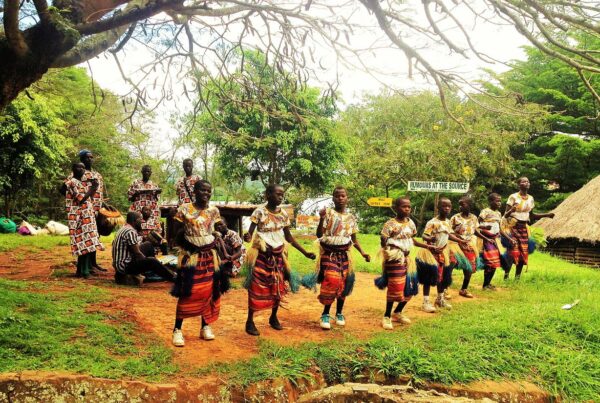
The imbalu ceremony is not a single moment but a week-long sequence of events. In the days before circumcision, initiates dance through their home villages and surrounding communities in a progression that gathers crowds and builds intensity. Dressed in ritual attire including animal skins and traditional body markings made from white clay and simsim paste, the initiates dance to the sound of drums with a controlled energy that communicates readiness and commitment. Community members line the roads to watch, cheer, and contribute small gifts to the candidates and their families.
This pre-ceremony dancing serves several functions simultaneously. It allows the community to identify and acknowledge the young men entering manhood. It gives the initiates a period of sustained ritual activity that focuses their minds and builds the psychological state needed for the climactic moment. And it creates a shared community event that reinforces Gisu cultural identity and intergenerational bonds.
After imbalu: the transition to manhood
Young men who complete imbalu with courage are celebrated as men of genuine worth — their performance in the circumcision moment is discussed in the community for years afterward. Those who show composure gain enormous social capital; their bravery becomes part of their identity and reputation. Following recovery, initiates enter a period of seclusion during which they learn the values, responsibilities, and knowledge appropriate to adult men in Gisu society. This period ends with further ceremonies marking their reintegration into community life as full adult members.
The Sabiny and Sebei circumcision traditions
The Sabiny (also called Sebei or Sabaot) of the Mount Elgon area share circumcision traditions with their Gisu neighbors but with distinct ceremonial forms. The Sabiny ceremony similarly involves community gathering, ritual preparation, and a public test of courage, and is similarly tied to specific calendar cycles. The Sabiny mountains in Kapchorwa District are not often visited by tourists, making a circumcision ceremony visit there a genuinely off-the-beaten-path cultural experience.
Female genital cutting: a different conversation
Female genital cutting is practiced by a small number of Ugandan communities, most notably historically among the Sabiny/Sebei. The practice is illegal in Uganda under the Prohibition of Female Genital Mutilation Act (2010) and is significantly less common than it was a generation ago due to active community campaigns, legal sanctions, and alternative rite of passage programs developed with community input. Discussing this practice requires careful distinction between male circumcision (a different biological procedure with different consequences) and female genital cutting (which involves the removal of healthy tissue and causes lasting harm). They are not equivalent despite both being called “circumcision” in casual conversation.
Witnessing imbalu as a visitor
The imbalu ceremony in even-numbered years around Mbale is one of Uganda’s most powerful cultural experiences for visitors willing to engage with it respectfully. The Uganda Tourism Board and local tour operators in Mbale can arrange accompanied visits to imbalu ceremonies, typically during the pre-circumcision dancing phase when large public crowds gather. Witnessing the actual circumcision is a more sensitive matter — some families welcome observers while others prefer privacy for the climactic moment.
Visitors should approach imbalu with the attitude of a respectful guest at a sacred community event rather than a spectator at a performance. Following guidance from the local operator or guide about appropriate behavior, dress, distance, and photography rules is essential. The ceremony is not staged for tourists — it is a genuine ritual with real consequences for real young men and their families. That authenticity is both what makes it so compelling and what demands thoughtful engagement from any visitor lucky enough to witness it.
What exactly happens during the Imbalu ceremony?
The Imbalu ceremony unfolds over several days with specific ritual stages. In the days before circumcision: the initiates (boys typically aged 16-25) are smeared with yeast (imbalu in the Lumasaba language — from which the ceremony takes its name) and travel through the community dancing and singing initiation songs. This pre-ceremony procession announces that the initiate is committed to proceeding. The circumcision itself: performed publicly by a specialist circumciser (umusumba); no anaesthetic is used; the initiate must stand without flinching, showing courage; any visible pain or fear brings lasting shame to the initiate and his family. The crowd surrounding the initiate sings loudly, which serves both as encouragement and as the primary acoustic context — a cultural technique for managing the experience. After circumcision: the initiate enters a seclusion period of several weeks during which he is mentored by elders in adult roles, responsibilities, and traditional knowledge; he emerges as a recognised adult man. Re-entry ceremony: a celebration at the end of seclusion formally welcomes him into the adult community.
Can visitors observe the Imbalu ceremony and how do they attend?
The Imbalu ceremony is a public event and visitors are generally welcome to observe — with important conditions. The ceremonies are held throughout the Bagisu territory around Mbale and the Mount Elgon area in August of even-numbered years; specific dates and locations are not published in advance but become known locally as the season develops. How to attend: stay in Mbale (the main town; approximately 4-5 hours from Kampala); ask your guesthouse or a local guide for information about forthcoming ceremonies in the area. Local guides from the Bagisu community can take you to ceremonies and provide interpretation. Conduct at the ceremony: dress respectfully; do not photograph without permission from the family hosting the ceremony; follow your guide’s instructions on where to stand and when to move. The ceremony is intense — the public circumcision is graphic; be prepared for this if you attend. The Imbalu is one of the most significant cultural tourism events in Uganda and has been promoted by UTB (Uganda Tourism Board) as a major cultural attraction. It is accessible without prior booking if you are in the area during the season with a local guide.
Which other Ugandan ethnic groups practice circumcision as initiation?
The Bagisu are the most visible and culturally elaborate circumcision practitioners in Uganda, but several other groups practice male circumcision either as initiation or as a non-ceremonial cultural norm. The Sabiny (Sebei) people of northeastern Uganda practice both male and female genital cutting (the female practice is illegal in Uganda and subject to active suppression by authorities and NGOs, though it persists in some areas). Muslim communities throughout Uganda practice circumcision of male infants as a religious obligation, without the elaborate initiation ceremony character of the Bagisu rite. The Baganda and most Bantu groups of central Uganda do not have circumcision as a traditional practice; however, medical and religious circumcision has become widespread among younger generations as a health practice following evidence-based HIV prevention research showing that male circumcision reduces female-to-male HIV transmission risk. The Ugandan government supported a mass circumcision campaign in the 2000s-2010s on public health grounds, which substantially increased circumcision rates among communities that did not traditionally practice it.
What is the social significance of Imbalu beyond the physical ritual?
The Imbalu ceremony functions as the primary mechanism for transmitting Bagisu cultural identity across generations. The pre-ceremony training and post-ceremony seclusion period are when older men formally transmit knowledge — about agriculture, community governance, marriage, conflict resolution, and the specific Bagisu relationship to Mount Elgon and its resources — to the new generation of adults. The public character of the ceremony serves social functions: the community witnesses and validates the transition; the family’s honor is publicly at stake (an initiate who shows fear shames the family); the collective singing and dancing around the initiate is a literal expression of community support and solidarity at the moment of greatest individual test. The social consequence of not undergoing Imbalu: in traditional Bagisu communities, a man who has not been circumcised (called a “mukhasi” — a derogatory term) cannot be taken seriously as an adult; he cannot represent his family in community affairs; marriage into a circumcising family is problematic. Urban Bagisu men who have grown up in Kampala without the community context still typically return to the Elgon area for Imbalu, demonstrating that the ceremony’s hold on Bagisu identity persists across the urban-rural divide.
Is Mount Elgon worth visiting as part of a Uganda safari?
Mount Elgon National Park in eastern Uganda is an undervisited destination that offers a genuinely different experience from the western circuit parks. The mountain is a massive extinct shield volcano — one of the largest volcanic bases in Africa by area — on the Uganda-Kenya border, with the caldera at approximately 3,500-4,300m containing a crater lake and high moorland. Specific draws: the cave elephants of Mount Elgon are one of the park’s most famous attractions — elephants that enter the caves (particularly Kitum Cave) to gouge salt and mineral-rich rock with their tusks; this is a documented and long-observed behaviour unique to the Elgon population. Sitatunga (a semi-aquatic swamp antelope) is present in the wetter forest zones. The Wagagai Peak (4,321m) summit trek is a 2-3 day hike accessible to fit trekkers; it is less demanding than Rwenzori. The birding includes Jackson’s francolin, white-starred robin, and several forest species restricted to the Elgon massif. Practical access: Mbale is the gateway town; approximately 5 hours from Kampala on the Jinja-Tororo highway. Combining Mount Elgon and Imbalu season produces one of Uganda’s most distinctive cultural and natural combined itineraries.
- Uganda naming ceremonies: how babies are named in different cultures
- Solo female travel in Uganda: safety, culture, and what to expect
- Gorillas in Popular Culture and Media: From Myth to Modern Day Icons
- Why Adult Male Mountain Gorillas Stay Etched in Your Mind After Gorilla Habituation
- Uganda Food Dishes You Should Try: A Taste of Tradition, Culture, and Heart
- Uganda gorilla trekking explained: everything a first-timer needs
- Uganda Gorilla Trekking from Kigali: The Cross-Border Option Explained
- Solo Female Gorilla Trekking in Uganda: Complete Safety Guide
- How Many People Are Allowed Per Gorilla Family Per Day: Uganda’s Strict Limit Explained
- Gorilla Trekking Group Size: Maximum People Per Trek in Uganda Explained