East Africa is defined, in most travel marketing, by the classic savanna safari: the Serengeti, the Masai Mara, Amboseli, Samburu. These are magnificent landscapes with extraordinary wildlife. They are also well-established products with a consistent, predictable, high-quality template that most experienced operators deliver to a consistent standard. Uganda offers something that does not fit this template — a set of wildlife experiences that are not simply “East Africa safari done differently” but experiences that exist nowhere else on earth in the same form. The gap between Uganda’s wildlife proposition and the East Africa standard is not just quality. It is category.
The Category Gap: Great Apes
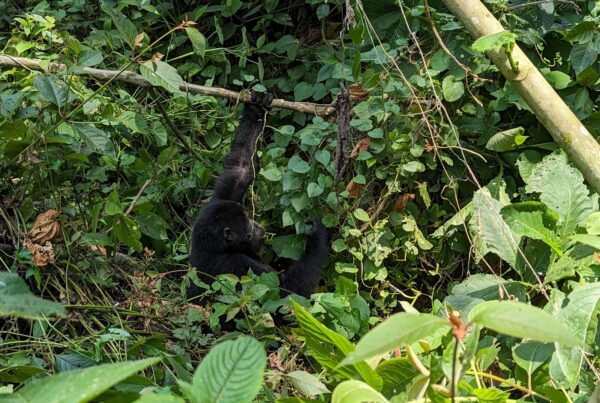
The East Africa standard — Serengeti, Mara, Ngorongoro, Samburu — does not include great apes. Tanzania has chimpanzees at Mahale and Gombe (historical home of Jane Goodall’s research), which are accessible but not in the same league of ease or reliability as Uganda’s chimp experiences. Kenya has no great apes at all. Uganda has both mountain gorillas (Bwindi, Mgahinga) and chimpanzees (Kibale) in close geographic proximity, both accessible via well-managed habituation programmes, and both offering encounter quality that has no equivalent in the standard East Africa safari circuit.
This is a category difference, not a quality difference. It does not mean Uganda’s savanna safari is better than Kenya’s — it is not, or not yet, or not at the same scale. It means Uganda offers a wildlife experience that is categorically unavailable elsewhere in the East Africa standard package. The gorilla encounter and the chimpanzee encounter are not variations on the safari theme. They are a different kind of experience entirely.
The Biodiversity Dimension: Birding
Uganda has more bird species per unit area than any country in Africa. Its position within the Albertine Rift — the world’s most biodiverse continental area — means that its forest habitats support endemic species found nowhere else. For a birder, Uganda is not “East Africa safari with bonus birding.” Uganda is a primary birding destination where the gorilla and chimpanzee experiences are additions to an already extraordinary birding itinerary. The Albertine Rift endemic species, the montane forest birds of Bwindi, the papyrus-specialist species at Mabamba — these represent bird-watching opportunities that the standard East Africa circuit does not offer.
The Landscape Dimension
East Africa’s canonical landscapes are open: savanna, grassland, alkaline lake. Uganda’s landscapes are dense and vertical: montane forest, equatorial jungle, the Rift Valley escarpment. The experience of moving through Bwindi Impenetrable National Park — a 321-square-kilometre ancient forest at altitude — is not the experience of any savanna landscape. The forest is dark, layered, and alive in a different way than open grassland. Travellers who have done multiple East Africa safaris describe their first Uganda forest experience as a genuine shift in their understanding of what “African nature” encompasses.
The Conservation Narrative Dimension
The East Africa safari narrative is a beautiful story: wild animals on ancient migration routes in landscapes that have changed little in the time that humans have been observing them. It is fundamentally a narrative of preservation — of maintaining something that exists. Uganda’s gorilla conservation narrative is different: it is a narrative of recovery. The mountain gorilla population was declining toward extinction 30 years ago. Today it is growing. The mechanisms of that recovery — tourism revenue, community benefit, anti-poaching investment — are all visible and attributable. Your visit contributes directly to a conservation success that is actively unfolding. That is not the same story as the Serengeti’s endurance narrative. It is a more urgent and more specifically hopeful one.
Contact us to plan a 2027 Uganda itinerary that goes beyond the East Africa standard into the category-defining experiences that only Uganda offers.