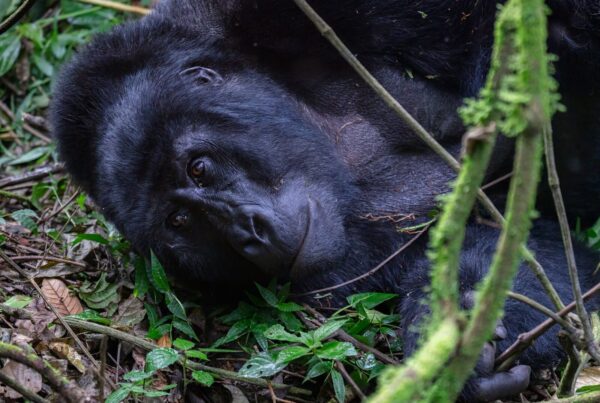
Gorillas in Bwindi Impenetrable National Park eat over 200 different plant species, and the complexity of their diet is one of the clearest indicators of both the gorillas’ ecological sophistication and the richness of the forest they depend on. The 200-plus plant species in the mountain gorilla diet are not eaten randomly — selection is specific, varies by season, reflects known nutritional content, and is taught to younger animals through observation of adults. Understanding what gorillas eat, and why they eat what they eat, illuminates the relationship between these animals and their forest in a way that changes how you look at the vegetation during a trek.
The Scale of the Gorilla Diet
A 200-species diet is remarkable by any measure. For comparison, most large herbivores in Africa depend on a relatively small number of plant species for the majority of their nutrition — wildebeest and zebra in the Serengeti rely primarily on grasses, elephants have broader diets but concentrate on a core group of plants. The gorilla diet breadth reflects both the diversity of Bwindi’s plant community (over 1,000 plant species recorded in the park) and the gorilla’s capacity to learn and remember the properties of a large number of plants.
The 200+ species include leaves, stems, roots, bark, flowers, fruits, and fungi. Different plant parts are selected in different seasons based on availability and, researchers believe, based on nutritional composition. Leaves that are highest in protein tend to be selected over leaves with lower protein content when both are available. Bitter plants that contain high levels of secondary compounds (plant defence chemicals) are eaten selectively or avoided, while sweeter, less defended plants are prioritised when available.
Seasonal Diet Variation
The gorilla diet in Bwindi shifts significantly across the two wet seasons and two drier periods of the year. During the main wet season, when new growth is most available and fruit production is at its peak, gorillas eat a broader and nutritionally richer diet. During drier periods when some plant resources are less available, the diet narrows and shifts toward more abundant staple foods like leaves and stems.
Bamboo Season
For families that range in bamboo-containing zones of Bwindi, bamboo shoots represent a specific seasonal bonanza. Fresh bamboo shoots are high in protein and water content and are eagerly sought when they are available. During peak bamboo season, gorilla groups may shift significant portions of their range to access bamboo zones, and their travel distances and routes change to reflect this priority. The bamboo season is also visible to trackers and guides, who know which families have bamboo in their range and when the shoots typically become available.
Fruit and Calories
Mountain gorillas eat fruit when it is available, but they are not primarily frugivorous in the way that chimpanzees are. The high-altitude forest of Bwindi produces fruit less consistently than lowland forests, and the gorilla digestive system is adapted to extract nutrients efficiently from fibrous vegetation rather than being optimised for high-sugar fruit digestion. When fruit is available, however, gorillas eat it preferentially over most other food types — it is the equivalent of a dessert that is also nutritionally advantageous.
How Gorillas Learn Their Diet
The 200-species diet knowledge is not instinctive — it is learned. Young gorillas acquire their dietary knowledge primarily through observation of adults, particularly their mothers. A juvenile gorilla travelling with its mother for the first three to four years of life has continuous access to a demonstration of which plants to eat, how to access them (some plants require specific processing — bark must be stripped, certain stems must be broken at specific points to access the edible core), and which to avoid.
This transmitted knowledge is culturally variable — different family groups in different areas of Bwindi have been observed to have slightly different dietary emphases, reflecting both the plant communities available in their home ranges and the specific dietary traditions of the family lineage. The plant knowledge accumulated by a family group over generations is, in a meaningful sense, part of their cultural heritage.
The Medical Diet: Gorillas as Self-Medicators
One of the most intriguing aspects of gorilla diet research is the evidence for deliberate self-medication. Researchers have documented gorillas selectively eating specific plant species that have known medicinal properties — species that contain antiparasitic compounds, anti-inflammatory agents, or antibacterial chemicals — with elevated frequency when they appear to be unwell or when parasite loads are high.
The evidence is not definitive in all cases — some of what looks like self-medication may be coincidental consumption of medicinally active plants that happen to be nutritious. But the pattern of elevated consumption of specific medicinal species by specific individuals under specific health conditions is consistent enough that researchers in ethnobotany have been interested: some of the plants gorillas use for apparent self-medication have been investigated as potential pharmaceutical sources.
The Forest as a Pharmacy
The 200-species diet that mountain gorillas depend on requires 200 species to be present in their habitat. This is not a trivial observation. Forest degradation typically reduces plant species diversity before it reduces total plant biomass — the species that are lost first are often the less common, more specialised ones, which may include precisely the species that gorillas use for specific nutritional or medicinal purposes.
Protecting the full biodiversity of Bwindi Forest, not just its total area, is therefore essential for gorilla food security. A forest with 150 of the right species is not equivalent to a forest with 200. The conservation goal is not just a certain number of square kilometres of forest but a certain quality of ecosystem — rich enough and diverse enough to meet the complex dietary needs of the animals that depend on it.
What You See During a Trek
Most of the hour you spend with a gorilla family will be spent watching them eat. This sounds less exciting than it is. Watching a mountain gorilla select specific plants from a complex environment, process them with the specific techniques appropriate to each plant type, and feed with the focused efficiency of an animal that has spent most of its life in this landscape is genuinely interesting once you know what you are watching. Your guide can explain what the animals are eating and why, and the knowledge transforms the observation from “large animals eating” to “an ancient dietary practice, refined over millions of years, playing out in front of you.”
Uganda gorilla trekking permits are $800 per person. Contact Uganda Gorilla Trekking to book your permit. Come hungry for knowledge. The gorillas are.