Gorilla trekking vs safari: why these are fundamentally different experiences
Gorilla trekking vs safari is a comparison that many prospective visitors to East Africa consider when planning their itinerary — particularly those who have already done a traditional game drive safari and are wondering whether gorilla trekking will offer something genuinely different. The answer is unequivocal: gorilla trekking is not a variant of the safari experience. It is a fundamentally different activity, producing fundamentally different responses, based on fundamentally different principles of wildlife encounter. Here are eight ways in which the difference is most clearly evident.
1. You walk to the wildlife
A traditional game drive safari involves sitting in a vehicle and driving through a wildlife area until animals are spotted. The encounter takes place from inside the vehicle, typically from a distance of 10 to 100 metres, and the vehicle can be repositioned for a better angle or moved on to the next sighting. Gorilla trekking involves walking on foot through dense forest for a period that can range from 30 minutes to 6 hours, pushing through undergrowth, climbing steep terrain, and following a ranger who is tracking the gorilla family’s location through a combination of GPS data and direct observation of signs in the forest. The physical effort invested in reaching the gorillas is part of the experience — and the contrast between the effort of the walk and the sudden stillness of the encounter creates an emotional intensity that the game drive vehicle cannot produce.
2. The proximity is categorically different
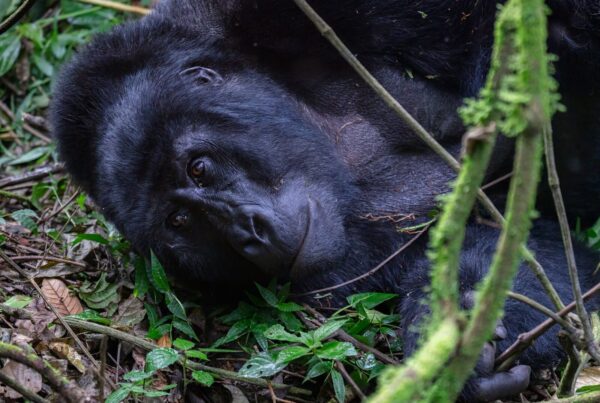
On a game drive safari, a lion at 15 metres is an extremely close sighting. On a gorilla trek, 15 metres from the nearest family member is the outer edge of a routine encounter — and actual distances of 4 to 8 metres are common. The enclosed space of the forest amplifies this proximity further: on an open savannah, 15 metres provides unobstructed views in all directions. In the forest, 7 metres means that the gorilla is visible through gaps in the vegetation, the sound of its breathing is audible, and its physical presence — its mass, its smell, its movement — is felt in a way that the open-air safari vehicle encounter cannot replicate.
3. The encounter is time-limited
Game drive safaris typically continue for as long as the vehicle occupants are interested in a particular sighting — until the lions move into cover, the elephants walk away, or the decision is made to drive on to the next sighting. Gorilla trekking permits allow one hour with the gorilla family, and this limit is strictly enforced regardless of what is happening when the hour ends. The time limit creates a quality of attention and presence in most trekkers that the open-ended game drive does not — knowing that the hour will end concentrates the mind in a way that indefinite access does not.
4. There is only one thing to look at
A game drive safari involves scanning the landscape continuously — looking for movement, for shapes in the grass, for the suggestion of an animal at the edge of visibility. The attention is distributed, exploratory, and subject to distraction. A gorilla trek, once the family is found, involves focusing completely on a single family group in a confined space. There are no other sightings to move on to, no other animals competing for attention. The entire quality of attention available to the visitor — for one hour — is directed at the gorillas in front of them.
5. Behaviour replaces spectacle
Game drive safaris excel at spectacle — the vast herds of wildebeest crossing the Mara River, the lion pride on a fresh kill, the elephant herd at a waterhole. These are scenes of scale and drama that are genuinely magnificent and that gorilla trekking cannot match in terms of visual spectacle. What gorilla trekking offers instead is behaviour — the intimate, detailed observation of complex social interactions between individuals whose faces you can read and whose relationships you can begin to understand within a single hour. The silverback’s relationship with his females. The way an infant interacts with siblings. The social grooming that communicates alliance and affection. This is behavioural observation at a level of intimacy that game drive safari, for all its spectacle, cannot provide.
6. It is physically demanding
Game drive safaris require almost no physical effort from participants. Gorilla trekking requires sustained physical effort — sometimes considerable physical effort — from every trekker regardless of their fitness level. This difference has implications that extend beyond simple comfort: the physical effort creates a different relationship with the landscape, the forest, and the gorillas themselves. You have earned the encounter through effort, and this earned quality affects how the experience is received and remembered.
7. It is a conservation act
Game drive safari fees support the management of national parks and wildlife areas through mechanisms that vary by country and operator. Gorilla trekking permit fees — in Uganda, $800 per permit — feed directly into the conservation system that protects mountain gorillas, through Uganda Wildlife Authority’s budget, community development programmes, and anti-poaching operations. The connection between the permit purchase and the conservation outcome is direct, transparent, and significant. Each gorilla trek is simultaneously a wildlife experience and a conservation contribution, and most trekkers are aware of this in a way that game drive safari participants are often not.
8. The impact is lasting in a different way
Travellers who have done both traditional safari and gorilla trekking describe the two experiences as emotionally distinct in their lasting impact. The safari — particularly a first safari — produces memories of extraordinary vividness and beauty. The gorilla trek produces something different: a shift in perspective that many trekkers describe as permanent. The direct encounter with an animal whose eyes communicate recognisable intelligence, whose family bonds mirror human ones, and whose survival depends on the conservation choices that human societies make — this encounter changes the visitor’s relationship with conservation in a way that wildlife viewing from a vehicle, however spectacular, rarely does.