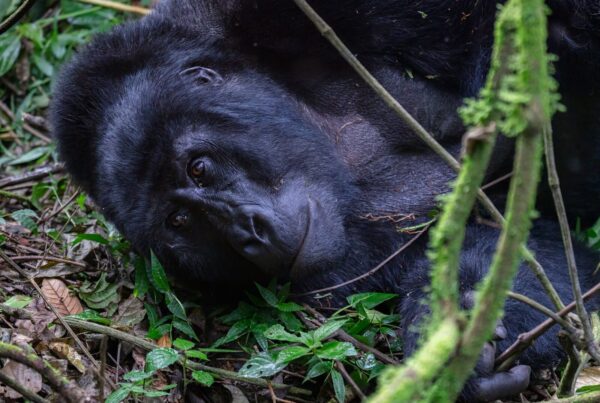
Primates vs Big Game: Two Safari Philosophies
Uganda and Botswana represent two entirely different African safari philosophies. Uganda is green, mountainous, forested, and primate-focused. Botswana is flat, arid, watery, and big-game-focused. One takes you into the misty forests of central Africa to sit with gorillas. The other takes you into the Okavango Delta, Chobe River, and Kalahari Desert to watch elephants, lions, leopards, and wild dogs. Comparing them is like comparing a symphony to a rock concert: both are magnificent, but the experiences they deliver are fundamentally different.
Wildlife
Uganda: Primates and Biodiversity
Uganda’s signature wildlife experience is gorilla trekking in Bwindi Impenetrable Forest. It also offers chimpanzee trekking in Kibale Forest, tree-climbing lions in Queen Elizabeth National Park, shoebill storks in Mabamba Swamp, and over one thousand bird species across the country. Uganda is the primate capital of Africa, with more primate species than any other country on the continent.
Botswana: Big Game in Big Numbers
Botswana has the largest elephant population in Africa, estimated at over one hundred and thirty thousand. The Okavango Delta is home to massive herds of buffalo, hippos, leopards, lions, cheetahs, wild dogs, and the rare sitatunga antelope. Chobe National Park along the Chobe River has the densest concentration of elephants in the world, with herds of several hundred gathering at the riverbanks during the dry season. Botswana has no gorillas, no chimpanzees, and no primate trekking.
Landscapes
Uganda
Uganda is lush, green, and mountainous. The landscapes are dominated by equatorial rainforest, volcanic mountains, crater lakes, and the vast freshwater lakes of the Rift Valley. The Rwenzori Mountains have glacial peaks above five thousand metres. Lake Victoria is the world’s largest tropical lake. The terrain is varied and dramatic, shifting from lowland savanna to highland forest within a few hours’ drive.
Botswana
Botswana is flat, dry, and vast. The Okavango Delta is a unique inland delta where the Okavango River spreads across thousands of square kilometres of Kalahari sand, creating a maze of channels, lagoons, and islands that supports extraordinary wildlife. The Makgadikgadi Pans are the largest salt flats in the world. The Kalahari Desert stretches across the south and west. The landscapes are open, expansive, and hauntingly beautiful.
Safari Style
Uganda
Uganda safaris are active and varied. Gorilla trekking involves hiking through dense forest for hours. Chimpanzee tracking requires walking through jungle. Boat cruises on the Kazinga Channel and Murchison Falls are included in most itineraries. Game drives in Queen Elizabeth and Murchison are typically done in 4×4 vehicles on unpaved tracks. Uganda safaris feel adventurous, immersive, and physically engaging.
Botswana
Botswana safaris are often more luxurious and exclusive. The Okavango Delta is explored by mokoro (traditional dugout canoe), motorboat, and 4×4 game drive. Walking safaris on delta islands offer close encounters with plains game. Scenic flights over the delta reveal its extraordinary patterns from the air. Botswana has positioned itself as a high-value, low-volume destination, with many lodges accommodating fewer than sixteen guests and charging premium prices.
Cost
Uganda
Uganda offers safari experiences at every budget level. A four-day gorilla trekking trip costs two thousand to four thousand dollars at mid-range level, including the seven hundred dollar permit. Budget options exist for under two thousand dollars. Luxury lodges range from two hundred fifty to five hundred dollars per night. Uganda is accessible to travellers across a wide budget range.
Botswana
Botswana is one of the most expensive safari destinations in Africa. The government deliberately limits tourist numbers and charges high park fees and concession rates. A four-night Okavango Delta safari at a mid-range camp costs four thousand to eight thousand dollars per person. Top-end camps like Mombo, Jao, and Vumbura charge one thousand to three thousand dollars per person per night. Budget options exist in Maun and on self-drive routes but are limited compared to other African countries.
Accessibility
Uganda
Uganda is accessible by international flights to Entebbe from Dubai, Istanbul, Addis Ababa, Nairobi, and several European cities. Domestic flights and drive options connect Entebbe to Bwindi and other parks. Roads are improving but some sections remain rough.
Botswana
Most Okavango camps are accessible only by light aircraft from Maun or Kasane. International connections come through Johannesburg or Nairobi. The remote location of many camps is part of their exclusivity but adds to the cost and complexity of reaching them.
Conservation Model
Both countries are conservation leaders. Uganda’s gorilla tourism directly funds the survival of a critically endangered species, with permit revenue paying for rangers, veterinary care, and community development. Botswana’s high-value, low-volume model minimises environmental impact while maximising the economic benefit of each tourist. Both approaches have achieved remarkable conservation outcomes.
The Verdict
Choose Uganda If:
- Gorilla trekking is your dream experience
- You want the world’s best primate diversity
- You prefer an active, adventurous safari style
- Your budget is mid-range or below
- You enjoy lush, green, mountainous landscapes
Choose Botswana If:
- Elephants, lions, and wild dogs are your priority
- You want exclusive, ultra-luxury safari camps
- The Okavango Delta is on your bucket list
- You prefer open landscapes and water-based safaris
- Budget is not your primary concern
Final Thoughts
Uganda and Botswana are not competing for the same traveller. Uganda appeals to adventurous primate lovers on a range of budgets. Botswana appeals to luxury-seeking big-game enthusiasts with deep pockets. Both are extraordinary. Both deserve a lifetime trip. If you are lucky enough to visit both, you will understand why Africa is the world’s greatest safari continent.
Frequently Asked Questions
Uganda is significantly cheaper. Uganda’s standard permit costs $800; Rwanda’s costs $1,500. For 4-hour gorilla habituation, Uganda charges $1,800 — Rwanda has no equivalent experience. The $700 saving on a standard permit is the primary reason most budget-conscious travellers choose Uganda.
Uganda. Bwindi and Mgahinga together have 20+ habituated gorilla families and issue more daily permits than Rwanda’s Volcanoes National Park. Uganda also offers the Gorilla Habituation Experience, which Rwanda does not. Rwanda’s advantage is accessibility — Volcanoes NP is 2 hours from Kigali airport.
Yes — this is a popular combination. The Kigali to Bwindi road journey takes approximately 4 hours via Kabale. Some visitors trek in Mgahinga (Uganda) one day and cross into Rwanda for Volcanoes the next. Note that your Uganda permit cannot be used in Rwanda and vice versa — separate permits are required.
Rwanda’s Volcanoes National Park offers easier access (2 hours from Kigali airport), high-end lodge infrastructure, and the Dian Fossey research legacy. Rwanda also offers golden monkey trekking in the same park. However, at $1,500 per permit, it costs nearly double Uganda’s $800 rate for the same 1-hour trek.
Uganda is home to the mountain gorilla (Gorilla beringei beringei), one of two subspecies of eastern gorilla. They live exclusively in the Virunga volcanic highlands (Uganda/Rwanda/DRC) and Bwindi Impenetrable Forest (Uganda only). Mountain gorillas are the only gorilla subspecies that cannot survive in captivity — every individual you can trek is a wild animal.