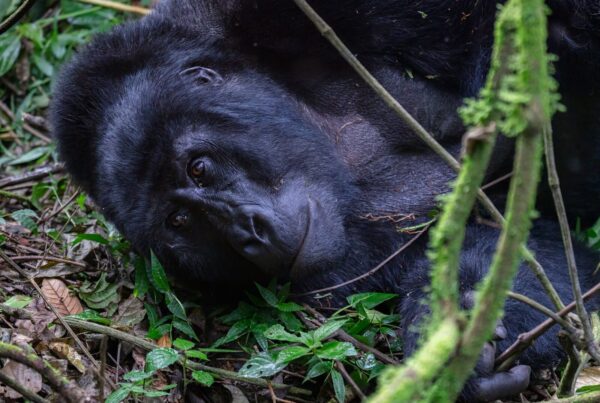
Gorillas use over 25 distinct sounds to communicate with each other, and the vocabulary of gorilla vocalisations is one of the most studied and most revealing aspects of mountain gorilla social life. These sounds range from the deep rumble of a contented silverback eating to the sharp bark of a female warning an approaching juvenile to keep away from her infant, and from the complex series of hoots that precede a full display to the low contact call that family members use to maintain awareness of each other’s position in dense vegetation. Learning to recognise even a few of these sounds transforms a gorilla trek from visual observation to something closer to eavesdropping on a conversation.
The Classification of Gorilla Sounds
Gorilla vocalisations are classified by researchers into several broad functional categories based on the contexts in which they occur and the responses they reliably elicit from other gorillas.
Contact Calls
The most frequently heard gorilla sound in a family group is the contact call — a series of low, belching grunts that individual gorillas make while feeding and moving. These sounds function as continuous location signals: “I am here, I am calm, I am doing this.” The contact call allows family members in dense vegetation to maintain awareness of each other’s position without visual contact. A family moving through thick undergrowth is audibly present through the constant background rhythm of contact calls.
In habituated family groups, the contact call is what visitors hear most during a trek — a low, rolling sound that increases as the group is feeding actively and subsides when they are resting. Experienced guides can identify when the sound shifts from contact-calling to something else, and adjust the group’s positioning accordingly.
Alarm Calls
The alarm bark is sharp and short — a sound that carries urgency in its quality even without any understanding of gorilla communication. Gorillas produce alarm calls in response to sudden disturbance (an unexpected sound, a sudden movement) and the rest of the family typically freezes in response. In a trekking context, an alarm bark from a gorilla family indicates that something the animals did not expect has occurred in their environment. Guides are trained to identify whether the alarm is directed at the visitor group or at something else in the forest.
The Belch Vocalisation
The belch vocalisation — despite its unfortunate name — is a sound of contentment. Gorillas make this sound while eating, during comfortable resting, and in peaceful social proximity. A family group producing frequent belch vocalisations is a settled, content family group. This sound, heard during the first minutes of a gorilla encounter, tells experienced guides that the morning will be calm. Its absence, particularly when the family is in a situation where it would normally be heard, can indicate stress or disturbance.
Display Vocalisations
The vocalisation sequence that accompanies a full silverback display is among the most studied and most dramatic in the gorilla repertoire.
The Hoot Series
A display begins with a series of soft hoots that gradually increase in pace, volume, and urgency over a period of several seconds to a minute. This progressive build-up is thought to function as a warning — to both the target of the display and to the silverback’s own family group — that what follows will require attention. The hoot series is also present in a shorter, lower-intensity version as a general alerting call.
The Scream and the Grunt
High arousal situations produce a range of louder vocalisations — screams, high-intensity grunts — that are distinct from the display hoots in their urgency and in the lack of the controlled build-up that characterises the display sequence. These sounds occur during inter-group encounters, in response to direct threats, and in situations of acute stress.
Social Vocalisations
Beyond alarm calls and display sounds, gorillas have a range of vocalisations that function in the context of ordinary social life.
Play Sounds
Juvenile and adolescent gorillas playing make a distinctive series of short, breathy calls that researchers describe as functionally similar to human laughter — they signal that the physical contact occurring is play rather than aggression, allowing the play partner to engage without defensive responses. When you hear these sounds during a trek, you are hearing juvenile gorillas communicating “this is fun, not a fight.”
Mother-Infant Communication
Mothers and infants maintain communication through a variety of soft, high-frequency sounds that are largely inaudible at the distances visitors maintain. These sounds regulate nursing, positioning, and movement between mother and infant. Researchers studying mother-infant communication in detail require specialised audio equipment to record and analyse the full range.
What the 25 Sounds Tell Us
A repertoire of over 25 distinct vocalisations places gorillas in the company of the most communicatively sophisticated non-human animals on Earth. For comparison, most mammal species have fewer than ten distinct vocalisations. The gorilla vocal repertoire is not language in the linguistic sense — it lacks the generative grammar that allows humans to produce an infinite number of novel sentences — but it is a complex communicative system that transmits specific information in specific contexts and is learned and refined over the course of an individual’s life.
The evolutionary significance of this complexity is worth noting: a communicative system of this sophistication does not appear without the social complexity to generate the need for it. The 25 sounds are evidence of gorilla social life being complex enough to require a 25-sound vocabulary.
Listening on a Trek
Your guide can identify the most common sounds you will hear during your hour with the gorillas and explain what they mean. Listening actively — rather than focusing entirely on visual observation and photography — adds a dimension to the experience that most first-time trekkers miss. The contact calls, the belch vocalisations of a content family, the occasional alarm bark — all of it is the gorilla family communicating, in their own language, about their morning.
Uganda gorilla trekking permits are $800 per person. Contact Uganda Gorilla Trekking to book your permit. The gorillas are talking. Your guide will help you listen.