Africa has many forests. The Congo Basin — the second largest tropical rainforest on earth — covers over 3 million square kilometres. East African forests range from the coastal forests of Kenya and Tanzania to the montane forests of the Rwenzoris and the Virungas. Kibale in western Uganda is one of the most primate-rich forests on earth. Within this extraordinary diversity, Bwindi Impenetrable National Park has qualities that are specific to it — qualities that make it not just a forest but a particular forest with a particular character that no other place on earth replicates.
Age
Bwindi is old. Not in the ordinary sense of an ancient forest but in the deep-time sense of a forest that survived the Pleistocene ice ages intact. During the last glacial maximum, approximately 18,000 years ago, most of Africa’s tropical forest contracted dramatically as temperatures dropped and rainfall decreased. Large areas of the Congo Basin and East African forests were reduced to savannah or scrubland. Bwindi, protected by its position on the Albertine Rift escarpment with its specific microclimate, persisted as a forest refugium — an island of forest in a landscape of changed vegetation.
This survival history is visible in Bwindi’s biology. The forest has levels of species diversity and endemism that reflect millions of years of evolutionary continuity, interrupted and shaped by the periodic isolation that the ice ages imposed. Species that evolved in Bwindi during periods of isolation are found here and nowhere else. The concentration of endemic plants, birds, and invertebrates is extraordinary even by African forest standards.
The “Impenetrable” Designation
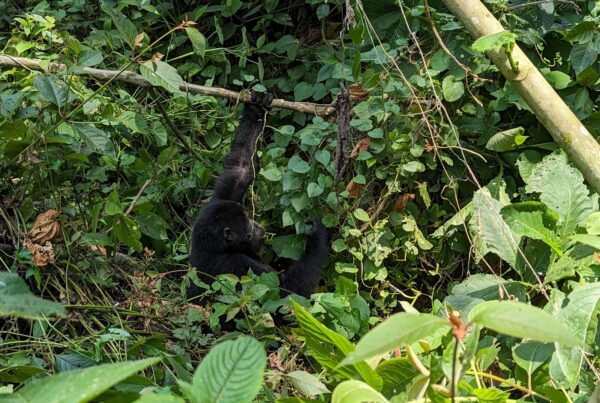
Bwindi’s common name — Impenetrable — reflects a real physical character. The forest is dense, layered, and genuinely difficult to move through without the trails established by park management and the gorillas themselves. Visibility inside the forest is short. The canopy is high and multi-layered. The understory is thick with vegetation in various stages of growth and decay. Moving through Bwindi requires attention to every step and is physically demanding in ways that more open forests are not.
This density is one of the reasons the forest has been difficult to deforest — not just because of legal protection but because of its physical character. The effort required to clear Bwindi’s dense vegetation is substantially greater than clearing lighter forest or scrubland. The forest’s physical impermeability has been, paradoxically, part of its protection throughout the period of human settlement surrounding it.
The Gorillas
Bwindi holds approximately 500 mountain gorillas — roughly half the world’s total population of 1,100. These are not the Virunga gorillas of Rwanda’s classic trekking circuit, though they are the same species. The Bwindi gorilla population is genetically distinct from the Virunga population to a degree that some researchers classify it as a separate subspecies — the Bwindi gorilla vs the Virunga gorilla — though the formal taxonomy remains debated.
The gorilla permit at Bwindi costs $800 USD for international visitors in 2027. With ten habituated families available across four trekking sectors (Buhoma, Ruhija, Rushaga, and Nkuringo), Bwindi offers more variety of gorilla trekking experience than any other single site. Different sectors have different terrain characters, different forest compositions, and different gorilla families with different personalities and behaviours. A visitor who treks Rushaga and Buhoma in the same trip will have meaningfully different forest experiences.
Tree Diversity
Bwindi has more tree species per hectare than any other forest in East or Central Africa. Over 200 tree species have been recorded in the park, with individual plots supporting concentrations of species that rival the world’s most biodiverse forests in the Amazon and Southeast Asia. This tree diversity supports a corresponding diversity of insects, birds, reptiles, and mammals that depend on specific tree species for food, nesting, and habitat.
The visual experience of walking in Bwindi reflects this diversity. Unlike more uniform forests where a single tree type dominates, Bwindi’s canopy is mixed, irregular, and dense with different forms. Massive trees with buttress roots sit alongside younger growth. Dead wood in various stages of decay hosts specialist invertebrates. The forest floor is layered with leaf litter, moss, and seedlings competing for light filtered through multiple canopy layers above.
The Altitude Range
Bwindi spans an unusually large altitudinal range for its size — from 1,160 metres at the lowest point to 2,607 metres at the summit. This range crosses multiple forest types, from lower montane forest at the base to upper montane forest and forest edge at the summit. Different gorilla families range at different altitudes, meaning that different trekking sectors access different vegetation zones. The Ruhija sector in the east of the park sits at the highest elevation and offers the most dramatic mountain scenery; the Buhoma sector in the north is more accessible and has gentler terrain.
What You Cannot Get Anywhere Else
Bwindi is not simply a gorilla trekking venue that happens to be in a forest. It is a specific biological entity — an ancient, diverse, ecologically complex forest that has survived for 25,000 years and contains the last viable population of a species that exists nowhere else. Trekking in Bwindi is not an encounter with gorillas against a forest backdrop. It is an encounter with a specific, irreplaceable forest in which the gorillas are the most visible expression of a complexity that runs through every level of the ecosystem. Nothing else in Africa is quite like it.
Frequently Asked Questions
Uganda is home to the mountain gorilla (Gorilla beringei beringei), one of two subspecies of eastern gorilla. They live exclusively in the Virunga volcanic highlands (Uganda/Rwanda/DRC) and Bwindi Impenetrable Forest (Uganda only). Mountain gorillas are the only gorilla subspecies that cannot survive in captivity — every individual you can trek is a wild animal.
The standard gorilla trekking permit gives you exactly 1 hour with the gorilla family. This time begins when you make first contact with the family — the ranger signals the start. The Gorilla Habituation Experience gives 4 hours with a semi-wild family. The walk to find the gorillas can take 30 minutes to 5 hours depending on where the family has moved.
Stay calm, crouch down slowly, avoid direct eye contact, and remain quiet. Do not run — running triggers a chase response. Rangers accompanying your group manage close approaches. Habituated gorillas are accustomed to humans and almost never make contact, but a charging silverback is managed by staying still and following ranger instructions immediately.
A maximum of 8 visitors per habituated gorilla family per day for standard trekking. The Gorilla Habituation Experience has a maximum of 4 visitors per family per day. These limits are set by UWA to minimise stress on the gorilla families and maintain the quality of the experience.
Uganda is home to the mountain gorilla (Gorilla beringei beringei), one of two subspecies of eastern gorilla. They live exclusively in the Virunga volcanic highlands (Uganda/Rwanda/DRC) and Bwindi Impenetrable Forest (Uganda only). Mountain gorillas are the only gorilla subspecies that cannot survive in captivity — every individual you can trek is a wild animal.