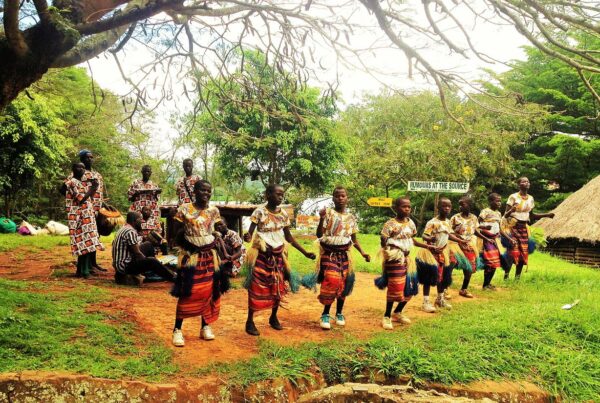
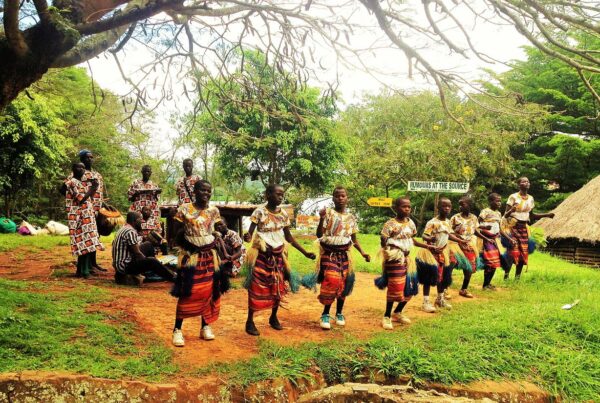
Kiganda dance is the traditional performing arts tradition of the Buganda Kingdom — Uganda’s largest and most historically powerful kingdom, centred on the northern shores of Lake Victoria — encompassing several distinct dance forms including Bakisimba (the principal women’s dance celebrating the kingdom), Nankasa (an energetic drum-based performance), and Muwogola (a royal court tradition), all of which were historically performed exclusively in the presence of the Kabaka (king). Today Kiganda dance is performed at the Ndere Cultural Centre in Kampala, at Buganda royal events, and through school cultural programmes — and is one of the traditions most commonly encountered by visitors combining cultural immersion with gorilla trekking at Bwindi. See Uganda safari packages that include a Kampala cultural evening.
- Origin: Buganda Kingdom, central Uganda — the kingdom’s heartland centres on Kampala and Lake Victoria’s northern shore
- Principal forms: Bakisimba (women’s dance), Nankasa (drum-based), Muwogola (royal court), Mulindwa
- Instruments: engalabi (long drum), baakisimba drum set, amadinda xylophone in court contexts
- UNESCO: Buganda royal music and dance are part of Uganda’s intangible cultural heritage framework
- Where to see: Ndere Cultural Centre (Kampala); Buganda Lubiri palace; Uganda Museum
Kiganda dance is the collective term for the traditional performing arts of the Buganda Kingdom — the largest and most historically powerful of Uganda’s kingdoms, centered on the northern shores of Lake Victoria. These dances are not casual entertainment; they are coded cultural expressions that communicate royal protocol, community values, historical memory, and spiritual belief through movement, music, and costume. In 2027, Kiganda dance remains alive at cultural centers, royal ceremonies, and community events across Buganda, and is readily accessible to visitors in Kampala and the surrounding region.
The Buganda Kingdom and its performing arts
Buganda was the dominant political power in the Great Lakes region for several centuries before British colonization. Its highly organized state structure — with a king (Kabaka), a hierarchy of chiefs, and a sophisticated court culture — produced equally sophisticated performing arts. Dance, music, and storytelling were integral to court life, used to praise the Kabaka, record clan histories, celebrate military victories, and mark the agricultural calendar.
The Buganda court maintained specialist performers whose role was hereditary — families that had served as court musicians and dancers for generations. This professionalism produced high levels of technical skill and a strong sense of performance standards. The tradition of excellence in Kiganda performing arts continues today through institutions like the Ndere Cultural Centre and the Buganda Kingdom’s own cultural programs.
Types of Kiganda dance
Kiganda dance encompasses several distinct forms, each associated with specific contexts and social meanings.
Bakisimba: the mother dance
Bakisimba is perhaps the most iconic Kiganda dance form. It is associated with women and was originally performed in royal contexts to celebrate the brewing of banana beer (tonto) for the Kabaka. The movement vocabulary emphasizes precise hip movements, subtle shoulder rotations, and graceful arm gestures — all performed with a controlled elegance that contrasts sharply with more vigorous East African dance styles. Bakisimba requires years of practice to master and is considered a marker of feminine grace and cultural refinement.
Men also perform bakisimba, though in a stylistically different way. Male performers emphasize footwork and rhythmic precision while maintaining the overall quality of controlled elegance. Mixed-gender performances of bakisimba at cultural events create a dialogue between masculine and feminine movement vocabularies within the same musical structure.
Nankasa: the drum dance
Nankasa is a faster, more rhythmically complex form driven by the nankasa drums from which it takes its name. It is more physically demanding than bakisimba and is often performed by younger dancers at celebrations and communal events. The emphasis in nankasa is on rhythmic accuracy and the ability to embody the complex interlocking drum patterns in movement. Watching an experienced nankasa performer is watching someone whose body has internalized musical structures that would confound most trained Western musicians.
Muwogola: the royal praise dance
Muwogola is performed specifically in royal contexts to honor the Kabaka and important chiefs. It involves elaborate costumes, formal movement patterns, and sung poetry praising the lineage and achievements of the ruler. Muwogola performances at the Buganda Palace (Lubiri) in Mengo, Kampala, are among the most formal and culturally significant performances available for visitors to witness in Uganda.
Kiganda costume and instruments
Traditional Kiganda dance costumes are carefully constructed from bark cloth (the UNESCO-recognized Buganda textile), animal skins, and woven grass. Women wear flowing bark cloth dresses or wrapped fabric skirts with elaborate bead jewelry. Men wear cowhide capes, barkcloth wraps, and sometimes elaborate headdresses made from animal fur or feathers. The visual impact of a full Kiganda performance company in traditional dress is extraordinary.
The primary accompanying instruments are the engoma drums (in their various sizes), the endongo (a bowl lyre unique to Buganda), the amadinda xylophone, and singing. The endongo produces a delicate, harp-like sound that provides melodic texture against the rhythmic foundation of the drums. Performances often open with the endongo establishing a mood before the drums and dancers enter.
Where to see Kiganda dance in 2027
The best venues for experiencing Kiganda dance in 2027 are concentrated in Kampala and the surrounding Buganda heartland. The Ndere Cultural Centre in Ntinda suburb of Kampala offers regular Thursday evening and Sunday lunchtime performances that include Kiganda dance alongside dances from other Ugandan ethnic groups. The shows are professionally produced with good lighting, narration in English, and opportunities to interact with performers afterward.
The Buganda Kingdom Palace (Lubiri) in Mengo occasionally hosts public cultural events featuring traditional performances, particularly around Buganda Kingdom Day (Kabaka’s Birthday in April) and other royal calendar events. The Uganda National Cultural Centre on Dewinton Road in central Kampala hosts performances and has a dance school where visitors can observe or join classes in Kiganda dance.
Kiganda dance as living heritage
Uganda’s Ministry of Tourism and various cultural organizations have invested in documenting and teaching Kiganda dance to younger generations. Schools in Buganda incorporate traditional dance into their curricula. Annual cultural competitions between schools and communities celebrate performance excellence and encourage young Ugandans to master the forms their grandparents practiced at court. This investment means that Kiganda dance in 2027 is not merely a heritage show for tourists but a living practice that young Ugandans engage with as part of their identity.
For visitors combining a gorilla trek (permits are $800 in 2027) with time in Kampala, an evening at the Ndere Cultural Centre offers an ideal introduction to the breadth and depth of Ugandan cultural performance — with Kiganda dance as its magnificent centerpiece.
What is Bakisimba and where does it come from?
Bakisimba is the principal women’s dance of the Buganda Kingdom. According to oral tradition, the dance was created when the Kabaka was pleased with a gift of banana beer (mwenge) — his joyful, slightly inebriated celebration inspired the swaying, hip-rolling movement that became the core motion of Bakisimba. Women perform in groups with slow, controlled hip movements and subtle footwork while maintaining an upright, dignified upper body posture — a combination that requires significant physical control. The name “Bakisimba” derives from the Luganda for banana stem planting, connected to the origin story. It was historically a royal dance performed for and before the Kabaka.
What is Nankasa dance?
Nankasa is a faster, more energetic form of Kiganda dance driven by rapid drumming. While Bakisimba is associated with the slow, controlled women’s style, Nankasa involves energetic footwork and movement from both male and female performers in response to accelerating drum patterns. The engalabi drum (a long, cylindrical drum with a monitor lizard skin head) is central to Nankasa performance — its distinctive timbre drives the energy of the dance. Nankasa is performed at celebrations, weddings, and communal events and is less exclusively royal in character than Bakisimba. Its energetic quality makes it one of the most visually arresting forms of Kiganda dance for outside observers.
What is the Buganda Kingdom and why is it important in Uganda today?
Buganda is the largest traditional kingdom in Uganda and the most influential historically. Its heartland covers the area from Kampala south to Lake Victoria and the Ssese Islands. The Buganda Kingdom was abolished by President Milton Obote in 1966 but was restored in 1993 as a cultural (non-political) institution by President Museveni. The Kabaka (king) of Buganda is Ronald Muwenda Mutebi II, who acceded to the throne in 1993. The kingdom has approximately 8 million Baganda subjects and maintains significant cultural influence in contemporary Uganda — the Lubiri (palace) in Mengo, Kampala, functions as the kingdom’s cultural and administrative headquarters and is open to visitors.
Where can visitors watch Kiganda dance in Kampala?
The Ndere Cultural Centre in Ntinda, Kampala, hosts the Ndere Troupe’s weekly performances on Thursday, Friday, and Sunday evenings — these are Uganda’s most professionally staged traditional dance performances and include Kiganda dance forms alongside traditions from across the country’s 56 ethnic groups. The show runs approximately two hours with narration in English and is specifically designed to be comprehensible and engaging for international visitors. Book in advance during high season (June-September, December-January). The Uganda Museum in Kampala also has occasional cultural programming. The Buganda Lubiri palace in Mengo occasionally hosts royal cultural events that are open to the public.
How is Kiganda dance different from other Ugandan dance traditions?
Kiganda dance is characterised by controlled, deliberate movements with emphasis on hip rotation and dignity of bearing — reflecting its royal court origins. By contrast, the Bakiga Ekitaguriro dance from southwestern Uganda (near Bwindi) involves dramatic vertical jumping and acrobatic physical display. Acholi orak from northern Uganda is intensely communal and involves competitive group formations. Karamojong dances feature cattle-related symbolism and long-striding warrior movements. Each tradition reflects the ecology, history, and social values of its originating community — Kiganda’s courtly restraint contrasts sharply with the athletic exuberance of highland and pastoral dance forms.
- The Buganda kingdom: the most powerful traditional kingdom in Uganda’s history
- The Kingdom That Ruled Uganda for 500 Years: Buganda History
- Buganda Kingdom Culture: The Customs of Uganda’s Largest Ethnic Group
- Uganda traditional music: drums singing and cultural performance
- Kanzu Uganda: the traditional men’s garment of the Buganda
- Buganda Kingdom coronation day: the cultural celebration guide
- Uganda’s kingdom system: the Buganda, Ankole, Bunyoro, and Toro kingdoms
- Kabaka’s Palace (Lubiri) – A Regal Journey Through Buganda’s Living Heritage
- The Case for Choosing Uganda Over a Traditional African Safari
- Uganda’s Traditional Medicine and the Plants That Gorillas Eat