Music in Uganda has never been merely entertainment — before radio and recording, the amadinda xylophone carried court messages in the Buganda palace, entenga royal drums assembled armies and marked the hours of the king’s day, and call-and-response singing organised agricultural work across the country’s hills and valleys, making music a functional technology of governance, communication, and social cohesion. The amadinda xylophone and its associated musical tradition were inscribed on UNESCO’s Representative List of Intangible Cultural Heritage in 2014. Visitors to Uganda combining cultural experiences with gorilla trekking at Bwindi can encounter traditional music at the Ndere Centre in Kampala or through community visits near the national parks. See Uganda safari packages.
- Amadinda: large log xylophone of the Buganda court — UNESCO intangible heritage 2014; played by 3 musicians simultaneously
- Akadinda: larger variant of the amadinda, also from Buganda royal tradition
- Entenga: set of tuned royal drums at the Buganda palace in Kampala
- Endingidi: spike fiddle played across multiple Ugandan ethnic groups
- Best place to experience: Ndere Cultural Centre, Kampala (weekly performances)
Music in Uganda is not entertainment — it is communication, ceremony, medicine, and memory. Long before radio or recording, drumming networks carried messages across kingdoms, call-and-response singing bound communities in shared labor, and elaborate court performances encoded the histories of clans and rulers. In 2027, traditional Ugandan music remains vibrantly alive, performed at ceremonies, cultural festivals, and community events across the country — and increasingly preserved and promoted through cultural tourism.
The drum at the centre of Ugandan music
The drum — called engoma in Luganda — holds a position in Ugandan culture that has no equivalent in Western musical traditions. Drums are not merely instruments; they are royal emblems, spiritual objects, and community anchors. The royal drums of Buganda Kingdom, called Mujaguzo, were so sacred that they had their own names, attendants, and designated guardians. Their sounds signaled the king’s presence, called armies to battle, and summoned communities to assembly.
Different sizes and types of drums serve different functions. The embuutu is the largest bass drum, providing the foundational beat. The mbuutu and nankasa are mid-sized drums that carry the rhythm. Small lead drums called engalabi — distinguished by their long, narrow shape and lizard-skin heads — carry the most complex melodic patterns. A skilled engalabi player is a musician of the highest order in Buganda tradition.
The royal drums of Buganda
The Mujaguzo drums of Buganda Kingdom represent one of the most remarkable musical traditions in Africa. The ensemble consists of dozens of drums of varying sizes, played together in interlocking rhythmic patterns of considerable complexity. The Mujaguzo could only be played in the presence of the Kabaka (king) or by his explicit permission. Hearing the Mujaguzo was an act of receiving royal blessing and power.
Today the Mujaguzo ensemble is maintained at the Buganda Kingdom Palace (Lubiri) in Kampala and at the Kasubi Tombs UNESCO World Heritage Site. Visitors to Kasubi can hear and sometimes see demonstrations of the royal drum tradition, connecting them to centuries of Buganda royal culture.
Singing traditions across Uganda’s ethnic groups
Uganda’s 65-plus ethnic groups each have distinct singing traditions. Call-and-response singing is perhaps the most widespread form — a lead singer (soloist) calls out a phrase and the community responds in unison. This pattern appears in work songs, lullabies, ceremonial songs, and social commentary songs across Bantu, Nilotic, and Central Sudanic language groups.
Among the Acholi of northern Uganda, larakaraka is a competitive singing and dancing form performed at communal celebrations. Teams of young men and women compete in elaborate choreographed performances judged by community elders. The Iteso of eastern Uganda perform akogo — a thumb piano tradition combined with singing that creates music of remarkable delicacy. The Basoga of the Nile region are famous for their amadinda xylophone tradition, which UNESCO recognized as part of the Intangible Cultural Heritage of Humanity.
The amadinda xylophone: Uganda’s contribution to world music
The amadinda is a large log xylophone played by three musicians simultaneously using interlocking patterns. Two players perform the basic pattern while a third improvises rapid ornamental notes on top. The resulting sound is hypnotic and complex — a piece of music that sounds as if it could not be performed by human hands but somehow is. Musicologists from around the world have studied amadinda music, and it has influenced contemporary composers including Steve Reich who cited African interlocking patterns as an influence on minimalist music.
The amadinda tradition is centered among the Basoga people near Jinja and along the shores of Lake Victoria. The Uganda National Cultural Centre and the Uganda Museum in Kampala sometimes have amadinda demonstrations. Various cultural villages and performance groups near Jinja also maintain the tradition.
Cultural performance venues in Uganda
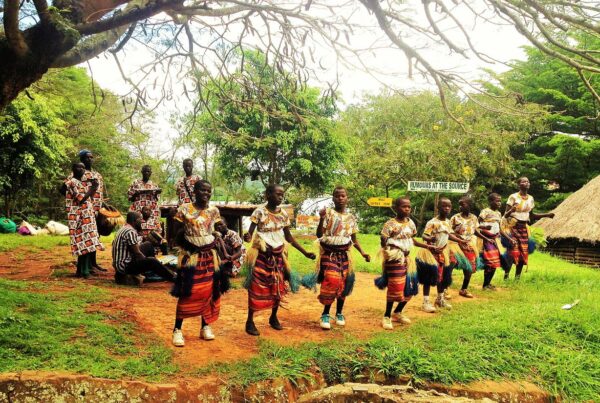
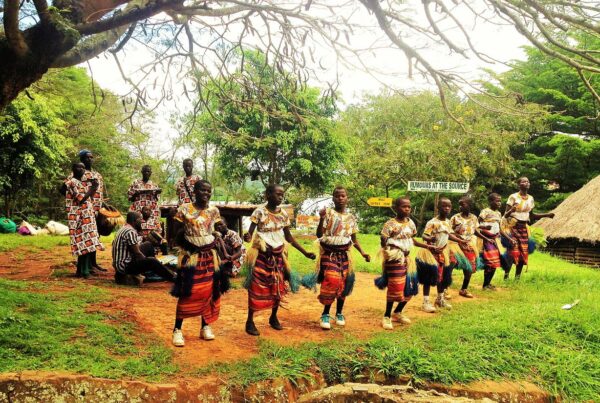
Several dedicated cultural performance venues and groups bring Uganda’s musical diversity to visitors in 2027. The Ndere Cultural Centre in Kampala is the most established, offering regular evening performances featuring music, dance, and storytelling from across Uganda’s ethnic groups. The shows at Ndere are polished and theatrical but draw on genuine traditional forms and involve performers who have trained rigorously in their ancestral traditions.
The Uganda Museum in Kampala houses a significant collection of traditional instruments including drums, xylophones, harps, lyres, and fiddles from across the country. The museum sometimes arranges live demonstration sessions. Village cultural tourism programs near major national parks — including those near Bwindi, Queen Elizabeth, and Murchison Falls — also typically include musical performances as part of community visits.
Music at gorilla trekking communities
For visitors to Bwindi Impenetrable Forest and Mgahinga Gorilla National Park in 2027, cultural performances are readily available at community tourism programs near the main trekking sectors. After a morning gorilla trek (permits cost $800), an afternoon at a community cultural center watching drumming, singing, and dance performances creates a complete day that honors both the natural and human heritage of southwestern Uganda.
Purchasing recordings of traditional Ugandan music from local artists, buying instruments made by local craftspeople, or taking a drumming lesson from a master drummer are all ways to engage with the musical tradition that go beyond passive watching and bring something genuinely meaningful home from Uganda.
Music in Ugandan daily life
Beyond formal performance contexts, music permeates Ugandan daily life. Women sing while grinding grain or carrying water. Fishermen sing as they paddle. Children invent elaborate singing games. Radio and mobile phones now bring recorded music everywhere, but communal singing and drumming remain fundamental to how Ugandan communities mark the moments that matter — birth, marriage, harvest, mourning, and reunion. Visitors who spend time in rural Uganda will encounter this music organically, in contexts that no cultural center can replicate.
What is the amadinda and why is it significant?
The amadinda is a large xylophone of the Buganda Kingdom, made from hardwood logs of varying lengths laid over banana stems that act as resonators. Unlike Western xylophone performance where one player plays the full melody, amadinda performance involves three musicians playing simultaneously — two players alternate rapid interlocking patterns on the same instrument while a third plays a complementary counter-melody on a higher-pitched version. This produces a dense, polyrhythmic sound that creates emergent melodic patterns in the listener’s perception that are not played by any single musician. The technique requires years of practice and is passed through apprenticeship within specific family lineages. UNESCO inscribed the tradition in 2014 specifically for this unique performance practice and its social role in Buganda court culture.
What role did drums play in Uganda’s kingdoms?
Drums were instruments of royal power across Uganda’s Bantu kingdoms — Buganda, Bunyoro, Toro, Ankole, and others. The entenga royal drums at the Buganda Lubiri (palace) in Kampala are a set of tuned drums in specific intervals — they were played at the Kabaka’s court to mark the hours of the day, to announce royal presence, to send messages, and to mobilise warriors. Drum rhythms encoded specific messages that trained listeners could decode. The royal drums were symbols of the kingdom itself — capturing or destroying the royal drums of an enemy kingdom was a key military objective in inter-kingdom wars. The Buganda Lubiri in Kampala still maintains a set of entenga drums and occasional performances for visitors.
Where can tourists experience traditional Uganda music?
The Ndere Cultural Centre in Kampala’s Ntinda area is the premier venue for traditional Ugandan music and dance performance. The Ndere Troupe performs weekly on Thursday, Friday, and Sunday evenings, presenting traditions from across Uganda’s 56-plus ethnic groups — including Buganda, Acholi, Kiganda, Karamojong, and others — with professional dancers, musicians, and narrators. This is consistently recommended as the best cultural experience available to tourists in Kampala. The Buganda Lubiri (palace) in Mengo, Kampala, also has cultural programmes. Near Bwindi, some lodges arrange evening cultural programmes with Bakiga music and dance from surrounding communities.
How does music vary between Uganda’s different ethnic groups?
Uganda’s 56-plus ethnic groups have distinct musical traditions reflecting their environments, histories, and social structures. Buganda court music (amadinda, akadinda, entenga) is hierarchical and formal — tied to the kingdom’s administrative structure. Acholi and Langi music from the north features call-and-response vocal traditions and the orak dance, which involves competitive group acrobatics. Karamojong music centres on cattle songs and the emoit dance. Kigezi music from the southwest (home of Bwindi) includes the energetic Ekitaguriro jumping dance of the Bakiga. The endingidi spike fiddle appears across multiple groups. This diversity reflects Uganda’s ethnic complexity — the country has more distinct ethnic groups per capita than almost any other African nation.
Is traditional music still practised in Uganda today?
Yes — though the context has shifted. Contemporary Uganda has a vibrant popular music scene (Afrobeats, Afrofusion, gospel) that dominates urban life and radio, but traditional music traditions are actively maintained through cultural organisations, school programmes, and ethnic community events. The Ndere Centre has been particularly influential in preserving and presenting traditional forms to both Ugandan and international audiences. UNESCO recognition of the amadinda tradition in 2014 gave formal international status to preservation efforts. Weddings, funerals, and cultural ceremonies in rural areas still feature traditional music prominently — visitors who spend time near communities rather than only in lodge settings will encounter it naturally.
- Ugandan music and cultural performances near Bwindi: the arts of the Bakiga people
- Kiganda dance: the traditional performance of the Buganda Kingdom
- Ugandan music traditions: from royal drums to Afrobeat on the road to Bwindi
- Cultural Tours in Uganda: Discover the Soul of the Pearl of Africa
- How to Plan the Batwa Cultural Experience
- What I Expected vs What I Got on a 3-Day Gorilla Trekking and Cultural Safari in Uganda
- Uganda Art & Music Scenes to Explore: Where Tradition Meets Vibrant Modernity
- Ndere Cultural Center: Uganda’s Living Theatre of Heritage, Rhythm & Unity
- This Is the Place Avicii Meant When Singing ‘The Nights’
- Cultural Tourism Sites in Uganda – Best Uganda Heritage