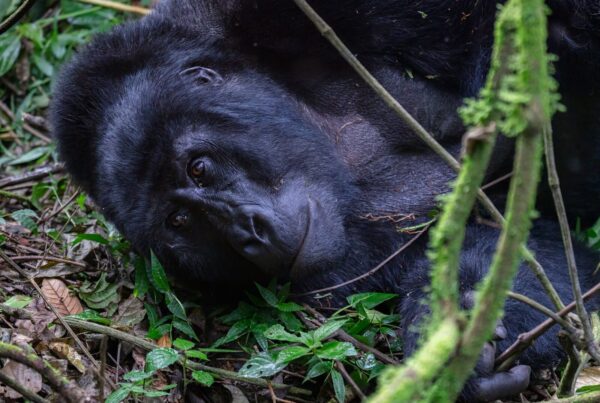
There is a documented intersection between the plants that mountain gorillas select for food in Bwindi’s forest and the plants that Ugandan traditional healers have used for medicinal purposes for generations — and this overlap is not coincidence. Gorillas, like many primates, appear to self-medicate using specific plant compounds, deliberately consuming particular species when ill or injured. Researchers studying gorilla diet in Bwindi have cross-referenced their findings with ethnobotanical records and found consistent overlaps between gorilla plant selection and documented traditional medicine applications. Understanding this points to why the forest gorillas inhabit is itself a pharmacological resource of unquantified value. See the gorilla families and the Bwindi forest ecosystem.
- Gorilla diet: primarily leaves, stems, bark, roots — they consume hundreds of plant species in Bwindi’s forest
- Self-medication: great apes including gorillas consume specific plants when ill — a behaviour called zoopharmacognosy
- Overlap with human medicine: documented cases where gorilla-selected plants align with traditional medicinal uses in surrounding communities
- Bwindi plant diversity: over 1,000 plant species in the forest — one of the highest in any montane African ecosystem
- Conservation implication: forest loss eliminates plant knowledge before it can be documented — in both gorilla behaviour and human tradition
There is a striking intersection between two bodies of knowledge that rarely meet in formal discourse: the traditional medicinal plant knowledge held by Ugandan herbalists and healers, and the plant food preferences of mountain gorillas. Researchers who have spent time documenting both have noticed something unexpected — a substantial overlap between the plants that gorillas specifically seek out during periods of sickness or apparent digestive distress and the plants that traditional Ugandan medicine uses for similar conditions in humans.
This overlap is not coincidental. It reflects a shared evolutionary history in which both humans and gorillas, over millions of years, learned to identify the same chemical compounds in plants as therapeutically valuable — compounds that have since been identified by pharmacologists as genuinely biologically active. The gorilla’s pharmacy and the Ugandan healer’s pharmacy draw from the same source.
Gorilla Dietary Medicine
Mountain gorillas in Bwindi Impenetrable Forest have a diet that shifts seasonally with fruit availability, but at its core consists of leaves, stems, bark, and roots from hundreds of plant species. Most of these are eaten as straightforward nutrition. But researchers studying gorilla feeding behaviour have documented specific instances of what appears to be deliberate medicinal consumption — gorillas eating plant species in ways that do not fit normal foraging patterns, at times that correlate with apparent illness or parasitic infection.
The most studied example involves the genus Vernonia — plants that produce intensely bitter compounds called sesquiterpene lactones that are toxic to intestinal parasites. Gorillas suffering from heavy parasite loads have been observed eating Vernonia leaves whole without chewing — a behaviour that maximises exposure of the gut to the compound while minimising the amount absorbed through the gut wall. The same behaviour has been documented in chimpanzees and other great apes. It looks very much like self-medication.
The Chemistry of Self-Medication
The compounds that gorillas seek in apparent self-medication are not nutritionally valuable — in many cases they are mildly toxic. Their value lies in specific biological activities: antiparasitic, antibacterial, anti-inflammatory, or analgesic effects that provide relief from specific conditions. The gorillas’ ability to identify these compounds — to distinguish the plant that provides antiparasitic relief from the hundreds of superficially similar plants in the forest — implies either learned behaviour transmitted across generations or an evolved chemical sensitivity that guides selection.
Research into this question is ongoing, and the results are consistently interesting. Studies comparing gorilla plant use with traditional medical knowledge from communities adjacent to Bwindi have found significant overlap — plants that gorillas use medicinally are disproportionately represented in the traditional pharmacopoeia of Bakiga and Bafumbira healers. This cannot be coincidence. The most likely explanation is that both gorillas and humans discovered the same active compounds through long experience with the same plant community.
Ugandan Traditional Medicine
Uganda’s traditional medicine system is one of the most diverse in sub-Saharan Africa, reflecting the country’s remarkable botanical diversity. The Albertine Rift, which runs through western Uganda and includes the Bwindi landscape, contains hundreds of endemic plant species found nowhere else on Earth — plants that have been used by local healers for generations and that remain largely unstudied by formal pharmacology.
Ugandan traditional healers — called bachwezi or herbalists depending on the tradition — operate within knowledge systems that are transmitted orally across generations, typically within family lineages. The knowledge includes plant identification, preparation methods, dosing, contraindications, and the ritual contexts in which specific remedies are used. It is a sophisticated system developed over centuries of observation and experience, and it addresses a wide range of conditions — from intestinal parasites and respiratory infections to obstetric complications and psychiatric disturbances.
Plants of Mutual Interest
Several plants documented as used by both gorillas and traditional Ugandan healers are particularly interesting. The African plum, Prunus africana, has bark that gorillas chew and that Ugandan healers use for urinary and prostate conditions. Contemporary pharmacological research has confirmed that Prunus africana bark contains compounds with genuine anti-inflammatory and anti-androgenic effects relevant to prostate health — the bark is now commercially harvested for European pharmaceutical products, creating conservation pressure that threatens the wild populations gorillas depend on.
Warburgia ugandensis, the pepper-bark tree, produces bark that is intensely hot in flavour — caused by the same chemical compounds that make chilli peppers hot — and that is used by traditional healers for respiratory infections and by gorillas during periods of apparent respiratory illness. The antimicrobial properties of Warburgia compounds are well-documented in the pharmacological literature. The gorillas appear to have known this before the pharmacologists arrived.
Conservation Implications
The medicinal plant knowledge embedded in traditional Ugandan healing systems represents a form of biodiversity intelligence — a millennia-long record of which plant species have medically significant properties. This knowledge is disappearing as the older generation of healers dies without adequate transmission of their expertise to younger practitioners, and as younger generations in Uganda’s increasingly urbanised society have less contact with the wild plant communities that form the basis of traditional medicine.
The conservation implication is twofold. First, the plants that traditional healers and gorillas rely on are part of the same ecosystem whose protection gorilla conservation requires. Protecting Bwindi’s forest protects not just the gorillas but the medicinal plant resources that both the gorillas and the surrounding human communities depend on. Second, the traditional knowledge itself — the centuries of accumulated observation about which plants have which properties — is a conservation asset that is at risk of being lost before it can be systematically documented.
Research and Documentation Efforts
Several research programmes operating in the Bwindi landscape have worked to document the intersection of gorilla plant use and traditional medical knowledge. These programmes combine primatological field observation, ethnobotanical interviewing with traditional healers, and pharmacological analysis of identified plant species. The results contribute both to understanding gorilla behaviour and to the documentation of traditional knowledge in ways that may eventually support its formal recognition and protection.
The research also has practical conservation applications. Understanding which plant species gorillas use medicinally identifies those species as conservation priorities — plants that must be maintained at population levels sufficient to meet gorilla needs within Bwindi, even as human pressure on the forest edge continues to grow.
What Visitors Can Learn
Gorilla trekking in Bwindi in 2027 — with permits at $800 per person — focuses necessarily on the gorilla encounter itself. But visitors who are interested in the deeper ecology of the forest can request guides who are knowledgeable about plant identification and use. The best Bwindi guides can identify dozens of plant species along any given trail, explain their ecological roles in the forest, and note which are used as food or medicine by the gorillas.
Some lodges near Bwindi offer medicinal plant walks led by traditional healers from adjacent communities — experiences that connect the forest ecology to the human knowledge systems that have interacted with it for generations. These walks provide a different kind of encounter with Bwindi than the gorilla trek itself but one that is equally illuminating. The forest is not just a gorilla habitat. It is a pharmacy, a food system, and a knowledge library that human communities have been reading for longer than formal science has existed.
Understanding this context transforms the gorilla encounter. When you watch a gorilla eating specific leaves with apparent deliberateness, you are watching an animal exercising a pharmacological intelligence that is, in its own way, as remarkable as any other gorilla behaviour. The forest that sustains the gorillas is the same forest that sustains the people around it. The plants are shared. The knowledge is shared. The challenge is keeping both alive.
Do gorillas self-medicate with plants?
Yes — the behaviour is called zoopharmacognosy and has been documented in chimpanzees, gorillas, and other great apes. Primates observed while ill or injured sometimes seek out and consume specific plant species that are not part of their regular diet — plants that contain compounds with anti-parasitic, anti-bacterial, or anti-inflammatory properties. In mountain gorillas, researchers have observed individuals deliberately consuming plants with bitter, medicinal compounds when showing signs of illness or gastrointestinal distress. The specificity and context-dependence of these choices suggests intentional plant selection rather than random browsing.
What plant species in Bwindi are important to both gorillas and traditional healers?
The specific overlap species documented in Bwindi and the Virungas include several plants used by traditional Bakiga and Bafumbira healers for fever treatment, wound healing, and intestinal complaints — the same applications that gorilla self-medication research associates with those plant groups. Vernonia species, Mimulopsis, and various Rubiaceae family plants appear in both gorilla dietary records and ethnobotanical surveys. The systematic documentation of this overlap is ongoing research — the intersection of primatology, ethnobotany, and pharmacology is a relatively new field, and Bwindi’s plant diversity makes it an exceptionally rich research environment.
How does traditional medicinal plant knowledge connect to gorilla conservation?
Traditional healers in communities surrounding Bwindi hold detailed knowledge of the forest’s plant species — their locations, seasonal availability, and preparation for medicinal use — that took generations to accumulate. This knowledge is in many cases more detailed than formal botanical surveys. Conservation of the forest preserves both the plants and the knowledge systems attached to them. Forest loss eliminates plant species before they can be catalogued, destroying medicinal resources that communities have used and that may have pharmaceutical applications not yet investigated. The healers who hold this knowledge are themselves a conservation argument for the forest they know.
Can gorilla trekking visitors learn about Bwindi’s medicinal plants?
Some guided experiences in the Bwindi area include medicinal plant components — the Buhoma Community Village Walk, for example, includes commentary on traditional plant uses from community guides with knowledge of local healing practices. Batwa cultural experiences often include forest plant identification with traditional knowledge context. Standard gorilla trekking guides focus on the gorilla family and general forest ecology; specific medicinal plant knowledge requires a guide or experience specifically designed for that content. Ask your operator about available add-on experiences beyond the gorilla trek itself.
How many plant species are in Bwindi Impenetrable Forest?
Bwindi Impenetrable National Park contains over 1,000 plant species across its 331 square kilometres, including over 100 species of ferns and more than 160 tree species. This diversity is exceptional for a montane forest and results from Bwindi’s position as a forest refugium during the African dry periods of the Pleistocene — species that survived in isolated pockets of stable forest diversified significantly. UNESCO designated Bwindi a World Heritage Site in 1994 partly for this biodiversity value, recognising that the forest’s significance extends beyond its gorilla population to encompass an ecosystem of extraordinary scientific and ecological value.
- Uganda’s traditional medicines and healing plants: what the forest provides
- Traditional medicinal plants of the Bwindi region: the forest pharmacy
- World Wildlife Day 2026: Protect Medicinal and Aromatic Plants – Conserving Health, Heritage and Livelihoods in Uganda’s Gorilla Forests
- The Case for Choosing Uganda Over a Traditional African Safari
- Tonto: Uganda’s Traditional Fermented Banana Beer Explained
- Uganda traditional music: drums singing and cultural performance
- Kiganda dance: the traditional performance of the Buganda Kingdom
- Religion in Uganda: Christianity Islam and traditional beliefs
- Uganda traditional healer: what a witchdoctor actually does
- Uganda dress code: traditional clothing and what tourists should wear