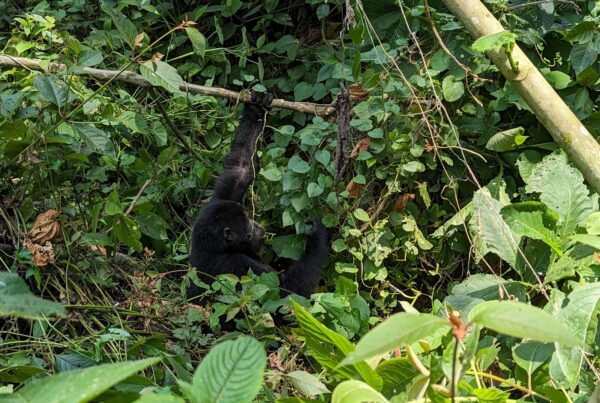
After you have seen mountain gorillas in Bwindi Impenetrable Forest, something happens to your other wildlife memories — they do not disappear, the lions of the Masai Mara remain magnificent in recollection, but they are reorganised: placed in a different category from the gorilla encounter by the quality of the experience itself, which most people who have done both describe not as better or worse but as a different order of thing — a wild animal encounter that engages the evolutionary self rather than just the aesthetic one. Plan your Bwindi visit: cost breakdown, accredited operators, 7-day Uganda safari.
- DNA proximity: mountain gorillas share 98.3% of human DNA; the encounter at Bwindi is with an animal close enough to human that the social behaviour is immediately legible; this is categorically different from observing any other wild animal
- No captive option: no zoo in the world contains mountain gorillas; the Bwindi or Mgahinga encounter is the only way to see one; this is not a premium version of a cheaper option
- The encounter: 60 minutes with a habituated family; 8 people maximum; permit USD 800; book via UWA or accredited operator
- Context: 1,063 mountain gorillas alive worldwide; the IUCN Endangered classification means the encounter has a conservation significance that adds depth to the experience
After you have seen mountain gorillas in Bwindi Impenetrable Forest, something happens to your other wildlife memories. They do not disappear — the lions of the Masai Mara remain magnificent in recollection, the whale sharks of Mexico remain enormous, the polar bears of Svalbard remain otherworldly. But they occupy a different position in your experiential hierarchy. The gorilla encounter sits above them. Not because the other experiences were lesser — they were what they were. But because the gorilla encounter operates on a different register.
People who have done gorilla trekking and then gone on to other wildlife experiences describe a consistent phenomenon: they compare everything to Bwindi. The comparison is unfair to other experiences, but it is genuinely involuntary. Something in the gorilla encounter sets a standard for what wildlife observation can be that other experiences then have to be measured against.
What Is Actually Happening in the Gorilla Encounter
The one-hour contact time with a habituated gorilla family in Bwindi involves proximity that no other safe wildlife encounter in Africa provides. You are on foot in a tropical forest, moving at the gorilla family’s pace, at the gorilla family’s level, in their environment rather than yours. They are not displaying for you or running from you or pretending you are not there. They are going about their morning in the presence of beings they have learned, through years of daily contact, are not threatening.
This familiarity creates encounters of extraordinary ordinariness. A gorilla mother nursing her infant. Two juveniles play-wrestling in a gap in the canopy. An adult female reaching past you — past you, not around you, through your space — to pull a vine from the undergrowth. The silverback who has been watching the family from a slight distance deciding to move closer, not because you are interesting but because his family is moving in your direction.
These ordinary moments are, paradoxically, more extraordinary than any dramatic wildlife event. The charge display of a big cat, the kill seen from a safari vehicle, the breaching whale — these are spectacular because they are dramatic. The gorilla encounter is extraordinary because it is intimate. You are not watching a performance. You are present at daily life of a related species, and the relationship is the thing that makes it different from all other wildlife encounters.
The Comparison That Comes Afterward
The wildlife experiences that most commonly draw comparisons to the gorilla encounter are those that also involve proximity to large, intelligent mammals — whale watching, elephant encounters, dolphin swimming. These are genuine and valuable in their own right. What they lack is the specific quality that the gorilla encounter provides: the recognition that passes between observer and observed. Gorillas look at you specifically. They assess you. They make a judgment about whether you are interesting, threatening, or negligible. The look is not the blank regard of an animal registering a stimulus; it has a quality of appraisal that is unmistakable.
This recognition — the gorilla looking at you and seeing something specific rather than something generic — is what produces the shift that travellers report. You are not a witness to nature. You are a participant in a relationship, however brief and asymmetrical. The gorilla’s look establishes that you exist in its world, not just in yours. That establishment changes something that the purely spectacular experiences of other wildlife cannot change.
Why Uganda and Bwindi
Mountain gorillas can be seen in three countries: Uganda, Rwanda, and the Democratic Republic of Congo. Uganda offers access at $800 per permit in 2027 — significantly less than Rwanda’s $1,500 — and in Bwindi Impenetrable Forest, one of the world’s most biologically rich ecosystems, with more habituated gorilla families open to tourism than any other country in the range.
The Bwindi experience has a specific quality that comes from the forest itself: wilder, less managed than Rwanda’s Volcanoes National Park, with more variable terrain and more genuine unpredictability. Some days the trek to the gorillas takes an hour; some days it takes five. The forest keeps the outcome uncertain in ways that managed safari experiences cannot replicate. This uncertainty is not inconvenience — it is the quality of genuine wildness that makes the encounter, when it comes, feel earned rather than delivered.
After Bwindi
Everyone who returns from Bwindi faces the same question from people who have not gone: what was it like? The question is unanswerable in the way that all the most significant questions are unanswerable — the experience does not translate into language without losing most of what made it matter. The best description most people manage is something like: “You need to go and see for yourself.” This is not a failure of eloquence. It is an accurate acknowledgement that the gorilla encounter is something that can only be understood from the inside.
Contact us to book your 2027 permit and have the experience that makes everything else feel ordinary. Not because the other things are not extraordinary. Because the gorilla encounter is something different. Something that sets the standard by which you will measure everything else you ever see in the wild.
How does gorilla trekking compare to the Masai Mara or Serengeti for a first-time Africa visitor?
The comparison is often made because these are the main candidates for “best first Africa trip.” Masai Mara / Serengeti: the premier savannah experience on Earth; massive herds; the wildebeest migration (July-October); big cat sightings among the most reliable in Africa; volume of game unmatched anywhere. The limitation: you share the experience with many other vehicles; the animals observe humans from a distance and vice versa; the experience is magnificent but mediated by distance and vehicle. Uganda gorilla trekking at Bwindi: 8 people per family per day; no vehicle; direct physical proximity; an animal that is 98.3% human DNA continuing its normal family life in your presence. Which is better: not comparable in terms of which is superior — they are different kinds of wildlife experience; many visitors do both and describe them as complementary rather than competing; the gorilla encounter is routinely described as more affecting; the Mara/Serengeti is described as more visually spectacular.
What specific Uganda wildlife experiences rival gorilla trekking in quality?
Uganda has several experiences that are genuinely exceptional rather than just good. Chimpanzee trekking at Kibale: Kibale Forest chimpanzee trekking rivals the gorilla experience for many visitors; chimp behaviour is more viscerally exciting (louder, faster, more dramatic social interactions) but the encounter is less intimate because chimps are more mobile; universally recommended as an add-on to gorilla trekking. Shoebill at Mabamba: the Mabamba Bay shoebill encounter by canoe in papyrus swamp is for birders what the gorilla is for mammal watchers — a genuinely prehistoric animal in its own habitat at close range; one of the strangest and most affecting bird encounters in Africa. Nile boat safari: the Albert Nile boat safari at Murchison Falls passes hippo pods and Nile crocodiles at 2-3 metre range — the combination of proximity and animal scale is exceptional. Kidepo Valley: Kidepo Valley NP game drives in one of Africa’s most remote parks; cheetah, lion, striped hyena; almost no other tourists.
What is the minimum budget for a high-quality Uganda gorilla trekking trip?
The minimum budget that delivers a quality experience without cutting corners on the essentials. Permit: USD 800 — non-negotiable; this is the fixed cost at all budget levels. Flights from Europe: USD 600-900 return to Entebbe if booked 2-3 months ahead; from USA: USD 1,100-1,600 via connecting hub. Accommodation at Bwindi (minimum quality): USD 80-120 per person per night at guesthouses adjacent to Bwindi; 2 nights minimum; USD 160-240 total. Transport (self-drive): 4WD rental from Entebbe USD 70-100/day; 5-6 days for a minimal itinerary; USD 350-600; or shared ground transport via operator at lower per-person cost. Total minimum 5-6 day trip: USD 2,000-2,500 per person from Europe; USD 2,500-3,200 from USA; this includes only Bwindi and transit. Full breakdown: gorilla trekking cost.
What makes Bwindi Impenetrable Forest itself special beyond the gorillas?
Bwindi is a UNESCO World Heritage Site with exceptional ecological status independent of the gorillas. Age: continuously forested for at least 25,000 years; Bwindi survived the African arid phase that eliminated most equatorial forests; this long continuity explains the exceptional species richness — it has been an ecological refuge for much longer than most forests exist. Birds: 350+ species including 23 Albertine Rift endemics (species found nowhere outside the Albertine Rift); the Bwindi bird list is world-class for a temperate montane forest of its size. Flora: 1,000+ plant species; 120 species of ferns alone; ancient fig trees and forest giants form the upper canopy. Mammals: 120+ species including l’Hoest’s monkey, chimpanzee (seen occasionally during gorilla treks), African civet, giant forest hog. The forest atmosphere: Bwindi’s age and continuity give it a quality that newer forests do not have — a density and strangeness that is distinct from any other forest environment in East Africa.
How do I plan a Uganda gorilla trekking trip in 2027?
Planning has five steps. 1. Choose your travel period: June-September for dry season; October-November and March-May for shoulder season deals; December-February for the short dry season. 2. Contact an operator: accredited Uganda tour operators confirm permit availability for your period and handle all logistics; this is the fastest and most reliable path. 3. Choose a sector: Bwindi sector guide — Buhoma for first-timers is the standard recommendation; Rushaga for the habituation experience. 4. Add other parks: Kibale and QENP fit naturally into the same western Uganda circuit. 5. Read: 30 things to know and full cost breakdown.
- Safaris That Offer Unique Wildlife Experiences in Uganda: Beyond the Ordinary
- Top African Wildlife Experiences
- What Makes Uganda Gorilla Trekking Different from Any Other Wildlife Trip
- Best Wildlife Encounters on Earth: Why Gorilla Trekking Makes Every List
- Gorilla Trekking vs the Serengeti: Which Is the Better Wildlife Experience?
- The Wildlife Experience That No Photograph Can Prepare You For
- The Experience Gap: Why Uganda Wildlife Is Different From East Africa Standard
- Gorilla Trekking Uganda for Veterans: Service and Sacrifice Deserve Extraordinary Experiences
- Gorilla Trekking Uganda for People Who Have Done Everything Else
- The Wildlife Encounter That Has Survived 30 Years of Visitors and Still Feels New