The Serengeti and Bwindi Impenetrable National Park represent two of Africa’s most iconic wildlife experiences. One delivers the spectacle of millions of animals across vast open plains; the other offers the intimate encounter with an individual great ape in dense tropical forest. Both are among the best wildlife experiences on earth. But they are profoundly different in what they offer, who they suit, and what they cost — and choosing between them, or prioritising one when time and budget are limited, requires an honest comparison. In 2027, with increasing numbers of travellers seeking both, this comparison has become one of the most common questions we receive. Here is our answer.
The Nature of Each Experience
The Serengeti experience is defined by scale. The annual Great Migration — approximately 1.5 million wildebeest moving in a continuous cycle around the Serengeti-Mara ecosystem — is the largest terrestrial animal migration on earth. Watching a river crossing, where tens of thousands of animals surge across crocodile-filled water in a matter of hours, is one of the most visually overwhelming wildlife spectacles available to any traveller. Beyond the Migration, the Serengeti supports exceptional lion, leopard, cheetah, elephant, and giraffe populations across an ecosystem of more than 30,000 square kilometres of open grassland and woodland.
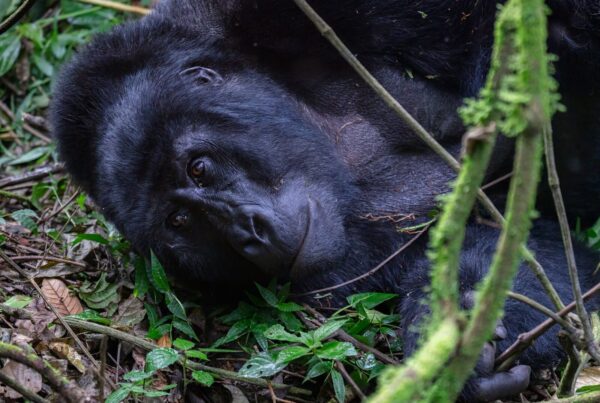
Gorilla trekking is defined by intimacy. You spend one hour with a specific family of 8 to 25 individual gorillas whose names and histories are known. The forest is dense, often steep, and visually challenging — this is not a place of panoramic vistas. The encounter is close — the minimum distance protocol is seven metres, and gorillas sometimes approach closer. The emotional quality of looking into a gorilla’s eyes and recognising something familiar is unlike any wildlife encounter the open plains can produce.
Photography Comparison
For photographers, the two experiences require completely different approaches. In the Serengeti, long telephoto lenses (400mm to 600mm) dominate. You are photographing from a vehicle at distances of 20 to 100 metres, often in bright light, with predictable background separation. The Serengeti rewards patience and positioning — knowing which vehicle track to park on for a river crossing, which waterhole to watch at dusk for big cat activity.
In Bwindi, long telephoto lenses are less useful than medium telephoto (70-200mm) because gorillas are close and the forest is dense. Low light capability matters enormously — forest light is often below what consumer cameras handle well. Wide aperture lenses (f/2.8 at most) are essential. The forest background is rarely clean, but the proximity of subjects compensates. The challenge is reaction speed and stability in difficult conditions. The reward, when conditions align, is the kind of portrait-quality wildlife photograph that open-plains photography rarely produces — a face, a gaze, a personality made visible by proximity.
Physical Requirements
Serengeti safaris are largely vehicle-based. Physical fitness is not a prerequisite. The most demanding activity is a walking safari, which typically covers flat terrain over one to three hours. Most Serengeti clients are comfortable in any physical condition.
Gorilla trekking is physically demanding. Treks range from 45 minutes to seven hours depending on family location. Terrain is steep, uneven, and often wet. Altitude in Bwindi ranges to over 2,500 metres. Moderately fit adults manage most treks without significant difficulty, but clients with cardiovascular conditions, mobility limitations, or poor fitness should consult us before booking. There is a porter option that significantly extends the range of clients who can complete a trek successfully.
Cost Comparison
A quality Serengeti safari (7 nights, mid-range lodges) costs approximately USD 4,000 to 7,000 per person in 2027, including flights from Nairobi, park fees, and accommodation. A gorilla trekking experience in Uganda (3 nights around Bwindi, one gorilla trek) costs USD 1,800 to 2,500 per person including permit (USD 700), transport from Entebbe, and accommodation. On a per-night basis, the Serengeti is significantly more expensive. On a per-significant-experience basis, gorilla trekking is harder to beat for value.
Emotional Impact: Which Experience Stays Longer?
This is the question that matters most and is hardest to answer objectively. Travellers who have done both consistently describe gorilla trekking as the more emotionally intense individual experience and the Serengeti as the more visually overwhelming collective experience. The Great Migration is spectacle. The gorilla encounter is connection. Both are extraordinary. Which stays longer depends entirely on the individual.
Our recommendation for travellers who must choose: if you are planning your first Africa wildlife trip and want the broadest possible introduction to African wildlife in an iconic landscape, the Serengeti is the classic starting point. If you are planning your second or third Africa trip and want the most singular, emotionally distinctive experience available to a wildlife traveller, gorilla trekking in Uganda is the answer. Contact us in 2027 to plan the gorilla experience that will define your next Africa chapter.