You have been to the Serengeti. You have ridden an elephant in Thailand (and later learned why you should not have). You have done the Inca Trail, the Sahara by camel, the Amazon by boat. You have photographed lions, leopards, and cheetahs from the roof of a Land Cruiser. You have watched whales breach off the Azores and penguins shuffle past your boots in Patagonia. And somewhere along the line, the question changed from “where should I go?” to “is there anything left that will actually surprise me?”
There is. And it is in Uganda.
Why Gorilla Trekking Is Different
Most wildlife experiences, however spectacular, operate on a fundamental principle: you are on one side of a glass, and the animal is on the other. Even the most open safari vehicle puts you in a metal box that separates you from the ecosystem. Even the most intimate whale-watching boat keeps you above the surface, looking down.
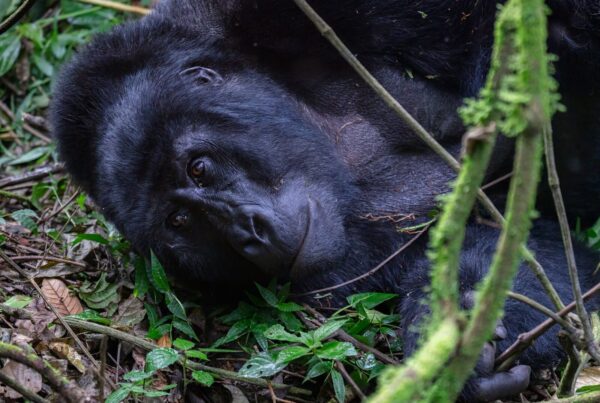
Gorilla trekking in Uganda removes that separation. You walk into the forest on foot. You follow tracks left by an animal that weighed 200 kilograms and passed through this morning. When you find the group, you crouch in the undergrowth at ten metres, eye level with a creature that shares 98% of your DNA, and you watch each other. There is no vehicle. No glass. No fence. Just forest and breathing and the realisation that you are in the presence of something genuinely other — and yet recognisably kin.
The Scarcity Factor
There are approximately 1,100 mountain gorillas left in the world. That is the entire global population of a species — not a regional subspecies count, not a national tally. All of them live in a small range of forests straddling Uganda, Rwanda, and the Democratic Republic of Congo. You cannot see mountain gorillas in captivity. No zoo holds them. The only way to see them is to go to them.
The Uganda Wildlife Authority issues a maximum of eight permits per gorilla family per day. With roughly ten habituated families available in Bwindi Impenetrable National Park and Mgahinga Gorilla National Park, the total daily visitor number across all of Uganda is under a hundred people. On the day you trek, fewer than one hundred people on earth will have the same experience.
The Permit, the Logistics, the Commitment
The gorilla permit costs $800 USD per person for international visitors in 2027. It is not cheap, and it is not meant to be. The price reflects the conservation cost of maintaining habituated gorilla families, funding ranger patrols, and limiting human impact on a critically endangered species. If you have done everything else, you already understand the relationship between cost and quality in wildlife tourism. This experience delivers.
Getting to Bwindi requires commitment. It is not a quick extension from Nairobi or Johannesburg. You fly to Entebbe, travel overland or by light aircraft through south-western Uganda, and spend at least two nights near the park. The effort is deliberate. It is part of why the experience remains rare and genuine rather than commodified and packaged.
What Experienced Travellers Notice That First-Timers Miss
If you have been on enough wildlife trips, your observation skills are calibrated differently. You know how to stay still and watch rather than photograph frantically. You know that the peripheral action — the juvenile playing in the branches above, the female passing within two metres of your shoulder, the silverback’s slow, deliberate gaze — is often more interesting than the obvious centrepiece.
Experienced travellers tend to have richer gorilla encounters because they are not trying to process novelty in real time. They have the background to contextualise what they are watching: the social dynamics, the feeding behaviour, the communication between individuals. Your existing knowledge of wildlife becomes a lens through which the encounter gains additional depth.
Beyond the Gorillas
Uganda offers other experiences that will satisfy someone who has truly done everything else. Chimpanzee tracking in Kibale National Park is the best in East Africa. Shoebill stork sighting in Mabamba Swamp is a bucket-list bird that fewer people have seen than most other iconic African species. The Rwenzori Mountains offer multi-day trekking through Afroalpine terrain that looks unlike any other mountain environment on earth.
Murchison Falls — where the entire Nile is forced through a seven-metre gap in the rock — is one of the most physically dramatic geographical features you will encounter anywhere. The boat trip to the base of the falls, with hippos surfacing alongside and Nile crocodiles on every sandbank, is a full wildlife experience in its own right.
The Question It Asks You
Experienced travellers often describe gorilla trekking as the experience that made them question what they were actually looking for when they travelled. The encounter is too close to be comfortable and too familiar to be dismissible. The gorillas are not exotic in the way that distant or alien species are exotic. They are recognisable. The way a mother holds her infant. The way adolescents play and test limits. The way the silverback’s posture communicates authority without aggression.
Many seasoned travellers find that the gorillas do not so much add to their list of things they have done as they reframe the entire project of seeking out the world’s remarkable places. It is not a box to tick. It is an encounter that stays with you and changes the question from “what else is there?” to “how do we protect what remains?”
If you have done everything else, you have not done this. And this is the one that tends to matter most.