Updated
Uganda grateful to be alive gorilla trekking is one of Africa’s most extraordinary wildlife experiences, connecting travellers with mountain gorillas in their natural forest habitat. There are places on Earth that do something unusual: they do not just impress you or entertain you or give you photographs to show people — they make you feel grateful to be alive, grateful for the specific arrangement of circumstances that brought you to this point, to this forest, to this exact moment of shared planetary existence with a mountain gorilla family in Bwindi Impenetrable Forest — and these places are rare enough that when you have found one it deserves more than a footnote in a travel summary. Plan your Bwindi visit: gorilla permits, cost breakdown, accredited operators.
- Mountain gorilla status: 1,063 individuals worldwide (2018 census); only population with a growing trend; confined to Uganda, Rwanda, and DRC; no mountain gorillas in captivity anywhere on Earth
- The encounter: 60 minutes with a habituated family at Bwindi; gorillas continue normal behaviour — feeding, nursing, playing — in the group’s presence; the encounter is observational not staged
- Permit: USD 800 per person; limited to 8 people per gorilla family per day; book via accredited Uganda tour operator
- The forest itself: Bwindi has been continuously forested for 25,000+ years; 120+ mammal species, 350+ birds, 1,000+ plant species; UNESCO World Heritage Site
There are places on Earth that do something unusual to you. They do not just impress you or entertain you or give you photographs to show people. They make you feel grateful to be alive. Grateful for the specific arrangement of circumstances that brought you here, to this place, at this time, with the capacity to witness what you are witnessing. Uganda is one of those places. Bwindi Impenetrable Forest, in its southwest corner, might be the most intense version of that feeling available to any traveler anywhere.
The Rare Places on Earth That Make You Feel Grateful to Be Alive: Uganda Is One
The Geography of Gratitude
Gratitude is an unusual travel outcome. Most trips deliver satisfaction, pleasure, wonder. Some deliver awe — the Grand Canyon, Everest Base Camp, the Sahara at night. But the specific feeling of gratitude — the sense that you are lucky to exist in a world where this is possible — requires something more than scale or beauty. It requires meaning. It requires the sense that what you are experiencing matters beyond yourself.
Gorilla trekking in Uganda delivers that. When you stand in the presence of a mountain gorilla family in Bwindi, you are not just witnessing something remarkable. You are participating in one of conservation’s great success stories. Mountain gorillas were once sliding toward extinction. Fewer than 650 individuals remained in the early 2000s. Today, more than 1,000 survive — the only great ape species whose numbers are growing. You are here because people cared enough to fight for this. And your presence, your permit fee, your choice to come, is part of what makes it continue.
What Uganda Does to You
Uganda does not overwhelm you with superlatives the way some destinations do. It does not announce itself. It accumulates. The equatorial light on the hills around Kampala in the early morning. The red dust roads that lead into the interior. The markets where color and noise and human energy compress into something almost overwhelming. The roadside stands selling roasted corn and passion fruit juice. The children who wave at every passing vehicle with an enthusiasm that never seems to diminish.
And then the forest. Bwindi does not ease you in. It absorbs you. Within minutes of stepping off the trail into the interior, the world outside recedes. The light changes. Sound changes. The density of life around you becomes palpable — birds in the canopy, insects in the undergrowth, plants competing for every inch of space. This forest has been here, essentially unchanged, for 25,000 years. You feel that age. You feel small and welcome at the same time.
The People of the Forest Edge
The Bakiga and Batwa communities who live around Bwindi are part of the experience. The Batwa, the forest’s original inhabitants, were displaced when the national park was gazetted — a painful history that conservation programs are now working to address through revenue sharing and cultural tourism. Meeting them, hearing their relationship with the forest they once called home, adds a layer of human depth to the gorilla encounter that most visitors do not expect but everyone remembers.
The rangers who lead treks grew up in these hills. Many of their families have lived here for generations. Their knowledge of the forest is intimate and specific — they know individual gorillas by name and personality, know which trails flood in the rains, know the trees by their bark and the birds by a single call. Walking with them is an education that no guidebook provides.
The Encounter Itself
You spend one hour with a habituated gorilla family. The permit costs $800 for international tourists in 2027. That hour is the reason people travel from every corner of the world to this small corner of southwestern Uganda. And it delivers something that travelers consistently describe as the most extraordinary experience of their lives.
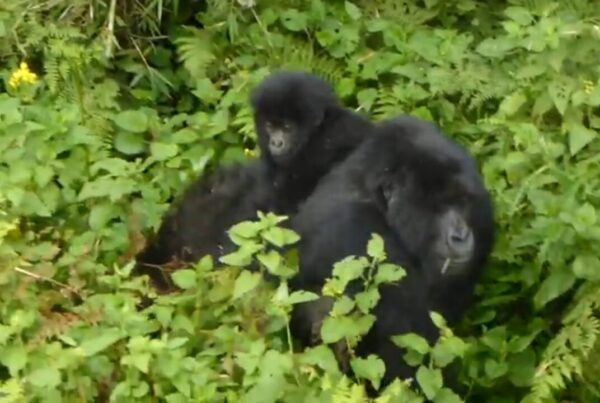
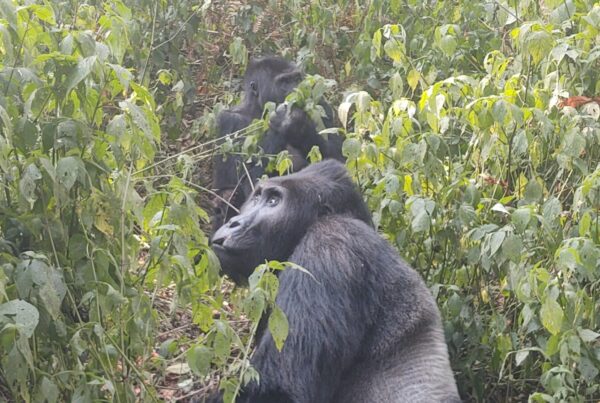
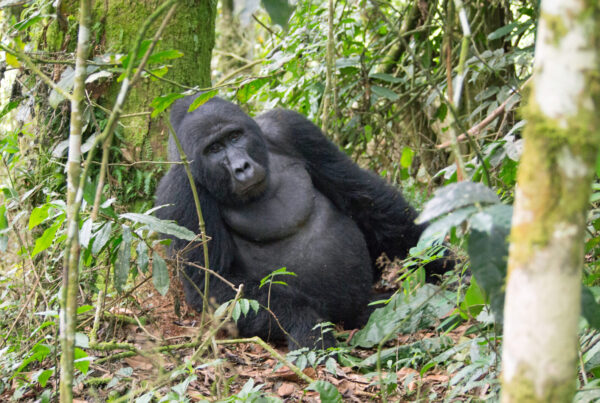
Not because the gorillas perform. They do not. They eat, rest, nurse their young, move through the undergrowth with slow deliberateness. The silverback may spend fifteen minutes simply sitting, chewing leaves, occasionally glancing at your group with an expression of calm authority. A juvenile may approach within a meter, inspect you with enormous dark eyes, then tumble away to rejoin its siblings. A mother nurses her infant while watching you watch her.
The Stillness Inside the Hour
What the hour produces is a particular quality of attention. You stop thinking about everything else. There is no email, no news, no social media, no past or future. There is only this — this family, this forest, this moment. People who are rarely still in their ordinary lives report that gorilla trekking is one of the only experiences that achieved complete presence for them. The gorillas demand it. The forest demands it. And the result is a quality of aliveness that feels like the gratitude it produces.
When the ranger says the hour is over and guides you back down the trail, the feeling does not leave with you immediately. It walks with you for a while. People cry, sometimes. Not from sadness — from fullness. From the specific sensation of having experienced something that mattered.
Uganda Beyond the Gorillas
The gratitude Uganda produces is not limited to Bwindi. Queen Elizabeth National Park offers tree-climbing lions and the vast, bird-rich Kazinga Channel. Kibale Forest holds the highest density of primates of any forest in the world, including chimpanzees. Murchison Falls thunders with a force that seems physically impossible. Lake Victoria — the source of the Nile — stretches to every horizon.
Uganda has 1,066 bird species. It has more than 350 species of mammals. It has landscapes that range from montane forest to savanna to wetland to highland grassland, often within a few hours’ drive. The natural world here is not in retreat. It is present, abundant, and accessible in ways that most destinations can no longer offer.
Come While It Is Like This
The world changes. Wild places shrink. The equilibrium that makes Uganda’s wildlife possible is held in place by ongoing effort, political will, community buy-in, and the permit revenue generated by travelers like you. It is stable now, in 2027. It may always be. But there is wisdom in not assuming permanence.
Come while the gorillas are thriving. Come while Bwindi is intact. Come while the communities around the forest still welcome travelers with the openness that makes the whole experience warm rather than transactional. Come while Uganda is like this — generous, wild, and grateful for visitors who come to witness rather than consume.
There are rare places on Earth that make you feel grateful to be alive. Uganda is one. Bwindi is the heart of it. And the booking form is one click away.
What makes the gorilla encounter emotionally different from other wildlife experiences?
The emotional register is different from game-drive wildlife encounters. Evolutionary proximity: mountain gorillas share approximately 98.3% of human DNA; the visual cues of social behaviour — grooming, mother-infant bonding, play, social hierarchies — are immediately recognisable to any human observer; the encounter is with something that is simultaneously profoundly familiar and entirely other. No intermediary: at Bwindi there is no vehicle, no enclosure, no barrier of any kind between the observer and the gorillas; this direct physical proximity in a shared natural environment creates an immediacy that zoo encounters or documentary footage cannot replicate. The habituation: the gorillas are not performing for the group; they are continuing their lives in your presence; the fact that they have chosen to tolerate human proximity rather than flee creates a quality of mutual acknowledgement that most people describe as the defining element of the experience.
What other Uganda experiences produce a similar quality of encounter?
Uganda has a remarkable concentration of transformative wildlife experiences. Chimpanzee trekking at Kibale: Kibale Forest chimpanzee trekking approaches the gorilla experience in emotional intensity but differs in character — chimps are noisier, more mobile, more demonstrably emotional in their visible behaviour; some visitors find chimp trekking more viscerally exciting than gorilla trekking; others find the gorilla encounter more moving because of the stillness and scale. Shoebill encounter at Mabamba: Mabamba Bay shoebill trekking by canoe in papyrus swamp is another deeply strange and affecting experience — the shoebill is prehistoric in appearance and behaviour in a way that creates a similar sense of geological time. Nile boat safari at Murchison: the Albert Nile boat safari past hippo pods and Nile crocodiles at close range below Murchison Falls; the combination of proximity and scale is affecting.
How long should I spend in Uganda to get the most from the experience?
Duration depends on what you want to take home. Minimum meaningful: 4 days (fly in, drive to Bwindi or fly by charter to Kihihi/Kisoro, trek, drive back); this produces the gorilla encounter but little else; the 3-day fly-in Bwindi covers this efficiently. Standard meaningful: 7-8 days combining Bwindi gorilla trekking with Kibale chimp trekking and Queen Elizabeth NP; see the 7-day gorilla trekking itinerary. Full Uganda: 14+ days adding Murchison Falls, Mabamba Bay, Lake Mburo NP, and possibly Kidepo Valley; this covers Uganda’s major wildlife experiences comprehensively; for many visitors this is the trip that makes them say they will return; and they do.
What happens during the 60 minutes with the gorillas at Bwindi?
The 60 minutes is the fixed permit window and it is used in full. Arrival: the ranger leads the group through the last section of forest to the gorilla family’s location; you may hear the gorillas before seeing them. Positioning: the group maintains a 7-metre regulation distance from the gorillas unless the gorillas choose to approach; the ranger manages movement; everyone stops when the gorillas approach. What the gorillas do: they continue normal behaviour — the silverback may feed or rest; females groom each other or nurse infants; juveniles play and tumble; subadult males observe the group with curiosity. The time: 60 minutes is both very short and very long; the intensity of the encounter makes time feel different; the ranger signals when the hour is complete; the group then follows the same or different route back to the start.
How do I book gorilla trekking at Bwindi as efficiently as possible?
The efficient booking path has four steps. 1. Choose dates: decide on a travel window and have 2-3 alternative dates if your first choice is not available; June-September and December-January are peak; other months have better availability. 2. Contact an operator: an accredited Uganda tour operator will check permit availability for your dates and sector preferences before you commit; this is more efficient than booking direct through UWA if you want a full tour package. 3. Pay deposit: once the permit date is confirmed, pay the deposit to hold it; permits are not held without payment. 4. Build the rest of the itinerary: flights, accommodation, other park visits around the confirmed gorilla trekking date. Full cost: gorilla trekking cost 2025.
- Best Wildlife Encounters on Earth: Why Gorilla Trekking Makes Every List
- The Wildlife Experience That Makes Everything Else Feel Ordinary
- OMG!! If It’s Safari, I’ve Been Missing Out: How This 5-Day Uganda Primate Safari Made Me Feel It All
- Best Places to Travel Solo: Safe, Inspiring & Unforgettable Destinations
- What Makes Uganda Gorilla Trekking Different from Any Other Wildlife Trip
- Uganda Gorilla Trekking for Couples: The Most Romantic Safari on Earth
- Mountain Gorilla Silverback: What Makes a Silverback?
- Cross River Gorilla: Africa’s Rarest Gorilla Subspecies
- First Safari? Why Uganda in 2026 Is the Best Decision You’ll Ever Make
- What It Feels Like When a Gorilla Charges at You and Stops