What it feels like when a gorilla charges at you and stops is something that is genuinely difficult to describe to someone who has not experienced it, because the physical and emotional components arrive simultaneously in a way that defies the sequence that language requires. I know this because it happened to me, and I have been trying to describe it clearly for six months. Here is the best account I have been able to produce.
First: What a Gorilla Charge Actually Is
Before getting to what happened, it is worth understanding what a gorilla charge is and is not, because the word “charge” carries associations from other wildlife that do not apply here.
When a large predator — a lion, a buffalo, a hippopotamus — charges, it is typically moving toward a target with the intention of contact. The charge is functional: a pursuit with a specific physical outcome as its goal.
When a gorilla charges, it is almost always a display — a demonstration of power, authority, and willingness to defend the family. The silverback charges toward a perceived threat not to attack it but to show it what would happen if the threat did not back down. In the vast majority of cases, with humans who behave correctly, the charge stops well short of contact. The gorilla is communicating, not attacking.
Understanding this intellectually does not, I should say immediately, make it easier when it happens.
The Context: Nkuringo Family, Southern Bwindi
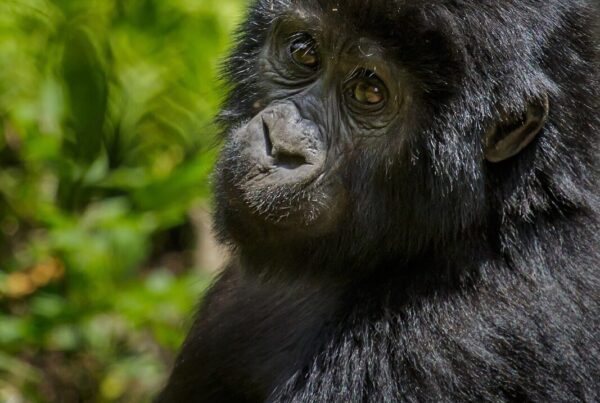
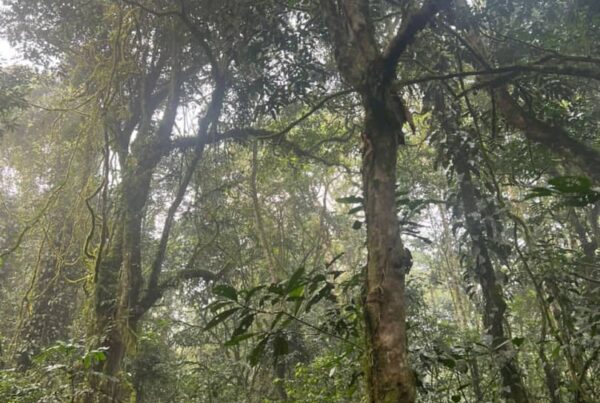
I was trekking with the Nkuringo family in the southern sector of Bwindi Impenetrable National Park. The Nkuringo silverback — also called Nkuringo, named for the community nearby — is described in the briefings as confident and settled, but also as an animal who takes a clear interest in monitoring the boundary between his family and visitors. This is normal silverback behaviour; he is doing his job.
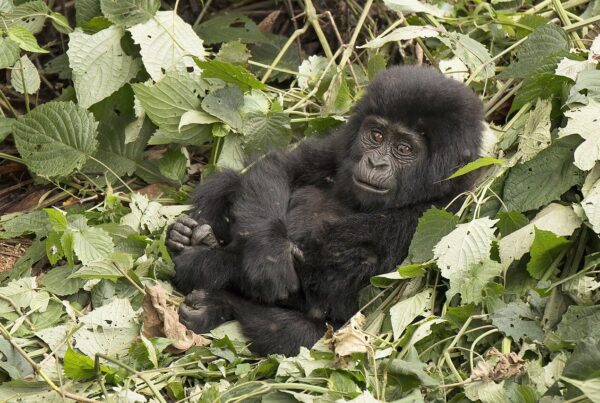
We had been with the family for about thirty-five minutes. The experience up to that point had been exceptional — the family was active and close, a female had walked within two metres of our group, and a juvenile had demonstrated a specific vine-swinging technique about six times in a row, apparently for its own satisfaction.
Our guide, Robert, was watching the silverback at the far edge of the clearing. He had been monitoring Nkuringo’s position and affect throughout — this is what guides do during a gorilla encounter, constantly. Nkuringo had been eating, settled, unbothered by our presence.
What Triggered It
One of the trekkers in our group — I will not identify them more specifically; what happened was an error and not a character failing — moved slightly faster and less quietly than they should have when a juvenile gorilla came too close. The movement was not dramatic. It was a step and a slight arm movement to maintain balance. But it happened quickly, and it happened in the direction of Nkuringo’s family.
Nkuringo saw it. He was on his feet and moving toward us before I had fully processed what I had seen.
The Charge
Robert said something — I cannot tell you what, because the sound arrived as pure instruction rather than language and what I registered was “do not move” rather than any specific words. The experienced rangers behind us had also moved, flanking us slightly, which I processed peripherally.
Nkuringo covered the ground between himself and our group — about twenty metres — in a time I cannot accurately estimate. Fast. The impression of enormous size at full speed is something that bypasses rational assessment completely. The sound was: knuckles on earth, vegetation parting, breathing that became audible as he closed the distance.
He stopped approximately four metres from the front of our group. Then he rose to his full height, looked at us, beat his chest once, and made a sound that I can only describe as the most authoritative sound I have ever heard produced by anything alive.
Then he stood. Looking at us.
What I Did and Did Not Do
I did not run. This I am certain of, though I am not certain it was entirely a conscious decision. My body was producing a quantity of adrenaline that I had not previously been aware it was capable of, and the result was not flight but a frozen stillness that was the physical equivalent of holding my breath.
I looked down and to the side, as instructed. I made myself as small as possible by crouching slightly. I was aware of Robert on my left and a ranger on my right, both still and unhurried, which was more reassuring than I could have articulated in the moment.
I was also aware of my own heartbeat in an unusually literal way — it was very present, very loud, very fast.
The Resolution
Nkuringo held his position for what Robert told us later was approximately forty-five seconds. It felt considerably longer. Then he turned, knuckle-walked back toward the family with the same authority with which he had come, and settled back into his feeding position.
Robert touched my arm lightly and said quietly: “It’s okay. He was just telling us.” I understood what he meant: Nkuringo had communicated exactly what he needed to communicate, had been heard, and had returned to his ordinary morning. The interaction was, from his perspective, complete and successful.
The Feeling: An Attempt at Accuracy
What does it feel like when a gorilla charges at you and stops? I have thought about this carefully because I want to be accurate rather than dramatic.
During the Charge
Time slows in the way that time slows in any high-stakes situation — not because seconds become longer but because perception becomes more detailed. I am aware of this phenomenon from one or two other high-adrenaline moments in my life (a car accident, a climbing slip). Everything was very sharp and very present. The emotional content during the charge itself was something I would describe as pure attention rather than fear — there was no room for fear as an emotion, because every available resource was occupied with immediate sensory processing.
When He Stopped
When he stopped four metres away, the fear arrived. Not before — after. The rational mind had a moment to catch up with events and produce the appropriate emotional response to what had just occurred, and what it produced was a profound, clear fear. Not panic. Fear. The specific kind that comes from knowing exactly how close something came to being very different.
After He Left
When Nkuringo turned and walked back to his family, the adrenaline had nowhere to go. My hands were shaking. A woman in our group was crying, silently. The man who had made the movement that triggered the charge was very pale and very still. Nobody spoke for several minutes.
Then the trembling became something lighter — almost laughter, though not quite — the specific release of tension that has no other channel. Several people exhaled very long breaths. Robert put his hand on the shoulder of the person whose movement had triggered it and said: “It’s over. Nkuringo is finished. Everyone is safe.”
What It Means for the Overall Experience
I want to be clear about something: the gorilla charge was not the worst part of my gorilla trekking experience. It was not even close to the worst part. It was a moment that was frightening and that resolved safely, and its resolution — Nkuringo returning to his family, the group reforming, the remaining twenty-five minutes of our hour continuing normally — contained a specific quality of aliveness that I would not trade.
I have been asked whether the charge put me off returning. It has not. If anything, it deepened my understanding of what the gorilla encounter actually is: not a managed performance, not a zoo visit, not a safe recreation of wildness. A genuine encounter with a wild animal in its own environment, where the rules are the animal’s rules and you are the guest.
For Those Who Are Wondering If This Will Happen to Them
Gorilla charges at trekking visitors are rare. The vast majority of gorilla treks occur without any display behaviour from the silverback. When they do occur, they almost always resolve as described — a display that communicates and then ends. The guides are experienced and the protocols exist precisely for these moments.
The correct behaviour — staying still, looking away, crouching, following guide instructions — is both the safe behaviour and the effective behaviour. It communicates to the silverback that the threat has been acknowledged and that his authority is not being challenged. He gets what he needs from the interaction, and it ends.
Contact Uganda Gorilla Trekking to book your permit and discuss what the experience involves. Go knowing what might happen. Go anyway.
Frequently Asked Questions
The standard gorilla trekking permit costs $800 per person for foreign non-residents (FNR). EAC foreign residents pay $700. During low season — April, May, and November — the FNR rate drops to $600. The Gorilla Habituation Experience permit (4 hours, Rushaga sector only) costs $1,800 per person.
Permits are issued by Uganda Wildlife Authority (UWA). Most visitors book through a licensed Uganda tour operator, who handles the UWA reservation, permit transfer, and sector logistics. Direct booking via the UWA eTourism portal is available but operators handle the complexity of sector assignment and date changes.
During peak season (June–September, December–February): book 3–6 months ahead. During low season (April, May, November): 4–8 weeks is usually sufficient. The AFCON 2027 period (June–July 2027) will see unusually high demand — book at least 6 months ahead for any date in that window.
UWA gorilla permits are non-refundable but can be rescheduled to another date subject to availability and sufficient advance notice. Your tour operator handles this process. Travel insurance that covers trip cancellation and curtailment is strongly recommended for all Uganda gorilla bookings.
Yes. The permit price is set by Uganda Wildlife Authority and is fixed regardless of which operator you use. No operator can offer a discount on the $800 permit — only their service fees (accommodation, transport, guiding) vary between companies.