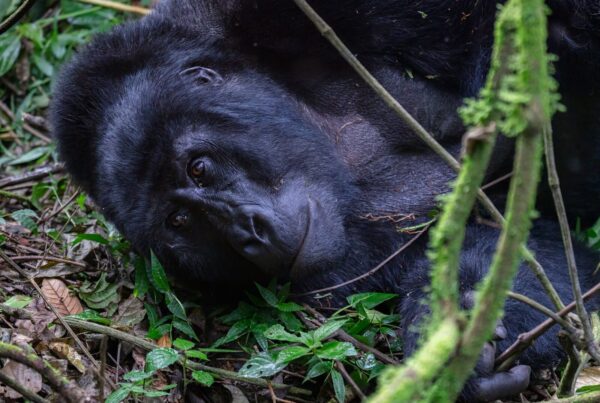
The Icon of the Gorilla World
The silverback is the defining image of mountain gorilla life — the massive, silver-saddled male whose presence anchors the family group, whose decisions govern the troop’s daily life, and whose physical form represents the apex of primate body size and power. But what exactly makes a silverback? The biology of silverback development, the social dynamics of silverback status, and the ecological role of the dominant male in mountain gorilla society are all more nuanced than the popular icon suggests.
The Biology of the Silver Saddle
The name silverback refers to the distinctive grey-white colouration of the fur across the lower back and rump that male mountain gorillas develop as they reach full sexual maturity. This silver saddle is not present at birth or in juveniles and emerges gradually during the transition from blackback (adolescent male) to adult silverback, typically appearing between 12 and 15 years of age and expanding in coverage through the late teens.
The silver colouration results from the progressive loss of pigment in the fur of the back region — a process analogous in some ways to human greying, though caused by different mechanisms and occurring in a specific body region rather than uniformly across the coat. The silver saddle is under hormonal control, as evidenced by the fact that it develops contemporaneously with other markers of male sexual maturity including increasing body mass, the growth of sagittal crests (bony ridges on the skull that anchor jaw muscles), and the development of fully adult canine teeth.
Size and Physical Development
A fully mature silverback is dramatically larger than any other member of the gorilla group. The size difference between silverback males and adult females — approximately 1.5 to 2 times the female body mass — reflects the intense sexual selection in gorilla social systems, where male reproductive success depends heavily on physical competitive ability. Males who grow larger, more muscular, and more physically imposing outcompete rivals for access to females and reproductive opportunities.
This growth continues well into the late teens and early 20s, with full physical maturity not complete until approximately 18 to 20 years. The period from 12 (when the silver saddle begins appearing) to 18 (when full adult body mass is reached) is a period of rapid physical development during which the young silverback also acquires the social skills and group relationships that will determine his success as a dominant male.
Social Status and Leadership
Not all silverbacks are group leaders. In multi-male groups, subordinate silverbacks occupy positions below the dominant male, occasionally mating but primarily deferring to the dominant male’s leadership decisions. Lone silverbacks — males who have left their birth groups without yet establishing their own groups — represent another category: physically mature but socially isolated, in the process of attracting females to found a new group.
The dominant silverback’s leadership role is comprehensive: he makes the group’s movement and foraging decisions, mediates intra-group conflicts, defends the group against external threats (rival males, predators, human disturbance), and serves as the primary breeding male. His authority is maintained through a combination of physical presence, displayed competitive quality, and the social bonds he maintains with adult females who choose to remain with him rather than transfer to rival males.
How Silverbacks Maintain Dominance
Dominant silverback status is maintained not primarily through constant aggression but through the management of competitive relationships and the demonstration of quality. The chest beat display — the iconic sequence of hooting vocalisations rising to a crescendo, bipedal stance, throwing vegetation, chest beating with cupped hands, and ground slapping — is the primary competitive signal through which silverbacks assess relative quality without necessarily engaging in physical combat.
Physical fights between silverbacks do occur during inter-group encounters, over female competition, or when younger males challenge established dominant males. These fights involve biting with large canines, wrestling, and charging, and can produce serious injuries including canine bite wounds. The risk of injury to both participants creates strong selection for mechanisms (like the display sequence) that allow competitive assessment without constant escalation to combat.
Silverback Ageing
As silverbacks age past their physical peak — typically in their late 20s and 30s — they may face increasing challenges from younger males within their groups or from outside rivals. The outcome of this transition varies: some older silverbacks maintain group leadership through social experience and established relationships even as their physical peak declines. Others are gradually displaced by younger, more physically capable males, either within their own group or through inter-group competition.
The death or permanent incapacitation of a group’s silverback is a crisis point for the family: without male leadership and protection, the group may fragment, females may transfer, and infants fathered by the deceased silverback are at risk of infanticide from incoming males who did not sire them. Long-term conservation monitoring pays particular attention to silverback health and succession for this reason.
Final Thoughts
The silverback’s silver saddle is not merely an aesthetic feature — it is the biological signal of full male maturity in a species where male competitive success depends on size, experience, and demonstrated quality. When you observe a silverback in Bwindi, the animal you are watching has navigated 15 to 20 years of growth, social competition, and relationship building to occupy his current position. His presence anchors the family you are visiting. His decisions governed where they slept last night and where they will feed tomorrow. In the mountain gorilla world, the silverback is not just the biggest gorilla. He is the one that everything else organises itself around.
Frequently Asked Questions
A silverback is a mature male mountain gorilla (12+ years old) whose saddle-area back hair has turned silver-grey — a visible sign of adulthood. The silverback leads and protects his family group, decides when and where the group moves, and mediates conflicts. Each habituated gorilla family in Uganda has at least one silverback.
Adult male mountain gorillas weigh 140–200kg and stand 1.5–1.8m tall. Their arm span can reach 2.3 metres. Females are significantly smaller at 70–113kg. Mountain gorillas are the largest living primates. Despite their size, mountain gorillas are generally peaceful and only become aggressive if threatened.
Habituated silverbacks are accustomed to small groups of human visitors and generally ignore the trekking group. You may see the silverback feeding, resting, grooming family members, or moving the group through the forest. Direct eye contact should be avoided. If a silverback charges or bluff-charges, rangers instruct visitors to crouch down, avoid eye contact, and stay still.
A blackback is a sub-adult male gorilla (8–12 years old) whose hair has not yet turned silver. Blackbacks have not reached full maturity and typically live in the family group until they leave to establish their own. A silverback is a fully mature male, larger, dominant, and recognisable by the silver saddle. Both may be present in a single habituated family.
Uganda is home to the mountain gorilla (Gorilla beringei beringei), one of two subspecies of eastern gorilla. They live exclusively in the Virunga volcanic highlands (Uganda/Rwanda/DRC) and Bwindi Impenetrable Forest (Uganda only). Mountain gorillas are the only gorilla subspecies that cannot survive in captivity — every individual you can trek is a wild animal.