Updated
The question is rarely asked in this direction — gorilla trekking literature is full of accounts of what visitors see when they look at the gorillas: the intelligence, the family structure, the physical presence, the eyes that seem to understand — and the reverse question, what the gorilla registered when it looked at you in Bwindi Impenetrable Forest, is the question that reframes the entire encounter from a human experience of a wild animal to a mutual event between two species that share a common ancestor 6 million years ago. Experience it yourself: gorilla permits Uganda, full cost breakdown, accredited Uganda operators.
- Shared ancestry: humans and mountain gorillas diverged approximately 6 million years ago; 98.3% DNA shared; the neural architecture for social cognition is broadly comparable
- Social gaze: gorillas are highly social animals; gaze is a primary social signal in gorilla communication; when a gorilla looks at you in Bwindi, it is processing a social entity using the same cognitive tools it uses with other gorillas
- Self-awareness: research indicates some gorilla individuals pass mirror self-recognition tests — a standard test for self-awareness; the encounter is between two self-aware animals
- Access: USD 800 permit; 8 people per family per day; the only encounter of this kind available anywhere; full guide
The question is rarely asked in this direction. Gorilla trekking literature is full of accounts of what visitors see when they look at the gorillas: the intelligence, the family structure, the physical presence, the eyes that seem to understand. The reverse question — what did the gorilla see when it looked at me? — receives less attention. It deserves more. Because the answer to that question, considered honestly, contains something more useful than the more familiar direction of the encounter.
What the Gorilla Saw When It Looked at You: A Philosophical Reflection
What a Gorilla’s Perceptual System Registers
Mountain gorillas have excellent colour vision comparable to humans, good hearing across a similar frequency range, and a highly developed olfactory sense that provides information about emotional states, health conditions, and individual identity that human observers are not aware of providing. When a gorilla looks at a visitor to Bwindi, it is receiving information through multiple channels simultaneously.
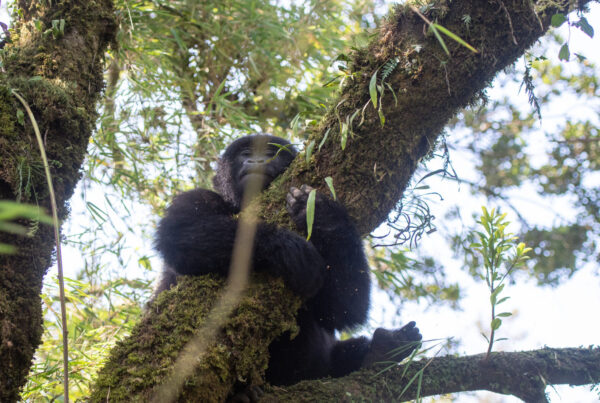
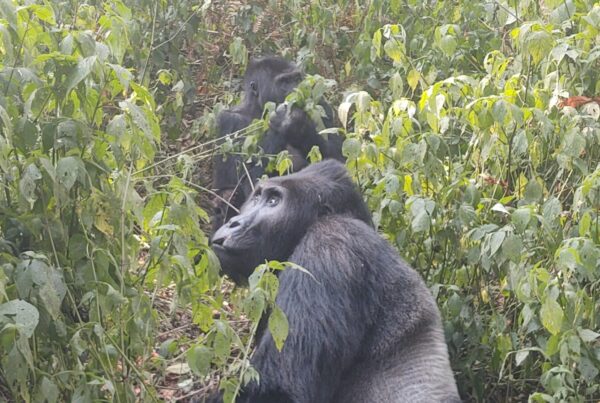
What the gorilla registers visually: a bipedal great ape of moderate size, moving carefully, breathing audibly, emitting the specific olfactory signature of a human being who is mildly stressed (most gorilla trekkers are, at least initially). The gorilla sees the face-forward binocular vision arrangement that marks all great apes, the relative hairlessness that distinguishes humans, the unusual clothing that has no natural equivalent in the forest. The gestalt impression, based on years of daily contact with groups of eight humans, is: familiar category, non-threatening, no action required.
What the Gorilla’s Assessment Tells You About Yourself
Being assessed by another animal and found familiar but uninteresting is an unusual position for most humans to occupy. We are accustomed to being the observer, the assessor, the creature who categorises and evaluates rather than being categorised and evaluated. The gorilla’s assessment reverses this position. For a moment, you are the object of another intelligence’s perception rather than its subject.
What this reversal reveals is simultaneously deflating and liberating. Deflating: you are not particularly interesting to the gorilla. You are a familiar kind of visitor in a familiar category — recognisably related, certainly, but not a subject of deep curiosity. You are not, from the gorilla’s perspective, the apex of anything in particular. You are a variant of great ape, the bipedal one, present in groups of eight for limited periods before disappearing. Liberating: you do not need to be particularly interesting to the gorilla for the encounter to matter. Your significance is not conditional on the gorilla’s interest.
The Ethics of the Encounter
The question of what the gorilla sees when it looks at you also raises the ethical dimension of gorilla tourism more acutely than the more common question of what you see when you look at the gorilla. You are visiting the gorilla’s home, in a regulated encounter that the Uganda Wildlife Authority has structured to minimise disruption to the gorilla family while maximising the visitor experience. The gorilla’s tolerance of your presence is not freely given — it is the product of a long habituation process in which the gorillas were gradually conditioned to accept human visitors.
This conditioning raises genuine ethical questions that conservationists continue to debate. The habituated gorillas are more vulnerable to human disease transmission than unhabituated gorillas. Their home range patterns may be influenced by the daily presence of visitors and trackers. The benefits — the permit revenue that funds conservation, the community benefit-sharing, the international attention to gorilla protection — are primarily benefits to humans and to the gorilla population as a whole, not necessarily to the specific family you visit.
Holding this ethical complexity alongside the extraordinary quality of the encounter is what responsible gorilla trekking requires. You are not simply purchasing access to a wildlife experience. You are participating in a conservation system that has made difficult tradeoffs to produce an outcome — a growing gorilla population, a protected forest, communities with economic stakes in conservation — that is, by most measures, genuinely good. The gorilla that looks at you in 2027 exists in part because people like you have been paying $800 to look back. That mutual looking — imperfect, ethically complex, and extraordinary — is the thing the permit provides.
Contact us to book your 2027 permit and have the encounter that looks both ways.
What do gorilla researchers believe gorillas are cognitively capable of?
Gorilla cognition research is specific and documents abilities beyond simple conditioning. Mirror self-recognition: gorillas (like chimpanzees and orangutans) demonstrate mirror self-recognition in laboratory settings — a test interpreted as indicating some form of self-concept; not all gorillas pass this test reliably (gorillas are more eye-contact averse than chimpanzees), but it has been documented. Tool use: gorillas in the wild have been observed using sticks to test water depth before crossing; this is simple tool use but it demonstrates instrumental reasoning. Social learning: young gorillas learn foraging behaviour by observation; the knowledge of which plants to eat and how to process them is transmitted socially. Communication: gorillas in captivity have been taught American Sign Language (most famously Koko) and demonstrated vocabulary use and simple novel combinations. At Bwindi: the gorilla’s gaze is the product of a mind capable of social assessment, individual recognition, and some form of self-awareness — not a blank stare.
What does the gorilla actually perceive when it looks at a trekking group?
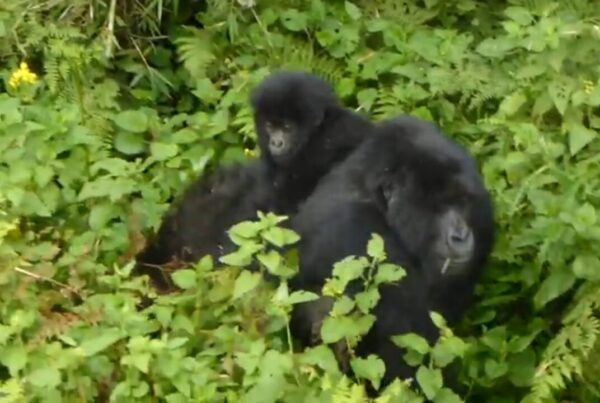
Based on what is known about gorilla perception and habituation, the encounter from the gorilla’s perspective is specific. Visual perception: gorillas are highly visual animals; colour vision comparable to humans; they see the trekking group in colour and detail at the 7-metre minimum distance at Bwindi. Individual recognition: habituated gorillas at Bwindi have lived with human ranger presence for years; they likely distinguish individual rangers from unfamiliar visitors; the trekking group is perceived as a known and safe category of presence rather than a threat. Social reading: gorillas are attuned to body language and posture; the trekking group’s behaviour — small, stationary, non-threatening posture — communicates something to the gorilla’s social cognition system; it is assessed and categorised. Curiosity: juvenile gorillas at Bwindi reliably approach visitors closer than adults do; this exploratory curiosity is not fear-based and suggests the group is perceived as interesting rather than threatening.
Why does the gorilla encounter feel like a mutual event rather than just observation?
The feeling of mutuality has a real basis. Attention is bidirectional: at Bwindi, the gorillas are aware of the human group throughout the 60 minutes; they are not ignoring the visitors while being observed; there is genuine attention in both directions. Social cognition operates: both the gorilla and the human are using social cognition systems to read each other; the feeling of being seen is not projection — the gorilla’s social brain is actively processing the human group. Evolutionary resonance: 6 million years of separate evolution from a common ancestor means the encounter carries an evolutionary recognition — the similarity is real, not imagined; the 98.3% DNA figure means the social signals of one species are partially legible to the other. No mediation: the encounter at Bwindi is unmediated by vehicle, glass, or distance — the gorilla and the visitor are in the same physical space in the forest.
What makes mountain gorillas different from other great apes to encounter in the wild?
The four great apes available for wildlife encounters have different qualities in the field. Chimpanzee: most closely related to humans (98.7% DNA); found in Uganda at Kibale Forest; more mobile and faster than gorillas; the encounter is more viscerally exciting but less sustained — chimps move and the group follows; less settled social atmosphere. Orangutan: Borneo and Sumatra; more arboreal — encounters are typically at distance in tree canopy; solitary lifestyle gives no family dynamic to observe; genuinely remarkable but structurally different encounter. Bonobo: DRC only; political access constraints make encountering them in the wild very difficult for most visitors. Mountain gorilla: Bwindi encounter is most settled and intimate; the family group stays together in the same area during the hour; the social structure is visible over the full 60 minutes; no zoo equivalent; this is why most wildlife travellers rank it as the definitive primate encounter.
How can I prepare mentally for the gorilla encounter at Bwindi?
Mental preparation improves the encounter quality in specific ways. Expectation management: do not expect a dramatic moment that announces itself — most trekkers report the encounter begins quietly and the significance accumulates; what you remember is rarely one moment but the quality of the 60 minutes as a whole. The gorilla’s agency: approaching the encounter with awareness that the gorilla is a social agent that sees you (not merely an animal you are observing) changes the texture of the experience. Silence: the briefing before the trek covers protocol; follow it; whispered communication only; the silence allows you to hear the gorillas and the forest. The present: the hour passes faster than any other hour for virtually every visitor; photography is valuable but not at the cost of the experience itself; put the camera down for part of the time and just observe. See 30 things to know and common mistakes.
- What the Gorilla Saw When It Looked at You: A Philosophical Reflection
- Blackback Gorilla Size: The Overlooked Power of Gorilla Adolescence
- The Moment a Silverback Looked Me in the Eye: Nothing Prepared Me for This
- What 30 Years of Mountain Gorilla Conservation Looked Like on the Ground
- The Trip That Made Me Stop Complaining: A Gorilla Trekking Reflection
- What gorilla trekking teaches about impermanence: the philosophical encounter