Updated
what gorilla sees looks at human Uganda trek is a subject central to Uganda’s wildlife tourism, where mountain gorilla conservation and responsible visitor experiences go hand in hand. The question is rarely asked in this direction — gorilla trekking literature is full of accounts of what visitors see when they look at the gorillas: the intelligence, the family structure, the physical presence, the eyes that seem to understand, but the reverse question — what did the gorilla see when it looked at you — is worth sitting with honestly, because it opens into something about the nature of the encounter that the usual framing does not reach. Explore the Bwindi gorilla trekking experience and read why this encounter matters for conservation. Plan your 7-day Uganda gorilla safari and book a gorilla trekking permit.
- Brain size: approximately 500cc — about a third of the human brain’s 1,350cc average; but relative to body size the ratio is comparable; gorilla brains have the same structures associated with social cognition and emotion as human brains
- Theory of mind: gorillas show evidence of understanding that others have different knowledge to themselves — a basic form of “theory of mind” documented in captive studies
- Recognition: habituated gorillas recognise individual humans; research at Bwindi and Volcanoes NP documents gorillas reacting differently to familiar researchers versus new visitors
- Emotional range: gorillas show documented expressions of grief, playfulness, fear, anger, and what researchers tentatively call affection; these are observed, not inferred
The question is rarely asked in this direction. Gorilla trekking literature is full of accounts of what visitors see when they look at the gorillas: the intelligence, the family structure, the physical presence, the eyes that seem to understand. The reverse question — what did the gorilla see when it looked at me? — receives less attention. It deserves more. Because the answer to that question, considered honestly, contains something more useful than the more familiar direction of the encounter.
What the Gorilla Saw When It Looked at You: A Philosophical Reflection
What a Gorilla’s Perceptual System Registers
Mountain gorillas have excellent colour vision comparable to humans, good hearing across a similar frequency range, and a highly developed olfactory sense that provides information about emotional states, health conditions, and individual identity that human observers are not aware of providing. When a gorilla looks at a visitor to Bwindi, it is receiving information through multiple channels simultaneously.
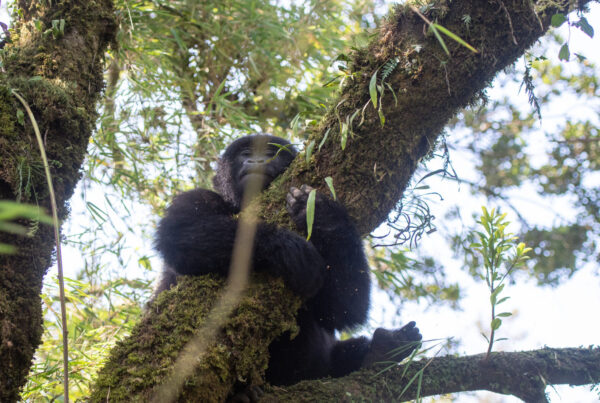
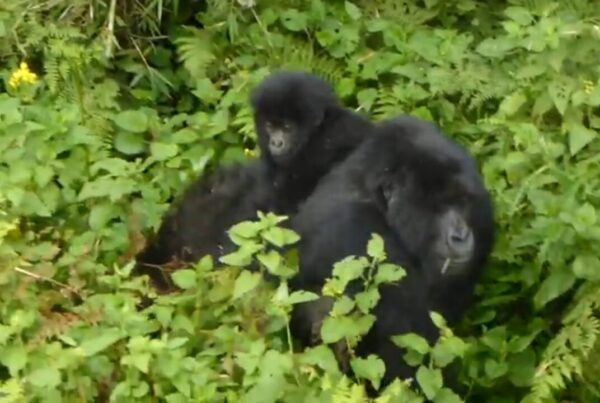
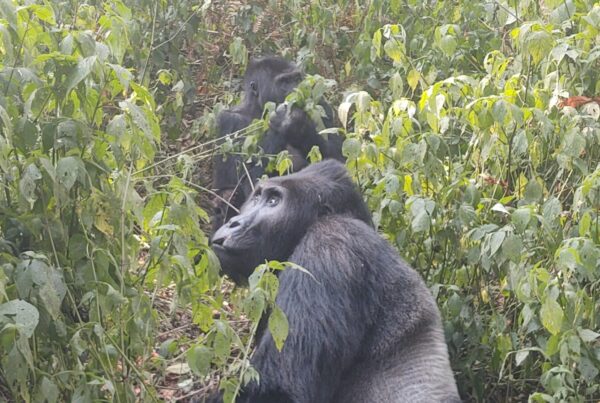
What the gorilla registers visually: a bipedal great ape of moderate size, moving carefully, breathing audibly, emitting the specific olfactory signature of a human being who is mildly stressed (most gorilla trekkers are, at least initially). The gorilla sees the face-forward binocular vision arrangement that marks all great apes, the relative hairlessness that distinguishes humans, the unusual clothing that has no natural equivalent in the forest. The gestalt impression, based on years of daily contact with groups of eight humans, is: familiar category, non-threatening, no action required.
What the Gorilla’s Assessment Tells You About Yourself
Being assessed by another animal and found familiar but uninteresting is an unusual position for most humans to occupy. We are accustomed to being the observer, the assessor, the creature who categorises and evaluates rather than being categorised and evaluated. The gorilla’s assessment reverses this position. For a moment, you are the object of another intelligence’s perception rather than its subject.
What this reversal reveals is simultaneously deflating and liberating. Deflating: you are not particularly interesting to the gorilla. You are a familiar kind of visitor in a familiar category — recognisably related, certainly, but not a subject of deep curiosity. You are not, from the gorilla’s perspective, the apex of anything in particular. You are a variant of great ape, the bipedal one, present in groups of eight for limited periods before disappearing. Liberating: you do not need to be particularly interesting to the gorilla for the encounter to matter. Your significance is not conditional on the gorilla’s interest.
The Ethics of the Encounter
The question of what the gorilla sees when it looks at you also raises the ethical dimension of gorilla tourism more acutely than the more common question of what you see when you look at the gorilla. You are visiting the gorilla’s home, in a regulated encounter that the Uganda Wildlife Authority has structured to minimise disruption to the gorilla family while maximising the visitor experience. The gorilla’s tolerance of your presence is not freely given — it is the product of a long habituation process in which the gorillas were gradually conditioned to accept human visitors.
This conditioning raises genuine ethical questions that conservationists continue to debate. The habituated gorillas are more vulnerable to human disease transmission than unhabituated gorillas. Their home range patterns may be influenced by the daily presence of visitors and trackers. The benefits — the permit revenue that funds conservation, the community benefit-sharing, the international attention to gorilla protection — are primarily benefits to humans and to the gorilla population as a whole, not necessarily to the specific family you visit.
Holding this ethical complexity alongside the extraordinary quality of the encounter is what responsible gorilla trekking requires. You are not simply purchasing access to a wildlife experience. You are participating in a conservation system that has made difficult tradeoffs to produce an outcome — a growing gorilla population, a protected forest, communities with economic stakes in conservation — that is, by most measures, genuinely good. The gorilla that looks at you in 2027 exists in part because people like you have been paying $800 to look back. That mutual looking — imperfect, ethically complex, and extraordinary — is the thing the permit provides.
Contact us to book your 2027 permit and have the encounter that looks both ways.
Do gorillas recognise individual humans?
Research at habituated gorilla study sites including Bwindi confirms individual recognition. Familiar researchers: gorillas at long-term study sites behave differently toward researchers they have seen many times compared to new visitors; they are calmer and more relaxed with familiar humans; this is individual recognition. Study methods: controlled experiments are difficult with wild gorillas; the evidence comes from systematic observation over years by researchers who maintained consistent presence; the behavioural differences are clear enough to be reproducible. What this means for trekking: the gorillas at Bwindi’s habituated groups may not remember you specifically — your single visit is one of hundreds they have experienced — but they are processing you as an individual stimulus, not as a category; the gorilla looking at you is looking at a specific entity, not just “human.”
What is a gorilla actually experiencing during the tourist encounter?
This is genuinely uncertain and that uncertainty is part of the interest of the question. Habituation effect: a fully habituated gorilla — one that has experienced human contact regularly for years — typically treats a tourist group as a neutral stimulus; neither interesting nor threatening; the gorilla continues its normal activities much as you might continue reading if a car drove past. Variation: young gorillas are more likely to investigate visitors; juveniles will approach closer and watch longer; adults are typically indifferent after the first scan. The silverback: the dominant male monitors the group throughout the visit; he positions himself between visitors and the rest of his family; this is not aggression but protective positioning; from his perspective the human group is a known, tolerated presence within his territory. The unknown: whether gorillas experience anything like curiosity, interest, or recognition toward tourist groups is not answerable with certainty; we know they habituate; we do not know what they experience.
Can gorillas understand what humans are saying?
Wild gorillas do not understand human language in the way this question implies. Captive studies: Koko the gorilla, born 1971, was taught American Sign Language by researcher Francine Patterson; Koko developed a vocabulary of approximately 1,000 signs; she combined signs in novel ways to describe new situations; these results are debated in terms of what they demonstrate about language comprehension. Wild gorillas: wild gorillas do not learn language; they recognise tone of voice in the same way a dog would; a calm, quiet human voice is processed differently from a loud, sudden one. At Bwindi: guides speak quietly to gorillas during encounters; the gorillas respond to tone and volume not words; a ranger saying “stay still” calmly conveys “calm situation” not the semantic meaning; a sudden shout triggers alarm regardless of content. The useful conclusion: on your gorilla trek, whispering and moving slowly are the meaningful signals, not what you say.
Is it ethical to visit and watch gorillas as a tourist?
This question is taken seriously by conservation biologists and the evidence supports a qualified yes. The disease risk: the genuine ethical concern is disease transmission; gorillas can catch human respiratory viruses and these can be fatal; the 7-metre rule, mask requirements for sick visitors, and permit limits (8 per group) are evidence-based mitigations. The conservation benefit: permit revenue funds the rangers who protect Bwindi; 20% goes directly to adjacent communities; the economic argument for keeping forests intact depends on tourism revenue being real; without visitors, the economic case for conservation weakens. The population trend: mountain gorilla numbers have increased while tourism has operated — from 254 in 1981 to 1,063 in 2018; the correlation is not coincidental. Ethical tourism practice: book through a registered Uganda operator; respect the rules; do not visit if you are ill; these choices make the ethical case clear.
What does science say about gorilla self-awareness?
Gorilla self-awareness is documented in controlled research. Mirror test: the mirror self-recognition test requires an animal to recognise itself in a mirror rather than treating the reflection as another animal; great apes — gorillas, chimpanzees, orangutans, bonobos — all pass this test; gorillas passed initially in some studies but results were more variable than for chimps and orangutans. Social awareness: gorillas clearly understand social rank; they adjust their behaviour based on who is watching; this implies an awareness of others’ perspective — a component of self-awareness. Individual recognition: gorillas recognise individual group members and treat them differently based on history; a gorilla that was attacked by a specific individual years earlier treats that individual differently; this requires a sense of self that persists through time. The encounter at Bwindi: standing in front of a mountain gorilla that is self-aware enough to recognise individuals, understand rank, and adjust behaviour based on experience is not like watching a fish or an insect — it is an encounter across the border of the self-aware.
- What the Gorilla Saw When It Looked at You: A Philosophical Reflection
- Blackback Gorilla Size: The Overlooked Power of Gorilla Adolescence
- The Moment a Silverback Looked Me in the Eye: Nothing Prepared Me for This
- What 30 Years of Mountain Gorilla Conservation Looked Like on the Ground
- The Trip That Made Me Stop Complaining: A Gorilla Trekking Reflection
- What gorilla trekking teaches about impermanence: the philosophical encounter