Updated
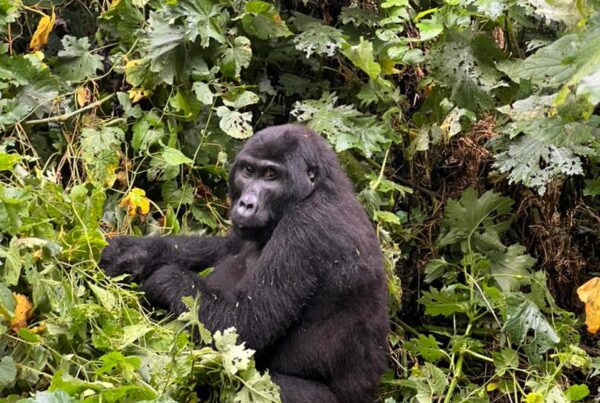
gorilla trekking mindfulness impermanence is one of Africa’s most extraordinary wildlife experiences, connecting travellers with mountain gorillas in their natural forest habitat. Mountain gorilla populations are finite and fragile. The animals you encounter on a Bwindi trek are members of one of the smallest populations of any great ape — just over 1,000 individuals distributed across two populations separated by hundreds of kilometres. Each of the habituated families has been carefully studied for decades, and the researchers and rangers who work with them have watched births, deaths, infant losses, silverback succession, and the slow generational turnover of animals they have known individually for much of their working lives. This context — of a population persisting at the edge of viable numbers, its history traceable in individual lives and deaths across the human researchers’ own careers — gives the gorilla encounter a temporal dimension that most wildlife tourism cannot offer.
What gorilla trekking teaches about impermanence: the philosophical encounter
The hour as a frame
The one-hour gorilla encounter is unusual in tourism and unusual in human experience: a defined, bounded period of time with a specific start (when the guide says you have found the family) and a specific end (when the sixty minutes expire and the group withdraws from the gorillas’ vicinity). This temporal framing, rather than detracting from the experience, intensifies it. You know, from the moment the encounter begins, that it will end at a specific time. This knowledge creates a quality of attention — a refusal to let the time slip unfocused — that open-ended experiences do not produce.
Buddhist meditation traditions speak of the value of impermanence awareness — the practice of perceiving things clearly precisely because you understand their transience. The gorilla hour is an involuntary version of this practice: the time limit is externally imposed, but its effect is the same as the deliberate cultivation of transience awareness. The animals in front of you are real, present, and unrepeatable in this particular moment in this particular configuration. The quality of your attention to them is shaped by knowing that you will not be there an hour from now, and they will continue their day without you.
Watching animals live without concern for tomorrow
The gorilla family in front of you has no awareness of the conservation crisis that defines their situation in the human frame of reference. The silverback does not know that his species numbers just over 1,000. The infant does not understand that its existence depends on international conservation funding, ranger patrols, and the continued willingness of foreign visitors to pay USD 800 for the permit that brought you here. They exist entirely in the present, in their immediate social world of family relationships, food availability, and the daily rhythms of forest life.
This contrast between the gorilla’s complete present-moment existence and the human visitor’s awareness of the broader endangered-species context is philosophically interesting in a way that is not merely academic. The gorillas’ indifference to their conservation situation is not ignorance but a different mode of being — one that has nothing to learn from the temporal anxiety that humans bring to the encounter. Watching them can produce something like envy: not for their specific lives, but for the quality of settled presence with which they inhabit those lives.
Grief and conservation
Some trekkers leave the gorilla hour in a state that they can only describe as grief — not for a specific loss, but as a response to the encounter with something extraordinary and threatened. This is not an unusual psychological response to proximity with an endangered species. The combination of beauty, intelligence, social complexity, evolutionary kinship, and fragility that the mountain gorilla encounter presents simultaneously activates both the aesthetic and the moral dimensions of human emotional response in a way that most wildlife encounters do not achieve.
The environmental psychologist Glenn Albrecht has coined the term solastalgia — the distress produced by environmental change in one’s home environment — and its close relative eco-anxiety — anxiety about the state and future of the natural world. Gorilla trekking visitors do not typically arrive carrying these named conditions, but the encounter with an endangered species in its habitat can activate something adjacent to them: an acute awareness of what the world is at risk of losing, experienced not abstractly but through a specific set of eyes that met yours across seven metres of forest understorey.
This emotional response, uncomfortable as it sometimes is, is functionally important. It is the emotional substrate on which conservation action is built. People who feel the threat to mountain gorillas viscerally — not as a statistic but as an emotional reality grounded in a specific encounter — are the people most likely to donate, advocate, vote, and change behaviour in ways that serve conservation over the long term. The grief response to the gorilla encounter is not a problem to be managed but evidence that the experience is doing its deepest work.
Returning home
The transition back to ordinary life after a gorilla trek — the flight from Entebbe, the return to the home city, the first morning at the desk or in the kitchen without the sound of the forest — is often described by trekkers as one of the more jarring re-entries they have experienced after any travel. The contrast between the gorilla’s world and the world of commutes, screens, and constructed environments is not merely scenic but existential: you have been, for a few days, in a place where the hierarchy of what matters is different, and returning to the ordinary hierarchy requires a kind of adjustment that takes longer than the jet lag.
Allowing this adjustment to be slow — not rushing to normalise the experience by filing it under “great holiday” and moving on — preserves the possibility that it will continue to do work in your life long after the photographs have been sorted and the thank-you emails sent to the guide. The gorilla encounter is not merely a memory but a reference point — a reminder, available on any occasion of distraction or mispriority, of what the world contains and what it would mean to lose it.
- 3 Days Congo Gorilla Trekking Safari: Raw Encounters in Africa’s Wildest Jungle
- What Should I Not Do When Gorilla Trekking? 10 Critical Rules for a Safe Encounter
- What Is Mountain Gorilla Habituation Experience in Uganda? The Ultimate Primate Encounter
- Best Wildlife Encounters on Earth: Why Gorilla Trekking Makes Every List
- What 1 Hour With Mountain Gorillas Teaches You About Being Human
- 10 Wildlife Encounters That Compete With Gorillas: None Win
- The Guardian Called Uganda Gorilla Trekking the World’s Greatest Wildlife Encounter
- Why Gorilla Trekking Beats Every Other Wildlife Encounter on Earth
- The Only Animal Encounter That Competes With Gorilla Trekking: Orangutans
- 15 Bucket List Wildlife Encounters: Where Gorilla Trekking Ranks