Updated
silverback gorilla eye contact Bwindi trekking is a subject central to Uganda’s wildlife tourism, where mountain gorilla conservation and responsible visitor experiences go hand in hand. The moment a silverback gorilla looked me in the eye, I understood something about power and peace that I cannot fully articulate even now. Nothing — not the documentaries, not the photographs, not the briefings from guides who have spent decades in these forests — nothing prepared me for what it felt like when Mubare, the dominant silverback of one of Bwindi’s habituated families, turned his head and looked directly at me.
The Moment a Silverback Looked Me in the Eye: Nothing Prepared Me for This
How You Prepare for Gorilla Trekking
You read everything you can find. You watch videos. You buy the right boots and the right rain layer and a camera lens that your bank account did not appreciate. You attend the morning briefing at the park headquarters and listen carefully while a ranger explains, with the patience of someone who has delivered this same talk hundreds of times, the rules of engagement with mountain gorillas.
Stay seven metres back. Do not make direct eye contact with the silverback — it reads as a challenge. Do not run if he charges. Crouch, look away, and trust that the guide knows what they are doing.
I nodded and took notes and believed, sincerely, that I was prepared.
The Trek to the Mubare Family
We set off at eight in the morning from Buhoma, nine trekkers and two guides and four armed rangers. The forest closes around you quickly — within minutes of leaving the briefing area, the path has narrowed to a single track through undergrowth that seems designed to grab ankles and steal hats.
The Climb
Bwindi means “impenetrable” in the local language, and the name is earned. The terrain is steep, wet, and indifferent to the ambitions of tourists. We climbed for nearly three hours. I was carrying a daypack, had a porter for my camera bag, and was still completely exhausted by the time the lead guide raised his hand to stop us.
Contact
The trackers had found the Mubare family half an hour earlier and had been watching quietly while we caught up. Through the trees, I could hear the sounds of the family — a low rumble that I felt more than heard, the crack of branches, the soft percussion of knuckles on earth as a juvenile moved through the undergrowth.
Entering the Presence of Mountain Gorillas
We spread out as instructed, keeping low, cameras ready. The first gorilla I saw clearly was a female, sitting perhaps six metres away, eating leaves with the steady focus of someone who has important work to do. She glanced at us once and returned to her breakfast.
The Family at Rest
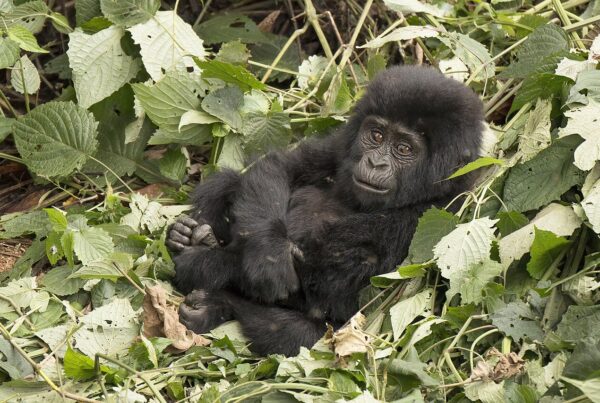
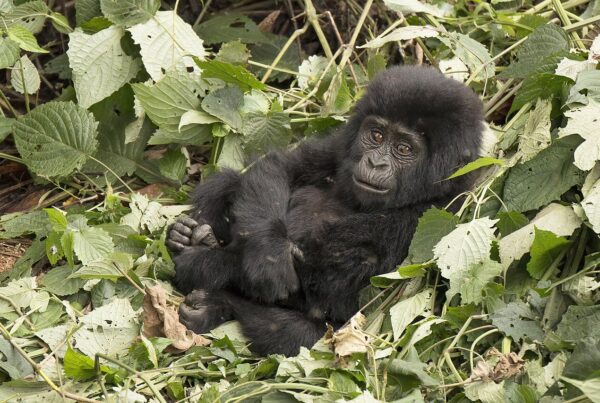
The Mubare family had settled in a natural clearing. Juveniles were playing in the undergrowth. An infant was nursing. Two adult females were grooming each other with the concentrated attention of people who have not checked their phones in weeks. It was, in every sense, an ordinary morning for them.
Where Was Mubare?
For the first twenty minutes, I could not locate the silverback. The guides moved us carefully around the perimeter of the family group, and I was so absorbed in watching the juveniles that I had temporarily forgotten the 200-kilogram patriarch somewhere nearby.
When Mubare Looked at Me
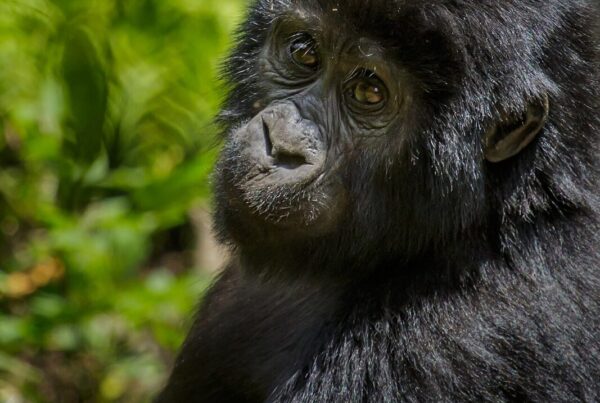
He was sitting behind a stand of vegetation, eating. I had not seen him until the guide touched my arm and pointed. Mubare was perhaps five metres away. He was immense — his back a broad silver plane, his arms as thick as my torso, his face an arrangement of features that somehow managed to convey simultaneously great age, great authority, and profound calm.
I raised my camera. He shifted slightly. And then he looked directly at me.
What I Had Been Told Not to Do
The briefing had been explicit: do not make direct eye contact with the silverback. It reads as challenge, as aggression, as a very bad idea. When Mubare’s gaze met mine, the correct response was to look away. To crouch lower. To avert my eyes and defer to his authority in his forest.
What Actually Happened
I could not look away. Not for several seconds. I was aware, distantly, that I was breaking every protocol I had been given. But Mubare was looking at me with an expression that I can only describe as curiosity without anxiety — a calm assessment of the strange creature crouching in front of him — and I found myself completely incapable of dropping my gaze.
After perhaps four seconds — an eternity in silverback terms — I looked down. My heart was hammering in a way that had nothing to do with fear. Mubare made a low sound, shifted his weight, and returned to eating.
The guide exhaled beside me. Later he would say: “You were lucky. Mubare is very settled.” He did not add what he might have — that the outcome could have been different with a less habituated animal or a less experienced guide.
What That Moment Contained
I have thought about those four seconds many times. What made them so overwhelming was not danger — though the potential for it was present. It was recognition.
The Closest Living Relative
Mountain gorillas share 98.3% of their DNA with humans. In those four seconds, looking into eyes that contained something ancient and aware and completely indifferent to my human concerns, that statistic became real in a way it had never been from a book or a screen.
The Weight of Rarity
There are just over 1,000 mountain gorillas left on Earth. Mubare — silverback, patriarch, keeper of his family’s safety and cohesion — was one of them. The weight of that rarity was present in the gaze in a way I cannot explain but will not forget.
The Rest of the Hour
We stayed for fifty-eight minutes after that moment. I watched Mubare eat, rest, and eventually rise to move deeper into the forest with a slow authority that made the trees seem like furniture. The family followed him in a loose procession. The last thing I saw before they disappeared was an infant riding on its mother’s back, looking back at us with eyes like polished stones.
Coming Back to the World
The walk back to the trailhead takes about an hour. Nobody in our group spoke much. This is common, the guides told us — people often need time to process what they have experienced before words become possible again.
Over lunch at the lodge, we started talking. Every person at the table had a different moment they had fixed on. For some it was the infant. For others it was the smell of the forest, or the sound of knuckles on earth. For me, it was those four seconds when Mubare looked me in the eye.
Why You Should Go
Gorilla trekking in Bwindi Impenetrable National Park is one of the few experiences that reliably exceeds expectation. Not because it is comfortable — it is not. Not because it is easy — it is not. But because it puts you in direct contact with something real and wild and irreplaceable in a world that has less and less of all three.
The permit costs $800. The trek can be hard. The preparation is worth doing carefully. And nothing — truly nothing — will prepare you for the moment a silverback looks you in the eye.
Contact Uganda Gorilla Trekking to book your permit and start planning. Mubare’s family is waiting, and they are entirely unimpressed by hesitation.