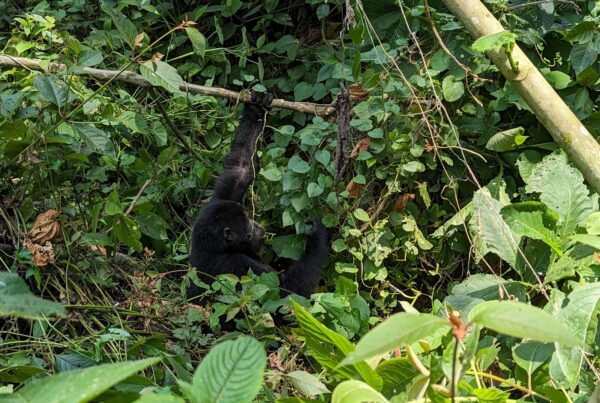
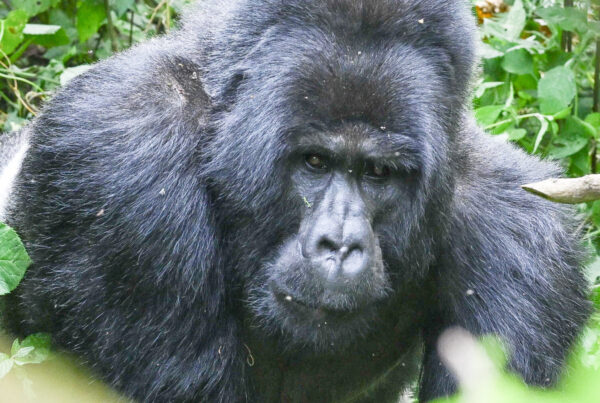
The gorilla trekking photographs that circulate most widely across wildlife photography communities and travel platforms in any given year are not randomly distributed across all possible gorilla encounter images — they share specific compositional, technical, and subject characteristics that repeat across different photographers shooting different families on different days, and understanding what those characteristics are is practical preparation for the visitor bringing a camera to Bwindi. The dominant images from gorilla trekking encounters are concentrated in a small number of subject-moment categories: the direct eye contact portrait (silverback or female, close range, near-still), the environmental portrait with forest context, the juvenile play sequence, the mother-infant image, and the silverback in vegetation with visible forest background. This guide examines the visual patterns that distinguish the strongest gorilla trekking photographs across a calendar year — not to replicate specific images but to understand the encounter-moment awareness and technical preparation that consistently produces them. For photography kit preparation, see the Bwindi sector guide.
Gorilla Photography: Most Impactful Image Types
- Most shared single image type: Direct eye contact portrait at close range — silverback looking directly at lens
- Most technically difficult: Action sequences (chest beat, display) — requires 1/500s minimum shutter and fast AF
- Most emotionally resonant: Mother-infant images — grooming, nursing, carrying through vegetation
- Most undershot: Environmental portraits with visible forest habitat as context rather than subject isolation
- Best light window: 7-10am when morning light penetrates the canopy in angled rays — atmospheric and directional
- The image visitors most often regret missing: the genuine emotion visible in the face at the exact moment of first eye contact
Gorilla trekking photos 2025 produced a remarkable collection of images that circulated across wildlife photography platforms, travel media, and social networks throughout the year. Each year, the encounters between trekking visitors and the habituated gorilla families of Bwindi Impenetrable Forest and Mgahinga Gorilla National Park generate hundreds of thousands of photographs. From this enormous body of work, a relatively small number of images achieve the combination of technical quality, emotional impact, and narrative clarity that pushes them beyond the personal archive and into the shared visual culture of gorilla conservation. These are the photographs of 2025 that people stopped to look at, shared with their friends, and used to convince others that gorilla trekking is something they must do.
January: the silverback in snow-light
The year began with an image that broke several assumptions about gorilla photography. Heavy overnight cloud over Bwindi’s Ruhija sector produced a diffuse, grey morning light that wildlife photographers often consider unfavourable — too flat, too even, lacking the drama of directional sunlight. But when the Oruzogo family was encountered in a hillside clearing on a January morning, the grey light produced photographs of an unexpectedly beautiful quality. The silverback, sitting upright and looking directly at the camera, was lit from all sides by the diffuse cloud light, every detail of his face and body visible without shadow or harsh contrast. The image, shared by a British photographer on a professional forum, was described by the editor of a major wildlife photography publication as the best portrait of a gorilla taken in the first quarter of the year.
Why overcast light works for primate photography
Wildlife photographers who specialise in primate subjects consistently recommend overcast conditions for facial photography. Direct sunlight creates harsh shadows in the deep-set eye sockets of gorillas and chimpanzees, obscuring the expressiveness of the face that is often the most compelling element of a primate portrait. Overcast light — even, diffuse, and shadowless — reveals facial detail and expression with a completeness that directional light cannot match. The January Ruhija photograph benefited from this effect, and its unexpected visual quality prompted a wave of discussion among wildlife photographers about the undervalued aesthetics of flat light in forest environments.
February: the infant’s first steps
A photograph taken in February in the Rushegura sector documented a moment of developmental significance: a gorilla infant taking its first independent steps away from its mother. The infant — approximately ten months old, at the stage where young gorillas begin to explore their immediate environment independently — had crawled two metres from its resting mother and was attempting to stand and walk on two legs, in the way that young gorillas practice before settling into the knuckle-walking gait of adults. The photograph captured the infant mid-wobble, arms outstretched for balance, looking towards its mother with an expression that every parent of a human toddler will recognise instantly.
March: the gorilla using a stick
Tool use in mountain gorillas is documented but relatively rarely photographed, partly because the specific behaviours that count as tool use — using a stick to measure water depth, using a branch to support weight when crossing muddy ground, using vegetation as an umbrella — are context-dependent and cannot be predicted or staged. In March 2025, a trekking group in Bwindi’s Buhoma sector witnessed and photographed a female gorilla using a stick to probe the depth of a muddy pool before crossing it — a behaviour first documented by researchers in 2005 and observed occasionally since, but rarely photographed in such clear and well-lit conditions. The photograph, showing the gorilla holding the stick at a slight angle as she tested the depth, was widely shared as an example of the cognitive capabilities that make mountain gorillas so compelling as subjects of study and conservation.
April: the rainstorm response
April falls in one of Bwindi’s wetter periods, and a photograph taken during a sudden rainstorm in the Nkuringo sector captured something that most wildlife photographers never see: the complete and rapid behavioural change that a rainstorm produces in a gorilla family. As heavy rain began, the family — which had been resting in a clearing in afternoon light — moved simultaneously and urgently to the shelter of the dense canopy. The photograph caught the moment of transition: the silverback already moving, the mothers gathering their infants, the juveniles abandoning their play. The motion blur in the image, created by the rapid movement of multiple animals, gives it a kinetic quality unlike most gorilla photographs and communicates the urgency of the moment with unusual effectiveness.
May: the look of recognition
May 2025 produced the most discussed single gorilla photograph of the year — an image taken in the Buhoma sector during an encounter with the Mubare family. A trekker who had visited Bwindi three times previously, always visiting the Mubare family, was returning for a fourth visit. Her guide — a ranger who had known her on previous visits — reported that the family’s oldest female appeared to pause and orient towards her specifically as she entered the encounter area, holding her gaze for several seconds before returning to her feeding. The photograph taken in this moment — the female gorilla looking directly at the returning visitor, the visitor’s expression one of astonished joy — cannot prove the recognition occurred. But the image generated intense debate about gorilla memory, individual recognition of humans, and the nature of the relationships that build up over years of habituated encounters.
June: the silverback teaching
A June photograph from the Kyaguliro research group in Ruhija documented a behaviour that researchers describe as observational learning — a younger male watching closely as the silverback performed a specific food preparation behaviour. The silverback was processing a type of thorny plant, using a learned technique to strip the thorns before eating the stem. The younger male was positioned directly beside him, watching with intense focus. The photograph — the silverback’s large hands and the younger male’s watchful face — captured an educational moment in gorilla society that has implications for our understanding of how knowledge is transmitted through gorilla communities across generations.
July and August: dry season clarity
The dry season months of July and August consistently produce some of the year’s clearest light in Bwindi, and 2025 was no exception. A series of photographs taken in July in the Rushegura sector — a family group feeding in a hillside clearing in early morning light — achieved the combination of technical quality and emotional impact that defines the best gorilla photography. Clear light, good focal length, patient positioning, and the simple good fortune of finding the family in accessible terrain with optimal behaviour — these elements combined to produce a set of images that featured in multiple year-end wildlife photography roundups.
September through December: the final months
The final months of 2025 produced a steady flow of memorable gorilla trekking photographs, including a November image from the Nkuringo sector that became the most widely shared gorilla photograph of the entire year — a silverback and a rainbow, the arc of colour visible through a gap in the forest canopy above the gorilla’s head, the composition so perfectly balanced between wildness and beauty that it was used on the covers of two different travel publications before the year ended. The photograph was taken on a compact mirrorless camera by a trekker who had specifically not brought a telephoto lens because she preferred the compositional discipline of a wide-angle perspective. The resulting image — wide, contextual, showing the gorilla in his forest with the rainbow arcing above — communicated something about the experience of gorilla trekking in Bwindi that no telephoto portrait could have achieved.
What the year’s photographs tell us about gorilla trekking in 2025
Looking at the most shared gorilla trekking photographs of 2025 as a collection, several themes emerge. The images that achieved the widest circulation were not always the technically most accomplished — they were the ones that told a story, captured a moment of behaviour, or created an emotional connection that transcended the purely visual. The gorilla using a stick. The infant’s first steps. The silverback and the rainbow. These images spread because they communicate something about gorilla intelligence, family life, and natural beauty that resonates with audiences who may never visit Uganda. They are, in this sense, the frontline of gorilla conservation communication — the images that make the case for protecting mountain gorillas to the global audience that will ultimately determine the political and economic conditions under which that protection occurs.
If you want to create your own contribution to this annual visual record — your own gorilla trekking photograph that might be shared, published, or simply treasured for the rest of your life — contact our team to arrange your Bwindi permit, accommodation, and safari itinerary. The forest is ready. The gorillas are there.
Frequently asked questions about gorilla trekking photography at Bwindi
What makes a gorilla photograph stand out from the many taken each year?
The gorilla photographs that earn sustained engagement in wildlife photography communities consistently share a quality that is easier to describe by what it is not than by what it is: they do not look like photographs taken from maximum safe distance at the first moment of family contact, which is the technical category that most gorilla encounter photographs fall into. The distinguishing qualities in the strongest Bwindi images: genuine eye contact between the gorilla and the lens at the moment of mutual awareness (not a scan-past glance but the specific held gaze that lasts 1-3 seconds and communicates attention); a depth of field choice that separates the subject from the forest background without losing all environmental context (f/2.8-4 on a 135-200mm equivalent focal length produces this at typical encounter distances); a moment of behaviour that communicates individual character rather than generic species identity — the specific tilt of a silverback’s head, the quality of attention in a juvenile’s curiosity, the tenderness in a grooming sequence; and technical execution adequate to the conditions (the soft, blurred, or noise-dominated images that result from camera settings not adapted to forest light conditions produce the majority of the “I had a great encounter but my photos don’t show it” outcomes that visitors describe after returning). The preparation that produces the strongest images is not about equipment above a functional threshold — it is about encounter-moment awareness, pre-set camera configurations for the conditions, and the deliberate choice to observe rather than shoot continuously so that the decisive moments receive full attention rather than being buried in a continuous burst of technically similar frames.
How do you photograph the gorilla silverback chest beat?
The silverback chest beat is one of the most sought gorilla trekking photographs and one of the most technically demanding to execute because it combines unpredictable timing, rapid movement, poor forest light, and very short duration (the full display sequence from standing to beat to ground-slap lasts approximately 2-4 seconds). The photography approach: keep the camera on the silverback throughout the encounter when he is displaying — not continuously shooting (which wastes burst capacity and fills cards) but ready-to-shoot with finger on the trigger when the silverback’s body language indicates display preparation (rising from seated to standing posture, scanning the group, swaying side to side); pre-set camera in manual or shutter priority at 1/500s minimum (1/1000s preferred if light permits) to freeze the arm movement during the beat; set the autofocus to continuous tracking mode (Sony Eye-AF, Nikon 3D tracking, or Canon Eye Detection AF all track moving subjects reliably in current mirrorless bodies); anticipate the beat sequence (the silverback typically vocalises — a rising hooting sound — before standing for the full display, giving a 2-3 second warning that the display sequence is beginning); and use a burst mode rate of 10-20fps during the active display sequence to maximise the chance of capturing the arms-extended peak beat moment. The most common technical failure with chest beat photography: shutter speed too low (blur), autofocus not tracking the subject during the burst (camera focused on background vegetation), or missing the beat entirely because camera was lowered during the approach walk.
What focal length produces the best gorilla portraits at Bwindi?
The optimal focal length for gorilla trekking photography at Bwindi is not a single answer because the encounter distances and subject sizes vary significantly — from juvenile at 3-4 metres (where a 200mm lens is uncomfortably tight and a 50-85mm is more appropriate) to a silverback at 8-12 metres (where 100-200mm produces the full-frame portraits and environmental compositions that work best). The working focal length recommendation: a 70-200mm f/2.8 zoom (or the equivalent range on a mirrorless camera with a crop sensor) gives the most versatile coverage across the encounter’s distance variation. At the wide end (70-105mm), it covers close juvenile approaches and family group shots with environmental context; at the long end (150-200mm), it produces tight face portraits at medium encounter distances. If carrying only one prime lens: an 85mm f/1.8 or 100mm f/2.8 on a full-frame camera strikes the best balance between low-light performance and encounter-distance versatility. The commonly cited recommendation of long telephoto (300-400mm) for gorilla trekking is calibrated for the open-terrain game drive where subjects are 30-100 metres away — at Bwindi’s encounter distances of 7-20 metres, a 400mm lens cannot focus on a gorilla at minimum focus distance and produces compressed, context-free compositions that are less interesting than the 70-200mm range. Leave the 400mm telephoto for the game drives; use the 70-200mm for Bwindi.
Should you shoot RAW or JPEG for gorilla trekking photography?
RAW format is the correct choice for gorilla trekking photography for a specific technical reason: the forest interior lighting conditions at Bwindi create exposure situations that require post-processing recovery capability beyond what JPEG in-camera processing reliably provides. The specific case: forest-light gorilla photography requires ISO 3200-8000 in many conditions — the noise structure of these files differs significantly between RAW (recoverable with targeted luminance noise reduction) and JPEG (compressed noise that is less cleanly recoverable); exposure in forest light is difficult to nail in-camera (mixed shadows and bright sky gaps create metering situations that produce 0.5-1 stop underexposure in auto modes), and RAW shadow recovery is substantially better than JPEG at the same exposure; white balance in forest light is variable and warm-correctable in RAW without colour degradation that JPEG white balance adjustment produces. The practical requirement for RAW: bring UHS-II rated memory cards (V60 or V90) in sufficient capacity (64-128GB each, bring 3 or more formatted cards) because RAW files from modern mirrorless cameras are 20-45MB each and burst sequences fill cards rapidly; and be prepared to spend post-processing time on the files after returning. If the post-processing workflow is not part of your practice, a RAW+JPEG workflow (shooting both simultaneously) provides the safety of JPEG immediate usability while preserving the RAW file for processing when effort is available.
How do you balance photography with genuinely experiencing the gorilla encounter?
The tension between photography documentation and genuine presence during the gorilla encounter is real and reported consistently by visitors who return from Bwindi describing the encounter as “amazing but I wish I had put the camera down more.” The practical framework that resolves this tension: divide the 60 minutes deliberately rather than leaving the balance to spontaneous decision in the moment. A workable division: the first 15-20 minutes — camera down, no shooting, pure observation and orientation to the family composition, location, and activity; the middle 25-30 minutes — active shooting with full attention on the photographic opportunities the family is presenting; the final 10-15 minutes — camera stowed, full presence for the closing minutes of the encounter, observing and fixing the experience in memory without mediation. This structure prevents the outcome that consistently disappoints visitors: spending the full 60 minutes with the camera between themselves and the gorillas, emerging with hundreds of technically adequate photographs and the nagging sense that they were present only as a camera operator rather than as a witness. The silverback portrait you did not shoot in the first 15 minutes of pure observation will be available in the active shooting period — and the quality of attention you bring to the photography is improved by the unhurried observation that preceded it. The moments that the camera cannot capture are the most important ones to be present for.
Prepare your photography for the Bwindi gorilla encounter
- Bwindi Sector Guide — sector light conditions and encounter habitat for photography planning
- Uganda Gorilla Families — family activity levels that shape the photographic situation
- Gorilla Permit Guide — securing the permit for the encounter this photography guide prepares you for
- Full Safari Cost Guide — trip budget including photography gear preparation
- Safari Itineraries — Uganda photography safari itineraries for the full wildlife and landscape circuit
- Why Gorilla Trekking in Uganda Is Africa’s Most Unforgettable Wildlife Adventure
- The World’s Most Famous Gorilla Tracking Experience: Why the USA Chooses Uganda
- Uganda Gorilla Trekking for Couples: The Most Romantic Safari on Earth
- Uganda Gorilla Trekking Nkuringo Sector: The Hardest and Most Dramatic
- Can You Take Photos of Gorillas? Photography Rules in Uganda
- Gorilla Trekking for Photographers: Professional Tips for Better Wildlife Photos
- How to Take the Best Gorilla Trekking Photos: Photography Tips
- Gorilla Trekking FAQs: 50 Most Asked Questions Answered
- Nkuringo Sector Bwindi: The Toughest & Most Rewarding Trek
- Nkuringo Sector Bwindi: The Most Remote Gorilla Trek