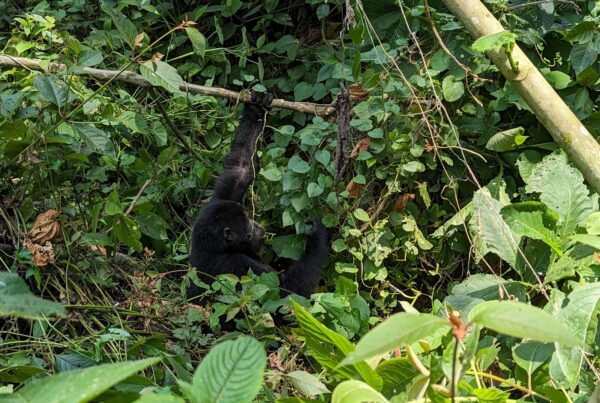
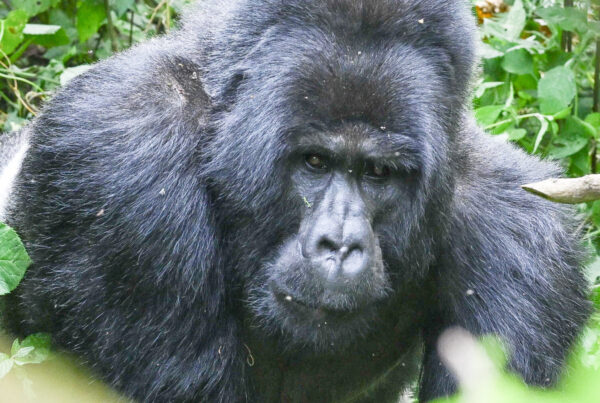
The gorilla trek photographs circulating across wildlife travel platforms — the silverback portrait, the mother-infant nursing image, the juvenile playing in the tree — are accurate representations of what the encounter produces visually, but they are not a complete representation of what the gorilla trek experience produces: the sweat, the silence, the muscle burn, the particular smell of the highland forest in the morning, the tracker calling ahead in a frequency that means “gorillas found,” the moment when you first hear breathing that is not your own. These 12 things happen on almost every gorilla trek and almost never appear in the brochure, the social media grid, or the trip report — not because they are bad (most of them are among the best parts) but because they are the texture of the experience rather than the image of it, and texture requires being there rather than looking at a screen. This account is for visitors who want to know what the Bwindi trek is actually like before they arrive.
The Gorilla Trek: What Actually Happens
- Duration: 2-8 hours total including approach trek, encounter, and return — not just the 60-minute encounter
- Physical reality: Steep, slippery, root-covered terrain at altitude — this is real hiking, not a walk
- Porter: Available at the gate for ~USD 15 — one of the best investments on the trek day
- Ranger instruction: The guide’s directions during the encounter override all other priorities including photography
- Encounter format: 8 visitors maximum per family, 60 minutes with the family, then immediate departure
- Noise: the forest is loud — birds, insects, the wind in the canopy — and the gorillas add to it, not silence it
The gorilla trek experience produces some of the most spectacular wildlife photographs in Africa — but the images that circulate in tourism materials and social media represent a carefully curated fraction of what actually happens during a gorilla trek. The photographs show clear light, relaxed gorillas, composed trekkers, and intimate encounters. What they do not show is the mud, the effort, the discomfort, the waiting, the confusion, and the unexpected moments of absurdity and grace that make a real gorilla trek so much more interesting and memorable than the photographs suggest. Here are 12 things that routinely happen on gorilla treks that nobody bothers to document.
1. The mud
Bwindi Impenetrable Forest is a mountain rainforest that receives rainfall throughout the year. Even in the dry season, the forest floor is moist, and after rain — which can arrive at any time — sections of the trail become deeply muddy. Photographs rarely show the mud because photographers are understandably focused on the gorillas, but every experienced gorilla guide’s memories of the trek are partly organised around mud. The slip on a muddy slope that is broken by a ranger’s steadying arm. The moment a boot is pulled off by suction and a foot goes into the forest floor in its sock. The section of trail that is navigable only by stepping on exposed roots because the path itself is indistinguishable from the surrounding swamp.
Proper footwear matters more than anything
Guides consistently rank inappropriate footwear as the single most common source of avoidable difficulty on gorilla treks. Trekkers who arrive in lightweight trail shoes or, worse, trainers without ankle support, are disadvantaged before they begin. The forest terrain in Bwindi is steep, uneven, and — as described above — frequently wet. High-sided hiking boots with good grip and ankle support are not optional equipment. They are the difference between an uncomfortable and a comfortable trek.
2. The waiting at the briefing
Every gorilla trek begins with a briefing at the park gate. Trekking groups assemble, permits are checked, the rules are explained, and the ranger describes what the group is likely to encounter. This briefing, which takes 20 to 30 minutes, is essential — it is the trekkers’ orientation to the experience and the ranger’s opportunity to establish the behavioural protocols that keep both visitors and gorillas safe. But for the first-time visitor who has been building towards this moment for months, the briefing can feel interminable. The anticipation, the waiting, the administrative formality — none of this appears in gorilla trekking photographs, but it is as real a part of the experience as the encounter itself.
3. Getting lost from the group for 45 seconds
In the dense vegetation of Bwindi, it is entirely possible to turn around for a moment — to adjust a camera setting, to drink from a water bottle, to recover your footing after a slip — and find that the group has moved on and is no longer visible. For most trekkers, this experience lasts less than a minute before the sounds of the group are located again and the gap is closed. But the 45 seconds of genuine disorientation in the forest — the realisation of how completely the vegetation closes around you, how quickly silence falls — is one of the most memorable moments of the trek for many visitors, and one that never appears in the photographs.
4. The ranger’s radio crackling with updates from the trackers
Throughout the trek, the lead ranger receives radio updates from the team of trackers who have been with the gorilla family since before dawn. These radio messages — often in rapid Rukiga or a mixture of local language and English — update the ranger on the family’s current location, direction of movement, and activity status. The crackle of the radio in the silence of the forest, the ranger’s brief responses, the adjustment of the group’s route in response to new information — all of this is part of the trekking experience that the photographs cannot capture. The radio communications represent the logistical infrastructure that makes the gorilla encounter reliable.
5. The porter carrying your daypack
Uganda Wildlife Authority employs local community members as porters who carry trekkers’ daypacks for a small additional fee. The porter service — offered at the gate before the trek begins — is used by a minority of visitors but makes a significant difference to the comfort of the trek for anyone with a heavy camera bag, a medical condition that limits their carrying capacity, or simply a preference for having both hands free during the encounter. Photographs rarely show the porter, who tends to stay slightly back from the group during the encounter itself. But the conversations between trekkers and their porters during the walk — the local knowledge shared, the stories exchanged — are among the most valued human interactions of the entire Uganda experience for many visitors.
6. The stinging nettles
Bwindi Impenetrable Forest contains extensive stands of stinging nettles — a plant that gorillas eat enthusiastically and that human visitors encounter with considerably less enthusiasm. Guides point out nettles before trekkers reach them and advise on how to move through them with minimum contact. Despite this preparation, every trekker who has pushed through a stand of Bwindi nettles has a story about the experience. Gloves help. Long sleeves and trousers help. But at some point in almost every trek, contact with the nettles is unavoidable, and the sharp sting on unprotected skin is a sensory memory that trekkers carry home along with their photographs.
7. The smell of the forest
Bwindi Impenetrable Forest has a smell that every trekker remembers and almost nobody can describe adequately. It is rich, damp, complex — soil and vegetation and the particular freshness of ancient forest in a way that is entirely unlike the smell of gardens, parks, or managed woodland. When the gorillas are nearby, there is an additional smell — not unpleasant, but distinctive and animal and immediate — that adds to the sensory experience of the encounter. Photographs cannot capture smell. This is one of the fundamental limitations of the photographic record of gorilla trekking, and one of the strongest arguments for experiencing the encounter in person.
8. The moment everyone tries to move quietly and fails
Gorilla trekking rules require silence in the presence of the gorillas, and every trekking group intends to comply with this instruction completely. Reality is somewhat different. Cameras click, boots slide on wet leaves, someone’s jacket rustles at exactly the wrong moment, a water bottle is knocked against a tree trunk. The effort to move silently through the forest — and the minor failures of that effort — produces a shared experience of concentrated attention and good-natured self-consciousness that creates its own memorable moments. Rangers manage this with experienced calm, and the gorillas are entirely unbothered by the minimal sound level that human visitors actually produce.
9. Someone crying
Gorilla guides report that someone in a trekking group cries during the encounter with some regularity — perhaps one group in five or six. The tears are not of sadness or fear but of an emotion that trekkers struggle to name — a mixture of wonder, gratitude, and something more fundamental about the experience of being in the presence of an animal whose eyes communicate a recognisable inner life. Photographs can capture a trekker’s expression during an encounter, but the photographs that circulate publicly rarely include tears. The emotional response to the gorillas is one of the most commonly cited aspects of the experience in testimonials, but one of the least photographed.
10. The walk back and the debriefing
After the hour-long encounter, the group walks back to the forest edge. This walk — usually shorter than the walk in, because the trackers have guided the group close to the gorillas’ current position — is a time of reflection and animated conversation. Trekkers compare what they have seen, share their best photographs on camera screens, ask the ranger follow-up questions about the family, and process the experience they have just had. The debriefing at the forest edge — the ranger’s summary of what the group witnessed, the opportunity to ask questions about gorilla behaviour and conservation — is one of the educational highlights of the experience and one that the photographs do not document.
11. The certificate
Every trekker who completes a gorilla trek in Uganda receives a gorilla trekking certificate from Uganda Wildlife Authority — a formal recognition of the permit-based encounter that some trekkers value highly and others treat as a minor footnote. The certificate, signed by the ranger who led the trek, includes the name of the gorilla family visited and the date of the encounter. For some visitors, particularly those who have planned the trek for years, the certificate is a genuinely meaningful keepsake. For others, the photographs are the only record they want. Both responses are valid.
12. The way the experience stays with you
The last thing that happens on a gorilla trek — and the one that no photograph can capture — is the way the experience persists in memory in the days, months, and years that follow. Trekkers who visited Bwindi years ago describe the encounter with a clarity and emotional weight that they rarely attach to other travel memories. The silverback’s gaze. The infant’s fingers. The smell of the forest. The specific quality of the light. These things stay. And the photographs — however good they are — serve not as substitutes for the experience but as triggers for memory, prompts that return the viewer to the forest and to the hour that changed how they see the world.
Frequently asked questions about what gorilla trekking is actually like
How physically hard is a gorilla trek in reality?
The gorilla trek at Bwindi is physically harder than most visitor pre-trip research suggests and harder than the lodge and operator marketing typically conveys — because the trek difficulty range (2 hours to 8 hours, flat valley to steep ridge, maintained trail to off-trail bush-pushing) is so wide that average descriptions mislead in both directions. The honest physical assessment: on the harder end of the range (Ruhija sector in wet season, families at high altitude), the gorilla trek is genuinely demanding for visitors without recent hiking fitness — sustained steep ascent on mud-slippery terrain at 1,800-2,200m altitude, pushing through vegetation that requires physical force to move through, for 3-5 hours of active effort. On the easier end (Buhoma sector in dry season, family at low altitude on a good day), the trek is a moderate forest walk that most mobile adults can complete without unusual difficulty. The variables that most affect individual trek difficulty: the specific family’s location on the trek day (unknown until the morning briefing); your own fitness level relative to the terrain (build up to 5-7km hilly walking in the weeks before); whether you hire a porter (removes pack weight and provides physical assistance on the steepest sections — strongly recommended for any visitor with fitness uncertainty); and your pacing (the ranger guide goes at the group’s slowest pace — asking for slower progress when needed is always correct).
What does the moment of first seeing a gorilla feel like?
The first gorilla sighting is typically not the dramatic reveal that first-time visitors expect — it is usually a glimpse of black through vegetation that the tracker points to before the full animal resolves from the background and becomes something you recognise as the thing you trekked for. Then it becomes very still. What consistently surprises first-time visitors is not the visual impact of the gorilla (though the silverback’s physical size at close range does surprise people who expected to feel larger than the subject) but the quality of awareness in the gorilla’s attention — the sense that the gorilla is assessing the group, processing information about each individual, making decisions. This quality is not something that photographs convey because it is relational rather than visual: it is the feeling of being seen and considered by an animal with an intelligence that is recognisably cousin to your own. Most visitors describe the first encounter as producing a physical stillness in themselves that was not planned — not the frozen stillness of fear but the stillness of attention, of not wanting to miss anything, of instinctively understanding that this moment requires presence rather than performance. The adrenaline of the approach trek drops out and something quieter replaces it. It is frequently described as the most powerful wildlife experience of a lifetime, by visitors who have been on safari across Africa.
What does a mock charge by a silverback actually involve?
A mock charge from a habituated silverback is one of the moments that visitor pre-trip research consistently misrepresents — either trivialising it (“the ranger will tell you what to do”) or dramatising it (“terrifying, I nearly ran”) — when the reality is more precise than either account. A mock charge from a habituated silverback is a dominance communication: the silverback is asserting his authority, testing whether the visitor group understands the social hierarchy, or responding to a perceived threat (a visitor who made sudden movement, got too close, or maintained direct eye contact at the wrong moment). What it looks and feels like: the silverback rises from feeding or resting into a standing posture, vocalises (a deep chest-rumbling sound distinct from the display chest-beat), and moves toward the visitor group rapidly — the speed and proximity are genuinely alarming. The correct response: stand still, lower your gaze to break direct eye contact, and let the ranger guide manage the situation. The silverback typically stops and withdraws without contact when the visitor group holds still and does not break or flee. Running triggers a genuine pursuit response. The ranger guide’s instructions during these moments are not suggestions — they are the management of a situation that requires exactly the human behaviour the guide directs. For the large majority of visitors, the mock charge is the most viscerally memorable moment of the encounter, and it is always described afterwards — from safety — as extraordinary.
What happens after the 60-minute gorilla encounter ends?
The end of the 60-minute encounter is clearly signalled by the ranger guide — the group is directed to withdraw from the family and begin the return trek to the sector gate. The withdrawal is conducted calmly and deliberately (no sudden movements, facing away from the family as you withdraw rather than running) and the gorilla family typically continues its activity — feeding, resting, moving — without visible response to the departure. The return trek follows the approach path to the gate, typically faster than the approach because the fitness anxiety of “will I make it to the gorillas” has resolved into the relaxed return of a completed objective. The return journey is often when visitors process the encounter verbally with each other — the comparison of what each person saw, the identification of specific individual gorillas from the family profile, the shared description of the silverback moment or the juvenile encounter. At the sector gate, Uganda Wildlife Authority issues a trekking certificate documenting the permit holder’s name, the date, and the gorilla family encountered — a formal record of the experience. Most sector gate areas have community craft cooperatives where visitors can purchase locally made items and contribute to the community revenue-sharing programme. The lodge return after the trek, the hot shower, and the decompression lunch or dinner that follows complete the physical experience of the trek day. For most visitors, the evening after the gorilla encounter is quiet and reflective — the experience requires processing time that active planning and itinerary discussion do not leave room for.
Is there anything you are not allowed to do during the gorilla encounter?
Uganda Wildlife Authority’s rules for the gorilla encounter are specific and enforced: do not approach within 7 metres of any gorilla (this minimum distance rule is the primary disease transmission protection — enforced by the ranger guide); do not use flash photography (the gorillas are habituated to camera presence but flash produces an unpredictable startle response and is prohibited throughout the encounter); do not eat or drink within sight of the gorillas (food odours attract approach and can produce food-motivated contact); do not attempt to touch any gorilla (even if the gorilla approaches to within arm’s reach — the no-contact rule is absolute and the gorilla initiating close approach does not suspend it); do not make sudden movements or loud noises (sudden movements trigger defensive responses from the silverback); maintain the 8-person group structure and do not separate from the group to pursue individual photography angles; and do not continue to approach when the ranger signals to stop. Violations of these rules result in immediate removal from the encounter area and are taken seriously — the rules exist because the habituated gorilla families are vulnerable to respiratory disease transmitted from humans, and the physical safety of the encounter depends on human behaviour that the gorilla population has been habituated to expect. The ranger guide’s instructions during the encounter are UWA regulations, not suggestions — follow them immediately and without negotiation.
Prepare for the real gorilla trekking experience
- Bwindi Sector Guide — sector terrain and trek difficulty for realistic physical preparation
- Uganda Gorilla Families — the families you will encounter and their individual character
- Gorilla Permit Guide — the permit booking that makes the experience possible
- Full Safari Cost Guide — complete trip budget including porter, gear, and accommodation
- Safari Itineraries — Uganda itineraries built around the gorilla trek experience
- What Happened to Derby’s Eland in Uganda?
- Bwindi Forest: What Happened to the White-Bellied Duiker?
- Uganda Gorilla Trekking Myths: 12 Things People Get Completely Wrong
- Uganda Gorilla Trekking Checklist: 30 Things to Do Before You Go
- What Happens If It Rains on Your Trekking Day?
- What Happens at the Gorilla Trekking Briefing? A Complete Walkthrough
- What Happens If Gorillas Are Not Found on Trek? The Honest Truth
- 10 Things That Surprise First-Time Gorilla Trekkers in Uganda
- What Happens If It Rains During Gorilla Trekking? Rainy Day Guide
- What Happens If You Don’t See Gorillas? Failed Trek Protocol Explained