Updated
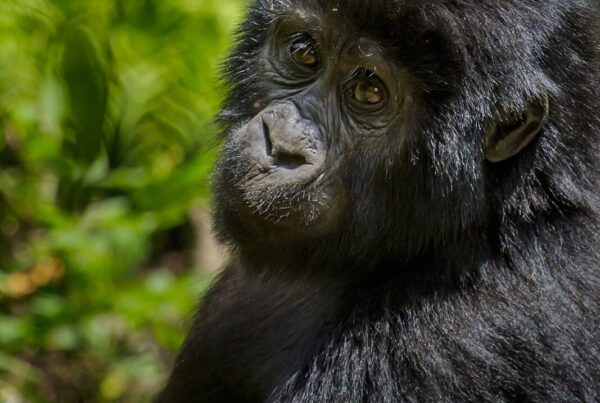
gorilla trekking Uganda human connection nature is one of Africa’s most extraordinary wildlife experiences, connecting travellers with mountain gorillas in their natural forest habitat. At some point during the hour you spend with a mountain gorilla family in Bwindi Impenetrable Forest, something will happen that you did not expect and cannot fully prepare for: a gorilla will look at you — not past you, not through you, but at you specifically, with a sustained attention that crosses the evolutionary distance between the two of you and lands in a way that most people who have experienced it describe as one of the most significant moments of their lives. Plan the visit: gorilla permits 2025, cost breakdown, accredited operators.
- Why it is significant: mountain gorillas share 98.3% of human DNA; the neural structures that process social gaze in gorillas are similar to those in humans; when a gorilla looks at you, something real is occurring in two minds simultaneously
- The families: Bwindi has 20+ habituated families; the silverback’s gaze is a social signal within the family and an acknowledgement of the human group; rangers are experienced in reading this behaviour
- Access: USD 800 permit; 8 people per family per day; 4 sectors at Bwindi; Mgahinga NP as a second Uganda option
- Conservation: 1,063 mountain gorillas alive worldwide; Endangered (IUCN); the population is growing as a result of the conservation programme that is funded by permit revenue
At some point during the hour you spend with a mountain gorilla family in Bwindi Impenetrable Forest, something will happen that you did not expect and cannot fully prepare for. A gorilla will look at you. Not past you, not through you, but at you — specifically, with a sustained attention that has a quality of recognition in it. And in that moment, the question of your place in the natural world — a question that most of us live with at a comfortable intellectual distance — will become immediate and physical and impossible to avoid.
This is what gorilla trekking is actually for. Not the photographs, not the permit stamp, not the box checked on the bucket list. The moment of recognition. The moment when the species barrier — the comfortable wall between “humans” and “animals” that modern life maintains through distance, mediation, and the careful management of most wildlife encounters — temporarily drops, and you find yourself on the other side of it, seen.
The Gorilla That Will Make You Understand Your Place on This Planet
The 98.3 Percent
Mountain gorillas share approximately 98.3% of their DNA with humans. This number is cited frequently in gorilla trekking literature, and it is true. But it is also, in isolation, a fact that does not convey what it means. The remaining 1.7% of genetic difference represents millions of years of separate evolutionary history, hundreds of distinct adaptations, and a range of cognitive and behavioural differences that are genuinely significant. Gorillas are not almost-humans who happen to live in forests. They are gorillas — a species with their own complete intelligence, their own social world, their own ways of being.
What the 98.3% figure actually conveys is not similarity but relationship. The common ancestor who gave rise to both humans and gorillas lived several million years ago in Africa. The descendants of that ancestor went in different directions — one line toward the hominin lineage that eventually produced modern humans, another line toward the gorilla lineage that produced mountain gorillas and their relatives. Both lines are here, now. Both lines work. Both lines are extraordinary.
Standing in front of a mountain gorilla, this relationship is not abstract. The architecture of the face is familiar in ways that create genuine cognitive dissonance: those are eyes that process light in a structure very similar to yours, that are connected to a visual cortex that processes information in ways that are recognisably analogous to your own. The hands are hands — five fingers, nails rather than claws, the capacity for fine manipulation that in your lineage eventually produced writing and surgery and the construction of telescopes. The social bond between a gorilla mother and her infant is identical in its emotional quality to what you recognise as parental love.
What Understanding Your Place Actually Means
The phrase “understanding your place on this planet” is susceptible to interpretation as either grandiose or clicheed. What it means in the context of the gorilla encounter is more specific: the experience provides a direct, embodied correction to the anthropocentrism that modern life quietly reinforces. The assumption — rarely stated explicitly but built into the structure of how most people live — that humans are uniquely separate from, uniquely superior to, and fundamentally different in kind from other living beings is challenged by the gorilla encounter in a way that argument and information cannot challenge it.
You are not separate. You are a specific version of the great ape lineage that went in one direction while the gorilla went in another. Your direction produced language, cities, mathematics, and iPhones. The gorilla’s direction produced a different kind of intelligence, a different kind of social life, a different relationship with the forest that is their home and yours in origin. Neither direction is the point of evolution; there is no point. Both are adaptations. Both work. Both are, in their own terms, extraordinary.
The Permission the Gorilla Gives
Something that many gorilla trekking veterans mention when describing the lasting effect of the encounter is a quality of permission. The gorilla’s existence — its continuity, its social richness, its evident intelligence, its complete indifference to human categories of value — gives permission to see the natural world as something other than a resource or a backdrop. The gorilla is just here, being a gorilla, in a forest that existed before humans named it and will exist after the names are forgotten. The encounter with that simple fact is more corrective of standard assumptions about human centrality than almost anything available in ordinary life.
The $800 permit in 2027 is the price of access to that correction. It funds the rangers, the conservation system, the community benefit-sharing that makes the protection of the forest viable. It buys one hour. In that hour, if you are paying attention, you will understand something about your place on this planet that you did not understand before. Contact us to book that hour. It is worth every dollar.
What happens neurologically when a gorilla makes eye contact with you?
The experience has a neurological basis that explains why people react so strongly. Shared social cognition: gorillas and humans share similar neural architecture for social gaze processing — the superior temporal sulcus, which processes gaze direction and social attention, is comparable in gorillas and humans; what this means in practice is that gorilla gaze behaviour reads as socially intentional to the human observer because it is. The sclera: humans are unusual among primates in having white sclera (whites of the eyes) that make gaze direction highly visible; gorilla sclera is darker but the direction of gaze is still clearly legible; at Bwindi at 7-metre range, you can read a gorilla’s gaze direction clearly. The mirror: research on great ape cognition shows that gorillas demonstrate some degree of self-awareness (mirror self-recognition in some individuals); the eye contact moment at Bwindi is contact between two self-aware creatures across a 6-million-year evolutionary gap — this is unique in a wild animal encounter.
How do the gorillas at Bwindi respond to human visitors?
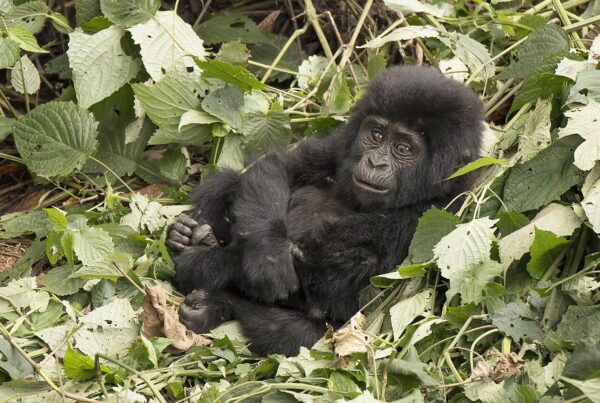
The habituated family’s response to the human group is specific and documented. Habituated behaviour: a fully habituated family at Bwindi has been exposed to human presence over several years of ranger contact before trekking begins; they do not flee and do not typically become aggressive during a well-managed visit; they continue normal family behaviour. The silverback’s role: the dominant male is the security decision-maker; if he accepts the human group’s presence (which habituated silverbacks do reliably), the family follows his lead; if he displays (chest-beating, vocalisations) the ranger interprets the signal and adjusts the group’s position. Juvenile behaviour: young gorillas (2-6 years) are often more curious than adults; they may approach the group within the 7-metre regulation distance; this is the moment most trekkers describe as the most disarming — a juvenile gorilla investigating the human visitors with the same curiosity you feel about it.
What rules must visitors follow during the 60 minutes with the gorillas?
The rules are specific and enforced by the ranger. Distance: minimum 7 metres from any gorilla at all times; if a gorilla approaches closer (which happens), the group moves back to maintain the distance; the gorilla determines the proximity, not the visitor. No flash: flash photography is prohibited; it startles the gorillas and is a genuine disturbance risk; available light only. No talking: voices above a whisper are discouraged; the ranger communicates in low voice or by hand signals. No eating or drinking: do not eat or drink in front of the gorillas; this avoids habituating them to human food and reduces disease transmission risk. Health: if you have symptoms of cold or flu, you will not be admitted to the trek; gorillas are highly susceptible to human respiratory diseases. Behaviour: if a gorilla charges, stand still and look down; do not run; the ranger handles this. See 30 things to know.
Is the gorilla encounter at Bwindi or Mgahinga better?
Both options are in Uganda and both produce excellent encounters. Bwindi Impenetrable Forest NP: Bwindi has 20+ habituated families across four sectors (Buhoma, Ruhija, Rushaga, Nkuringo); the forest is older, denser, and more complex; more accommodation options; easier to reach from Kampala. Mgahinga Gorilla NP: Mgahinga has one habituated gorilla family (Nyakagezi group); part of the Virunga volcanic massif; also offers golden monkey trekking (the golden monkey is an Albertine Rift endemic found only in Virunga); slightly smaller and more intimate than Bwindi. For most visitors: Bwindi is the main destination by volume and infrastructure; Mgahinga is sometimes chosen for its Virunga volcano atmosphere or as a Uganda-Rwanda border area combination. Combined: some visitors do both in the same trip — Mgahinga on the way to or from Rwanda or as an addition to Bwindi.
What is the full Uganda wildlife circuit for a 10-day trip?
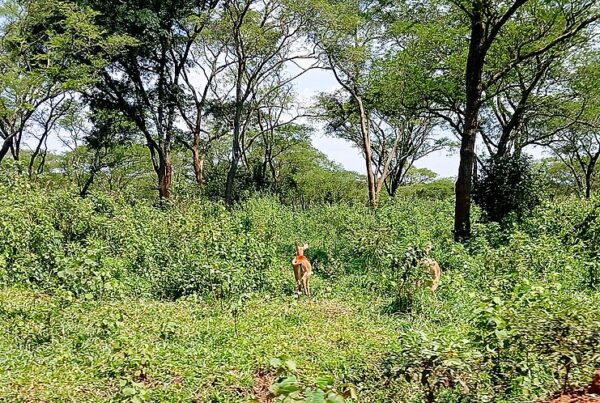
A 10-day Uganda circuit covers the country’s best experiences. Day 1: arrive Entebbe; Mabamba Bay shoebill afternoon. Day 2-3: Kibale Forest chimpanzee trek and Bigodi. Day 4-5: Queen Elizabeth NP — Kasenyi game drive, Kazinga Channel, Ishasha tree-climbing lions. Day 6-7: Bwindi Impenetrable Forest — gorilla trek Day 7 morning. Day 8: drive via Lake Mburo NP (afternoon stop: zebra, impala). Day 9: Entebbe; optional visit to Uganda Wildlife Education Centre. Day 10: morning flight out. Adding Murchison: extend by 3 days and fly Kampala → Pakuba for Murchison Falls game drives and Nile boat safari. See 7-day itinerary and operators.
- The Last Wild Place on Earth: Why Bwindi Forest Will Break Your Heart
- 20 Gorilla Photos That Will Make You Book a Flight Today
- The Rare Places on Earth That Make You Feel Grateful to Be Alive: Uganda Is One
- Gorilla Behaviour in the Wild: Understanding the Gentle Giants of Africa
- Sustainable Tourism: Protecting Our Planet While Exploring Its Wonders
- This Is the Place Avicii Meant When Singing ‘The Nights’
- Best Places to Travel Solo: Safe, Inspiring & Unforgettable Destinations
- What Makes Uganda Gorilla Trekking Different from Any Other Wildlife Trip
- Understanding Gorilla Behaviour: What Their Actions Mean During Your Trek
- Understanding the Cost of Gorilla Trekking: Complete Budget Breakdown