Updated
Mountain Gorilla Behaviour: What Gorillas Do All Day
A Day in the Life of a Mountain Gorilla
Mountain Gorilla Behaviour: What Gorillas Do All Day A Day in the Life of a Mountain Gorilla Mountain gorillas follow a predictable daily activity pattern that researchers have documented in detail through decades of continuous observation of habituated families in Bwindi and the Virungas. Mountain gorillas follow a predictable daily activity pattern that researchers have documented in detail through decades of continuous observation of habituated families in Bwindi and the Virungas. This pattern — alternating foraging, resting, social interaction, and travel — reflects the metabolic demands of large-bodied herbivores living in a seasonal highland forest environment. Understanding the gorilla’s daily routine helps visitors contextualise their trekking encounter and appreciate where within the cycle their hour-long visit is likely to fall.
Morning: First Foraging Period
The gorilla day begins well after sunrise — typically 7 to 8 am, often later during cold or rainy mornings. The group emerges from their night nests slowly: individuals stir, stretch, and begin the gradual process of becoming active. Infants nurse from their mothers in the first minutes. The silverback, who typically wakes before most group members, may scan the environment before initiating movement.
The morning foraging period is the longest and most intense feeding period of the day. Gorillas move through their home range with focus and direction, consuming large quantities of preferred vegetation. A feeding mountain gorilla moves methodically through a patch of forest herbs, stripping stems, folding leaves, and processing food with the practiced efficiency of an animal that has performed this behaviour thousands of times. Group members spread through a feeding patch but maintain vocal contact through low belch vocalisations that signal contentment and location simultaneously.
The silverback’s movement decisions during the morning foraging period are not random. He draws on his knowledge of the home range to navigate toward areas with productive food patches, adjusting direction in response to the sounds and smells of the forest. Researchers tracking daily movement paths have shown that silverbacks route their groups more efficiently than random movement would predict — evidence of genuine spatial planning rather than purely reactive foraging.
Midday: Rest and Social Time
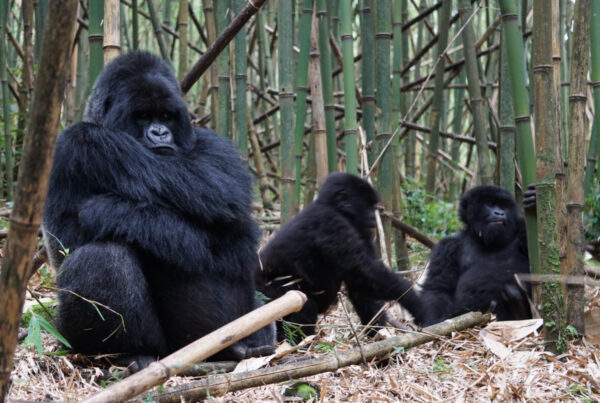
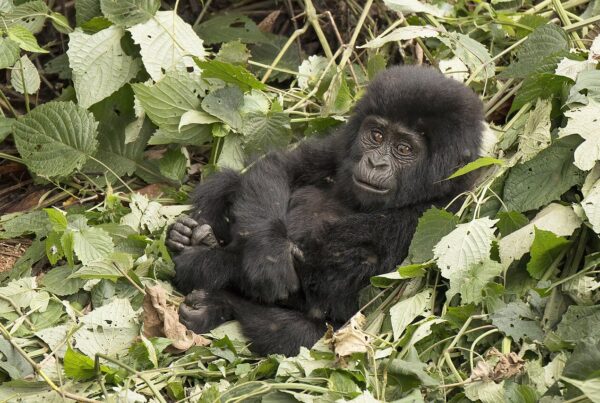
By mid-morning or midday, the group typically transitions into the rest period — a pause of 2 to 4 hours during which foraging largely ceases and the group focuses on recovery, social interaction, and digestion. This period often begins with sunbathing: gorillas seek patches of sunlight penetrating the forest canopy, orientating their dark fur toward the light to absorb solar warmth. The midday rest scene — adults sprawled in sunlit clearings, juveniles chasing each other through the understorey, infants wrestling clumsily at their mothers’ feet — is one of the most visually compelling aspects of gorilla group observation.
Social grooming is concentrated in the rest period. Adult females groom the silverback or each other; juvenile males groom peers; mothers groom infants and juveniles. The social texture of grooming — who grooms whom, for how long, who initiates — maps the alliance structure of the group in real time. Experienced researchers can read the current state of group social dynamics from a 30-minute observation of grooming patterns.
Play behaviour among juveniles also peaks during the rest period. Young gorillas chase, wrestle, climb, and vocalise in extended play bouts that sometimes involve juveniles from different maternal lineages playing together in mixed groups. The silverback occasionally participates in play with juveniles, particularly young males — an interaction that appears to maintain individual bonds and social tolerance between the group’s dominant male and the next generation of males who will eventually challenge him or inherit his role.
Afternoon: Second Foraging Period
The afternoon foraging period resumes after the midday rest, typically running from approximately 2 to 5 pm before the group transitions to nest construction. Afternoon feeding is typically less intense than the morning session — individual food intake rates are somewhat lower, and movement between food patches is more leisurely. The group gradually drifts in the direction of the area where they will nest for the night.
The afternoon period sometimes includes secondary social interactions: adult male displays, inter-individual conflicts over food or social position, and the quieter social bonding of individuals sitting in close proximity without active interaction. By late afternoon, the group’s energy is winding down toward the evening nest construction and sleep that will occupy the next 12 hours.
Evening: Nest Construction
Within the hour before dark, each gorilla in the group selects a nest site and constructs their sleeping platform. The nest-building process takes 5 to 15 minutes for experienced adults and marks the formal transition from the day’s activity to the night’s rest. Infants settle with their mothers; juveniles build their own nests (of varying quality) nearby. The silverback’s nest, typically at a central or slightly elevated position in the cluster, is usually among the largest and most substantially constructed.
As darkness falls, the group settles and most social activity ceases. Occasional vocalisations, infant nursing, and brief repositioning mark the early sleep period before the group enters the long nocturnal rest that restores them for the following day’s cycle.
Variation Within the Pattern
The pattern described above is the baseline, but daily variation is considerable. Heavy rain interrupts foraging and may cause the group to shelter under dense vegetation canopy rather than forage. Inter-group encounters disrupt normal activity and may occupy hours of display and manoeuvring before resolution. Unusual food resources — a fruiting fig tree, a rich bamboo patch — may cause the group to deviate from its usual movement pattern and concentrate feeding in one area for multiple days.
Seasonal variation shifts the pattern somewhat: wet season months with abundant new plant growth allow more efficient foraging, potentially compressing the morning feeding period. Dry months with reduced food quality may require longer travel and more distributed foraging. These seasonal adaptations are managed by the silverback’s responsive route-finding through the home range.
Where the Trekking Encounter Fits
Most gorilla treks depart trailheads early in the morning, with tracker teams having located the group from the previous evening’s nest site. The trek typically reaches the gorilla group during the mid-morning to midday transition — either catching the tail end of the morning foraging period or observing the group settled into the midday rest. This timing often provides the most accessible observation conditions: animals are relatively stationary, social interactions are active, and the full range of group behaviour is visible.
Final Thoughts
Understanding the daily cycle of mountain gorilla life transforms every element of the trekking encounter from random animal movement into comprehensible behaviour within a larger pattern. The silverback leading the group to a feeding patch is doing what he does every morning. The juvenile wrestling match in the midday rest is a daily social ritual. The contented belch vocalisations from the undergrowth are the soundtrack of a gorilla group going about its ordinary, extraordinary day.
Frequently Asked Questions
Uganda is home to the mountain gorilla (Gorilla beringei beringei), one of two subspecies of eastern gorilla. They live exclusively in the Virunga volcanic highlands (Uganda/Rwanda/DRC) and Bwindi Impenetrable Forest (Uganda only). Mountain gorillas are the only gorilla subspecies that cannot survive in captivity — every individual you can trek is a wild animal.
The standard gorilla trekking permit gives you exactly 1 hour with the gorilla family. This time begins when you make first contact with the family — the ranger signals the start. The Gorilla Habituation Experience gives 4 hours with a semi-wild family. The walk to find the gorillas can take 30 minutes to 5 hours depending on where the family has moved.
Stay calm, crouch down slowly, avoid direct eye contact, and remain quiet. Do not run — running triggers a chase response. Rangers accompanying your group manage close approaches. Habituated gorillas are accustomed to humans and almost never make contact, but a charging silverback is managed by staying still and following ranger instructions immediately.
A maximum of 8 visitors per habituated gorilla family per day for standard trekking. The Gorilla Habituation Experience has a maximum of 4 visitors per family per day. These limits are set by UWA to minimise stress on the gorilla families and maintain the quality of the experience.
Uganda is home to the mountain gorilla (Gorilla beringei beringei), one of two subspecies of eastern gorilla. They live exclusively in the Virunga volcanic highlands (Uganda/Rwanda/DRC) and Bwindi Impenetrable Forest (Uganda only). Mountain gorillas are the only gorilla subspecies that cannot survive in captivity — every individual you can trek is a wild animal.