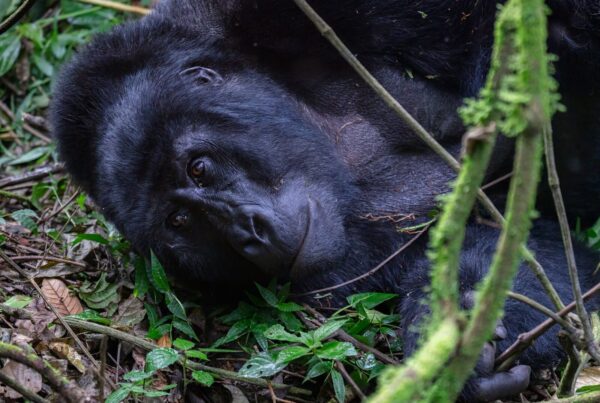
Bwindi Impenetrable National Park will break your heart, and you should go anyway. The breaking is not unpleasant — it is the kind of break that comes from something being too beautiful and too fragile and too real for your existing emotional capacity to contain without adjustment. You go in with your ordinary heart and you come out with something larger and more aware and permanently changed in a way you cannot fully undo. This is what the last wild places do to people, and Bwindi is among the last.
What Makes Bwindi Extraordinary
Bwindi Impenetrable National Park in southwestern Uganda covers approximately 321 square kilometres of ancient montane rainforest. It sits at elevations between 1,160 and 2,607 metres, straddling the Albertine Rift Valley, and is considered one of the most biologically diverse areas in Africa. Over 120 mammal species, 350 bird species, 220 butterfly species, and more than 1,000 plant species have been recorded there.
That is the statistical account. The actual account begins when you step off the path and into the forest properly and realise that you are inside something that has been running for millions of years without interruption, without management, without human oversight — something that was old before the civilisations whose history we learn in school had begun.
The Age of the Forest
Bwindi is one of the few forests in Africa that survived the climatic changes of the last Ice Age. While much of the continent’s forest cover was replaced by grassland during periods of cooling and drying, Bwindi remained forested — a refuge for species that would otherwise have been lost. The biological diversity of the park today is partly explained by this history: Bwindi has been an ark for longer than modern humans have been in Africa.
Walking through it, you are walking through something that has continuity with the Pleistocene. The tree you put your hand on has ancestors that were alive when the first hominins were learning to control fire. This is not metaphor. This is the actual situation you are in.
The Gorillas: Why They Are the Forest’s Heart
Mountain gorillas are not merely an attraction that Bwindi happens to contain. They are, in a meaningful sense, the reason Bwindi still exists. The conservation of the forest has been driven largely by the presence of the gorillas — the international attention they generate, the tourism revenue they attract, the emotional and symbolic weight they carry in conservation discourse. Without the gorillas, Bwindi would be significantly more vulnerable to the agricultural and logging pressures that have diminished forests elsewhere in East Africa.
And the gorillas, in turn, would not exist without the forest. They are co-dependent in the way that all great relationships are co-dependent: each is the reason the other survives.
The Number That Changes Things
There are just over 1,100 mountain gorillas on Earth. All of them live in two populations: Bwindi, and the Virunga massif across Uganda, Rwanda, and the Democratic Republic of Congo. None exist in any other ecosystem. None exist in captivity — all attempts to keep mountain gorillas in zoos have failed; they do not survive outside their forest homes.
1,100. If you need a number for comparison: that is fewer people than attend a moderately popular local sports event on a Saturday afternoon. That is the entire remaining population of an entire primate species that has been on this Earth for millions of years. Standing in Bwindi and knowing this changes how the forest feels. The weight of it is tangible.
Why It Will Break Your Heart
The heartbreak of Bwindi is not a simple heartbreak. It comes from several directions at once.
The Beauty
Bwindi is beautiful in a way that hurts. The forest light through the canopy, the smell of damp earth and living things, the sounds of birds and primates and water and wind through leaves — all of it assembles into something that the human aesthetic sense recognises as profound beauty and responds to accordingly. Beauty on this scale produces a specific sensation that is close to ache: the desire to hold onto something that you know is passing.
The Fragility
The forest that took millions of years to develop is surrounded, on all sides, by human pressure. Communities who depend on the land for survival live at the park boundary. Climate change is altering the rainfall patterns that the forest depends on. The 1,100 gorillas are vulnerable to human respiratory viruses — a fact that is the reason trekking visitors must stay seven metres away and must not trek if they have flu-like symptoms.
The beauty and the fragility are the same thing, experienced simultaneously. This is what makes Bwindi heartbreaking: you cannot appreciate its scale and rarity without also comprehending how much of what was once like it has already been lost.
The Gorillas Themselves
You stand three metres from a mountain gorilla and look at it and it looks at you, and the two emotional responses — the overwhelming privilege of this moment, and the knowledge that there are only 1,100 of these animals left on Earth — arrive together. You cannot have one without the other. The joy and the grief share the same moment.
What the Rangers Carry
The rangers who protect Bwindi carry something that is not often discussed in travel writing about the park. They work in an environment that is threatened from multiple directions — poaching, agricultural encroachment, the complexities of managing a protected area surrounded by communities that are genuinely poor and have legitimate needs that sometimes conflict with conservation goals.
They also carry decades of relationship with the families they protect. Guides who have worked with the same gorilla group for ten or fifteen years know the individuals — their personalities, their histories, the infants they have watched grow into adults. When a gorilla dies — from disease, from injury, from the occasional poaching incident — the loss is personal in a way that employment categories do not adequately describe.
This work is extraordinary and underpaid and sustained by people whose commitment to these animals exceeds any rational calculation of self-interest. When you pay for a gorilla trekking permit, you are funding these people and this work. This is not an abstraction. This is the specific chain of cause and effect that has grown the gorilla population from 620 in 1989 to over 1,100 today.
What You Should Know Before You Go
Bwindi will not be comfortable in the way that comfortable travel is comfortable. The terrain is demanding. The weather is variable and can turn quickly. The remoteness is real — this is not a theme park, not a managed safari, not a curated version of wildness. It is a functioning ecosystem and you are a visitor in it.
This is, precisely, why it will break your heart in the right way.
Gorilla trekking permits are $800 per person. The permit fee is a direct contribution to conservation. Porters are available for those who need physical support on the trek. The guides are among the most knowledgeable and experienced in Africa. The forest is intact. The gorillas are there.
The Last Wild Place
I said at the beginning that Bwindi is among the last wild places on Earth, and I should be precise about what I mean by that. I do not mean the last forest, or the last national park, or the last habitat for large primates. I mean the last kind of place where you can stand in the presence of something ancient and living and irreplaceable and feel, without any mediation, what it means to be a creature in a world that contains other creatures.
That quality of encounter is becoming rare in direct proportion to the pace at which human activity is transforming the planet. Bwindi, for now, still has it. Go while it does. Go and let it break your heart in the right way. The larger heart you come back with is worth the pain of expansion.
Contact Uganda Gorilla Trekking to book your permit and plan your visit. Some places are worth travelling very far to see. Bwindi is among the furthest worth going.