Gorilla photos from Uganda that change the way you see the world
Gorilla photos from Uganda have a peculiar effect on people. Travel agents, tour operators, and gorilla trekking guides all report the same phenomenon: a traveller arrives undecided, sees a handful of photographs from inside Bwindi Impenetrable Forest, and books their trip within the hour. There is something about the direct gaze of a mountain gorilla — the intelligence in the eyes, the sheer physical presence, the obvious emotional life — that bypasses rational decision-making and triggers an instinct to go and witness it for yourself.
The silverback stare
The most powerful gorilla photograph in existence may be the simplest: a silverback gorilla looking directly into the camera lens. Not charging, not eating, not sleeping — just looking. The intelligence behind those eyes, combined with the sheer physical mass of the animal, creates an image that unsettles and inspires in equal measure. Uganda’s habituated gorilla families in Bwindi and Mgahinga produce this moment regularly during trekking encounters, when the dominant male of the group pauses in his daily routine and turns his attention to the humans who have entered his territory.
What the silverback is actually thinking
Gorilla researchers who have spent decades observing mountain gorillas describe the direct gaze of a silverback as an assessment — the animal is reading you, evaluating your posture and behaviour, deciding whether you are a threat or simply an irrelevance. The fact that habituated gorillas have been conditioned to accept human presence means that most encounters end with the gorilla returning to his feeding or resting, apparently satisfied that the visitors pose no danger. But in the photographs taken during that moment of mutual observation, the intelligence of the animal is unmistakable.
The infant clinging to its mother
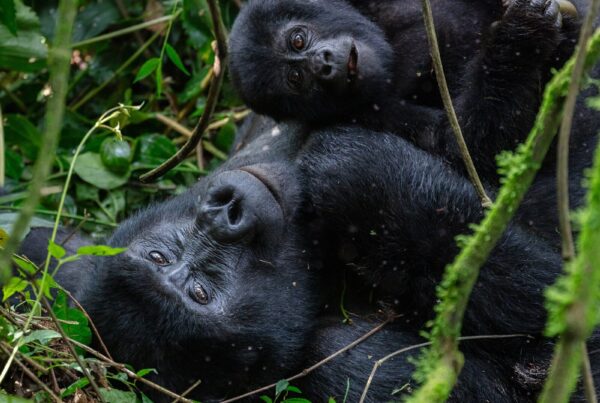
Gorilla infants are born weighing around 2 kilograms — roughly half the weight of a human newborn — and spend their first months clinging to their mother’s chest. Photographs of a gorilla mother moving through the forest with her infant pressed against her body capture a tenderness that is immediately recognisable to any parent. The infant’s fingers gripping the mother’s fur, the mother’s arm steadying the baby during movement, the infant’s curious eyes examining the world from the safety of its mother’s embrace — these details create images of great emotional power.
Juveniles playing in the canopy
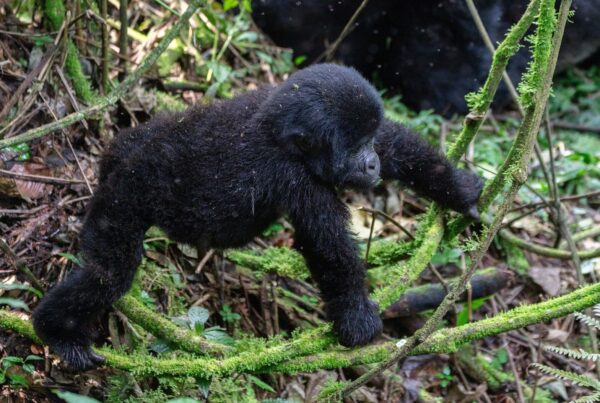
One of the most joyful gorilla photograph subjects is a group of juveniles at play. Young gorillas wrestle, chase, swing from branches, and tumble through undergrowth with an energy and enthusiasm that is completely recognisable as play behaviour. Bwindi’s family groups typically contain several juveniles who interact constantly, and photographers who position themselves at the edge of a clearing where juveniles are playing can capture images of pure, exuberant animal joy that resonate with human viewers on a fundamental level.
The game of chase
When juvenile gorillas play chase in the forest, they move fast and unpredictably, crashing through vegetation and making enough noise to draw attention from the entire group. Photographs of juveniles in full sprint — arms pumping, eyes bright with excitement — capture a vitality that contrasts beautifully with the stillness and gravitas of the silverback resting nearby. This combination of energy and calm in a single frame tells the story of gorilla social life more completely than any written description.
The family resting in the forest
Mountain gorilla families spend much of their day resting. The silverback chooses a location with good visibility and shelter, and the rest of the group settles around him — mothers feeding their young, juveniles playing at the margins, blackbacks lounging in the undergrowth. Photographs of a resting gorilla family capture the social structure of the group in a single frame: the silverback at the centre, his family arranged around him, the forest canopy filtering light onto the scene. These images communicate the complexity of gorilla social life in a way that immediately engages the viewer.
The knuckle-walk through the forest
Gorillas move on all fours, using their knuckles to support the weight of their upper body — a posture called knuckle-walking that is unique to gorillas and chimpanzees among the great apes. Photographs of a gorilla family moving in single file through the forest — the silverback leading, mothers with infants following, juveniles bringing up the rear — create a visual narrative of family life that has become one of the most recognisable images in wildlife photography. The movement captures the gorillas in their natural role as forest dwellers, part of an ecosystem that has existed for millions of years.
Following the ranger through the forest
Gorilla trekking photographs that include the ranger — a park guide, armed with knowledge of the forest and the gorilla family’s daily movements — add a human scale that makes the encounter more vivid. The ranger moving silently through the undergrowth, the trekking party following, the forest closing in overhead, and then the sudden stillness that signals the gorillas are near — this sequence, captured in photographs, tells the complete story of what gorilla trekking actually involves.
The direct approach
One of the most dramatic gorilla photographs is taken when a young male approaches the trekking group out of curiosity. Habituated juveniles and younger blackbacks sometimes investigate visitors directly, moving towards the group with a combination of bravado and curiosity that keeps rangers alert. Photographs taken in the seconds before the ranger intervenes — the gorilla at close range, its face filling the frame, its expression unreadable — are among the most visceral wildlife images that visitors to Bwindi bring home.
Bwindi in the early morning
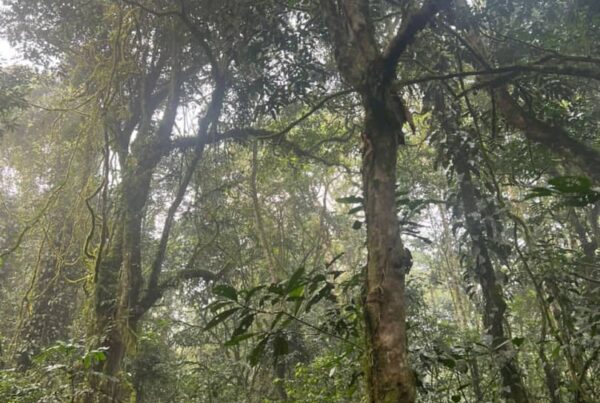
Gorilla treks begin at dawn, and photographs taken in the early morning light inside Bwindi Impenetrable Forest have a quality that afternoon images cannot replicate. The low angle of the light, the mist still present in the valleys, the dew on every leaf and spider’s web — all of these elements combine to create a visual environment of extraordinary beauty. When gorillas are found in early morning light, resting or feeding before the day’s activity begins, the photographs that result are among the finest wildlife images produced anywhere in Africa.
Why these images inspire action
The most common response to gorilla photographs from Uganda — reported consistently by tour operators and travel writers — is not admiration but urgency. People who see these images do not simply think “how beautiful.” They think “I need to go.” The combination of the gorillas’ obvious intelligence, the intimacy of the forest encounter, the evident emotional lives of the animals, and the knowledge that this experience is available and accessible creates a motivational response that no amount of written persuasion can match.
If these 20 reasons to visit Uganda have persuaded you, our team can arrange your gorilla trekking permit, accommodation, and safari itinerary. The encounter you see in these photographs is waiting for you in Bwindi Forest — and it is every bit as powerful in person as it appears on screen.
Frequently Asked Questions
The standard gorilla trekking permit costs $800 per person for foreign non-residents (FNR). EAC foreign residents pay $700. During low season — April, May, and November — the FNR rate drops to $600. The Gorilla Habituation Experience permit (4 hours, Rushaga sector only) costs $1,800 per person.
Permits are issued by Uganda Wildlife Authority (UWA). Most visitors book through a licensed Uganda tour operator, who handles the UWA reservation, permit transfer, and sector logistics. Direct booking via the UWA eTourism portal is available but operators handle the complexity of sector assignment and date changes.
During peak season (June–September, December–February): book 3–6 months ahead. During low season (April, May, November): 4–8 weeks is usually sufficient. The AFCON 2027 period (June–July 2027) will see unusually high demand — book at least 6 months ahead for any date in that window.
UWA gorilla permits are non-refundable but can be rescheduled to another date subject to availability and sufficient advance notice. Your tour operator handles this process. Travel insurance that covers trip cancellation and curtailment is strongly recommended for all Uganda gorilla bookings.
Yes. The permit price is set by Uganda Wildlife Authority and is fixed regardless of which operator you use. No operator can offer a discount on the $800 permit — only their service fees (accommodation, transport, guiding) vary between companies.