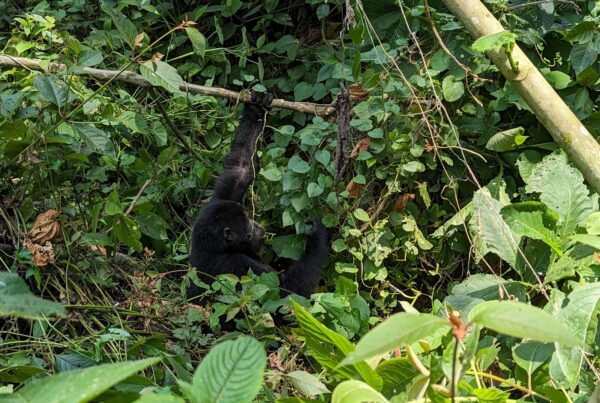
Mgahinga Gorilla National Park and Bwindi Impenetrable Forest are the two Uganda national parks where mountain gorilla trekking is permitted, and they offer genuinely different experiences — not only in logistical terms (Bwindi is larger with many more habituated families and established tourism infrastructure; Mgahinga is smaller with typically one habituated family and a wilderness character) but in landscape character, the gorilla families’ histories and personalities, and the combination activities available alongside the trekking that define the texture of the multi-day Bwindi or Mgahinga stay. The overwhelming majority of Uganda gorilla trekking visitors go to Bwindi by default because Bwindi has more permit availability, a wider range of accommodation tiers, and the infrastructure recognition of decades of established tourism. Mgahinga’s rarity — fewer trekkers, fewer permits, a Virunga volcanic cone backdrop unavailable at Bwindi — gives it a specific appeal for visitors who have already trekked at Bwindi or for those who specifically want the less-travelled experience. This guide compares both parks across every relevant dimension. For permit availability at both parks, see the permit guide.
Mgahinga vs Bwindi: Side-by-Side Overview
- Families available: Bwindi: 20+ families across 4 sectors | Mgahinga: typically 1 family (Nyakagezi)
- Landscape: Bwindi: highland montane forest | Mgahinga: Virunga volcanic cones + forest
- Permit availability: Bwindi: much higher, multiple daily permits | Mgahinga: 8 permits per day maximum
- Additional activities: Mgahinga: Batwa cultural trail, volcano hiking | Bwindi: broader range across sectors
- Infrastructure: Bwindi: well-developed (luxury to budget) | Mgahinga: limited mid-range options
- Gorilla family cross-border movement: the Nyakagezi family crosses between Uganda and Rwanda — confirm current location before travel
Most travellers planning gorilla trekking in Uganda focus exclusively on Bwindi Impenetrable National Park, and with good reason. Bwindi hosts the majority of Uganda’s habituated gorilla families, offers multiple trekking sectors with varying difficulty levels, and has the most developed tourism infrastructure. However, Mgahinga Gorilla National Park, Uganda’s smallest national park located in the southwestern corner where Uganda meets Rwanda and the Democratic Republic of Congo, offers a gorilla trekking experience that is genuinely different from Bwindi’s and, for certain travellers, potentially preferable.
This guide compares gorilla trekking in Mgahinga and Bwindi across every dimension that matters to visitors: gorilla family characteristics, terrain and trekking difficulty, scenery and atmosphere, accessibility, accommodation, combination activities, and the intangible qualities that make each park unique. Understanding these differences allows you to choose the park that best matches your preferences, or ideally, to visit both and experience the full range of Ugandan gorilla trekking.
The Gorilla Families: Nyakagezi’s International Lifestyle
Mgahinga has only one habituated gorilla family: the Nyakagezi group. This apparent limitation is actually one of Mgahinga’s most distinctive features. While Bwindi’s numerous families allow for varied assignments and multiple treks, Mgahinga’s single family creates a focused, intimate experience with a group whose story is as unique as their habitat.
The Nyakagezi group’s most remarkable characteristic is their cross-border lifestyle. Their home range spans Uganda, Rwanda, and the Democratic Republic of Congo, moving between the three countries according to seasonal food availability, social pressures, and perhaps sheer wanderlust. This international mobility makes them the only habituated gorilla family in the world whose daily life involves crossing international borders.
For trekkers, this mobility creates both excitement and uncertainty. When the Nyakagezi group is in Uganda, the trekking experience is extraordinary. When they have crossed into Rwanda or DRC, Mgahinga cannot offer gorilla trekking, and visitors must either wait or transfer to Bwindi. Park authorities monitor the group’s movements closely, and operators can usually confirm their location before your arrival, but the possibility of absence is real and should be factored into planning.
The family itself is led by a silverback named Mark, who took leadership after the death of the previous dominant male. Under his guidance, the group has maintained its habituated status and continues to tolerate human presence during encounters. The group’s smaller size compared to some Bwindi families creates a more intimate encounter, with fewer gorillas to observe but more opportunity to focus on individual behaviours and relationships.
Terrain and Trekking Difficulty
Mgahinga’s terrain differs significantly from Bwindi’s. While Bwindi is characterised by dense forest, steep ridges, and thick undergrowth that lives up to its impenetrable name, Mgahinga sits on the volcanic slopes of the Virunga Massif. The trekking routes traverse bamboo forests, alpine moorland, and the lower slopes of three dramatic volcanoes: Mgahinga, Sabyinyo, and Muhavura.
The volcanic terrain is generally more open than Bwindi’s closed-canopy forest, with better visibility and less need to push through dense vegetation. However, the altitude is higher, with trekking starting at approximately twenty-five hundred metres and potentially ascending significantly from there. The thinner air at this elevation can challenge sea-level dwellers, and the steep volcanic slopes require sustained effort that some trekkers find more demanding than Bwindi’s undulating forest terrain.
Weather conditions at Mgahinga’s altitude are cooler and more changeable than Bwindi’s. Morning temperatures can drop to near freezing, and mist and rain are common regardless of season. Trekkers must be prepared for cold, wet conditions that differ from the warm humidity typical of Bwindi’s lower elevations.
Scenery and Atmosphere
Mgahinga’s scenery is arguably more spectacular than Bwindi’s. The Virunga volcanoes provide a dramatic backdrop that no forest landscape can match. On clear days, views extend across all three volcanoes, into Rwanda and DRC, and over the vast agricultural plains below. The sense of altitude and openness creates an atmosphere of grandeur that Bwindi’s enclosed forest cannot replicate.
The bamboo forests that characterise much of Mgahinga’s trekking route are visually striking, with tall, straight stems creating cathedral-like spaces that filter light in beautiful patterns. When mist drifts through the bamboo, the effect is ethereal, almost otherworldly. Photographers often find Mgahinga’s lighting conditions more favourable than Bwindi’s dim forest shade.
The atmosphere at Mgahinga is also quieter and more contemplative than Bwindi’s. With only one gorilla family and fewer daily trekkers, the park feels less busy, more remote, and more exclusive. For travellers who value solitude and wilderness immersion over social interaction, Mgahinga offers a purer experience.
Accessibility and Logistics
Mgahinga is significantly less accessible than Bwindi. The park is located approximately nine to ten hours by road from Entebbe, and the final approach involves steep, rough mountain roads that challenge even experienced drivers. Kisoro, the nearest town, has limited services and accommodation compared to the towns serving Bwindi’s various sectors.
Domestic flights to Kisoro are available but less frequent than flights to Bwindi’s airstrips. Road transfers from Kisoro to Mgahinga take approximately one hour on rough roads. The logistical challenges mean that Mgahinga is best suited to travellers with flexible itineraries and tolerance for remote travel conditions.
Permit availability at Mgahinga is also more constrained. With only one family and a maximum of eight trekkers per day, permits sell out quickly during peak periods. Booking well in advance is essential, and contingency plans should be in place in case the Nyakagezi group crosses a border before your trek date.
Accommodation and Infrastructure
Accommodation near Mgahinga is more limited than near Bwindi. A handful of lodges serve the park, ranging from basic community campsites to comfortable but not luxurious properties. None of Bwindi’s high-end lodges have equivalents at Mgahinga, and travellers seeking luxury accommodation may be disappointed.
However, the lodges that do exist offer genuine charm and proximity to the park that Bwindi’s more developed properties cannot match. The smaller scale creates a more personal atmosphere, and many lodges have stunning views of the volcanoes that compensate for simpler amenities.
Combination Activities Beyond Gorilla Trekking
Mgahinga’s location in the Virunga Massif creates unique combination opportunities that Bwindi cannot offer. The park is one of the few places in the world where three countries meet at a single point, and adventurous travellers can hike to the tri-border marker where Uganda, Rwanda, and DRC converge.
Volcano climbing is a major attraction. Mount Sabyinyo, at three thousand six hundred sixty-nine metres, offers a challenging day hike that takes trekkers through bamboo forest, alpine moorland, and finally to the summit where the three countries meet. The climb involves ladders and scrambling sections that require reasonable fitness and a head for heights. Mount Gahinga, slightly lower, offers a less demanding but equally rewarding volcanic hike.
Golden monkey tracking is another unique Mgahinga activity. The park is home to habituated golden monkeys, beautiful primates with distinctive golden-orange fur that are found only in the Virunga Massif. A golden monkey tracking permit costs significantly less than a gorilla permit and provides an excellent primate encounter for travellers who want additional wildlife experiences.
The Batwa Trail, a cultural experience led by Batwa guides, offers insight into the traditional life of the forest’s original human inhabitants. This experience is arguably more authentic at Mgahinga than at Bwindi because of the park’s smaller scale and closer community relationships.
Which Park Should You Choose?
Choose Bwindi if you want the highest probability of successful gorilla trekking, multiple family options, developed tourism infrastructure, and a range of accommodation choices from budget to luxury. Bwindi is the safer choice for first-time trekkers, for travellers with limited flexibility, and for those who want to combine gorilla trekking with other Ugandan destinations without excessive additional travel.
Choose Mgahinga if you value dramatic scenery, smaller groups, exclusive atmosphere, and unique combination activities such as volcano climbing and golden monkey tracking. Mgahinga suits adventurous travellers who accept the risk of the Nyakagezi group crossing borders, who enjoy remote and less developed destinations, and who find volcanic landscapes more appealing than dense forest.
For travellers with sufficient time and budget, visiting both parks provides the most comprehensive gorilla trekking experience in Uganda. The contrast between Bwindi’s ancient forest and Mgahinga’s volcanic slopes, between multiple families and a single international group, between developed infrastructure and raw wilderness, creates a richer understanding of mountain gorilla conservation than either park alone can provide.
Final Thoughts
Bwindi and Mgahinga are not competitors for the same travellers. They are complementary expressions of Ugandan gorilla conservation, each with strengths that the other does not possess. Bwindi’s reliability and variety make it the backbone of Uganda’s gorilla tourism industry. Mgahinga’s uniqueness and drama make it the jewel for those willing to seek it out.
Wherever you trek, you are participating in one of conservation’s great success stories. The gorillas of Bwindi and Mgahinga are the same species, facing the same challenges, protected by the same dedicated rangers and supported by the same tourism revenue. Your permit fee, whether spent in the forest or on the volcano, contributes to their survival. And when a silverback meets your gaze, whether surrounded by ancient trees or volcanic mist, the connection is equally profound.
Frequently asked questions about Mgahinga vs Bwindi gorilla trekking
Why do most visitors choose Bwindi over Mgahinga for gorilla trekking?
Most visitors choose Bwindi over Mgahinga for gorilla trekking for three practical reasons. First, permit availability: Bwindi has over 20 habituated gorilla families across four sectors (Buhoma, Nkuringo, Rushaga, Ruhija), meaning significantly more trekking permits per day than Mgahinga, which typically has one habituated family (Nyakagezi) permitting a maximum of 8 visitors per day. Second, accommodation range: Bwindi has decades of established tourism infrastructure from luxury camps (Sanctuary Gorilla Forest Camp, Clouds Mountain, Mahogany Springs) to community guesthouses at every sector, with reliable availability across price tiers; Mgahinga’s accommodation is limited primarily to Ntebeko Inn, Mount Gahinga Lodge, and a few smaller properties — a narrower range with less availability. Third, the Nyakagezi family’s cross-border movement: the Nyakagezi family at Mgahinga crosses between Uganda and Rwanda’s Volcanoes National Park, which means that on a given day, the family may not be in Uganda territory, requiring permit refund and rescheduling. This cross-border uncertainty makes Mgahinga permit bookings slightly less predictable than Bwindi’s, where families are resident in Uganda territory year-round.
What is the Nyakagezi gorilla family at Mgahinga like?
The Nyakagezi family is the primary habituated gorilla family at Mgahinga Gorilla National Park and is one of the most famous gorilla families in Uganda’s conservation history. The family’s current composition includes multiple silverbacks, adult females, juveniles, and infants — its size and structure have fluctuated over years as members died, were born, and as young silverbacks left to establish their own groups. The Nyakagezi family is specifically known for having one of the longest histories of silverback-plural leadership in Uganda’s habituated families, with multiple adult males coexisting in the same group — a social structure that is less common than the single-silverback family model. The family’s home range spans the volcanic forest zone at the base of the Virunga cones in the Mgahinga park boundary area and crosses into Rwanda’s Volcanoes National Park periodically. Encounters with the Nyakagezi family are typically characterised by the multi-silverback presence — observing multiple massive silverback males in close proximity gives the encounter a particular intensity that single-silverback family encounters do not have. The volcanic landscape and the multi-silverback dynamics make the Nyakagezi encounter specifically distinctive compared to any Bwindi family.
Can you see golden monkeys at Mgahinga as well as gorillas?
Yes — Mgahinga Gorilla National Park is the only Uganda location where golden monkey trekking is offered alongside gorilla trekking, making it Uganda’s exclusive site for this Albertine Rift endemic primate. The golden monkey (Cercopithecus kandti) is a Virunga-endemic species restricted to the bamboo and forest zones of the Virunga volcanic range — it is not found in Bwindi or any other Uganda park. Mgahinga’s bamboo zone (the intermediate vegetation zone between the lower forest and the upper heath moorland) is golden monkey habitat, and UWA offers golden monkey trekking permits (USD 60 per person) as a separate activity from the gorilla trekking permit. A combined day at Mgahinga — morning gorilla trek, afternoon golden monkey trek — provides both of the park’s signature primate experiences in a single stay and is a compelling reason to include Mgahinga in a Uganda primate circuit that already covers gorillas at Bwindi and chimpanzees at Kibale. Rwanda’s Volcanoes National Park also offers golden monkey trekking at the same species location across the shared Virunga boundary, but Mgahinga is the Uganda-side access point.
How do you get to Mgahinga Gorilla National Park from Bwindi?
Mgahinga Gorilla National Park is approximately 60–80 kilometres from Bwindi’s Buhoma sector by road — a 2–3 hour drive through Kabale town and then south to the Mgahinga gate near Kisoro. From Rushaga sector (Bwindi’s southern sector), the distance to Mgahinga is shorter — approximately 50–70 km, 1.5–2 hours. The drive passes through Kabale, the main highland town of the Kigezi region, which provides fuel, food, and banking services along the route. The road quality between Bwindi and Mgahinga is mixed: the tarmac sections toward Kabale are good; the final approach road to Mgahinga gate is unpaved and can be rough in wet conditions. The standard combined Bwindi-Mgahinga itinerary allocates one full trekking day at each park: gorilla trek day at Bwindi (either Rushaga or Buhoma), transfer day to Mgahinga (2–3 hours), gorilla trek day at Mgahinga + optional golden monkey trek, then onward. Given the cross-border uncertainty with the Nyakagezi family, confirm the family’s current location with your operator or the UWA Mgahinga office the day before your planned trek.
Is Mgahinga better than Bwindi for a first-time gorilla trekking visitor?
For a first-time gorilla trekking visitor, Bwindi is generally the better choice over Mgahinga for practical reasons that relate to permit reliability and family selection range rather than encounter quality. Bwindi’s 20+ families across four sectors means significantly more permit dates are available, making it easier to match the trek date to a preferred time of year and accommodation arrangement. The Nyakagezi family’s cross-border movement at Mgahinga introduces an uncertainty that is specifically unwanted for first-time visitors who have planned the trip specifically around the gorilla encounter — if the Nyakagezi family is in Rwanda on the planned trek day, the permit is refunded but the trip’s structure is disrupted. Bwindi’s families are resident in Uganda territory year-round and do not cross borders, eliminating this uncertainty. Mgahinga is specifically excellent as a second Uganda gorilla trekking destination — for the returning visitor who has experienced one or more Bwindi treks and wants Mgahinga’s specific combination of volcanic landscape, multi-silverback family, and golden monkey extension as a complementary experience to the already-familiar Bwindi format.
Plan your Mgahinga or Bwindi gorilla trek
- Gorilla Permit Guide — permits for both Mgahinga and Bwindi through UWA
- Uganda Gorilla Families — the Nyakagezi family at Mgahinga and all Bwindi families compared
- Bwindi Sector Guide — Bwindi’s four sectors as alternatives and complements to Mgahinga
- Full Safari Cost Guide — Mgahinga vs Bwindi permit and accommodation cost comparison
- Safari Itineraries — Uganda itineraries combining Mgahinga and Bwindi in a single trip
- Top Gorilla Trekking Destinations in Uganda – Bwindi vs. Mgahinga 2025
- Why Americans Choose Bwindi, Mgahinga, and Volcanoes Over the Museum
- Can You Use a Drone in Bwindi? Drone Laws in Uganda Explained
- How Do Rangers Find Gorillas Every Morning in Bwindi? The Tracking Process Explained
- Why Choose Bwindi Over Mgahinga for Gorilla Trekking
- Why Choose Mgahinga Over Bwindi for Gorilla Trekking
- Is the Drive to Bwindi Really 8 Hours? All the Options Explained
- Kisoro Town: The Last Stop Before Mgahinga and Bwindi 2027
- Uganda’s Bwindi Impenetrable Forest: a UNESCO World Heritage Site explained
- The Virunga volcanoes: Uganda’s Mgahinga Gorilla National Park explained