How Do Rangers Find Gorillas Every Morning in Bwindi? The Tracking Process, Skills, and Dedication Behind Every Trek
Every morning before dawn, while gorilla trekkers are still waking up in their lodges, sipping coffee, and preparing their daypacks, a dedicated team of Uganda Wildlife Authority trackers is already deep in the misty forest, following faint trails left by gorilla families the previous day. The ability to reliably locate habituated gorilla groups within a reasonable timeframe is the invisible foundation of gorilla tourism, and the extraordinary skill, traditional knowledge, physical stamina, and dedication of these trackers make the magical one-hour encounter possible. Understanding how rangers find gorillas each morning reveals a fascinating combination of traditional ecological wisdom, modern conservation technology, physical endurance, and profound knowledge of individual gorilla personalities that together create the most predictable great ape encounter available to tourists anywhere on Earth.
The Pre-Dawn Start at Park Headquarters
Trackers typically begin their day at the park headquarters around 5:00 AM, well before the sun rises over Bwindi’s dense forest canopy. They gather in small teams, review detailed notes from the previous day’s tracking, check weather conditions that might affect gorilla movement patterns, and divide into teams assigned to specific gorilla families. Each team consists of experienced trackers who have spent years, sometimes decades, learning the individual characteristics, personalities, ranging patterns, and food preferences of the gorillas they follow. Some senior trackers have followed the same gorilla family for more than fifteen years and can identify individual animals by their footprints alone.
Starting from the Previous Night’s Nest Site
The starting point for each morning’s search is the nest site where the gorilla family slept the previous night. Trackers who followed the group the day before carefully recorded the GPS coordinates and physical characteristics of these nests, which gorillas construct fresh each evening from branches, leaves, and vines woven together into surprisingly comfortable sleeping platforms. Gorillas rarely reuse a nest, so the morning team begins precisely where the previous afternoon’s team left off, methodically searching for the direction in which the group moved after waking at dawn.
Reading the Invisible Signs of the Forest
Experienced trackers can read the forest floor like an experienced detective reads a crime scene. Bent vegetation, broken twigs, disturbed leaf litter, and crushed undergrowth indicate the direction, speed, and size of gorilla movement. Fresh dung provides information about diet, health, and how recently the group passed through. Footprints in soft mud reveal the number and approximate size of individuals in the group. Chewed bamboo stalks, stripped bark, and discarded plant stems show feeding patterns and preferred food sources. The most skilled trackers can estimate how far ahead the gorillas are, predict where they might be heading based on weather conditions and season, and even identify which specific individual made a particular footprint.
Technology Supporting Traditional Knowledge
While traditional tracking skills remain the essential foundation of gorilla location, modern conservation technology plays an increasingly important supporting role. Handheld GPS units record nest sites, important feeding areas, and territorial boundaries. Two-way radio communication keeps trackers in constant contact with park headquarters and with each other when multiple teams are operating in the same area. In some research groups, individual gorillas wear temporary tracking collars that provide precise location data for scientific study. However, for tourist groups, the search remains primarily a manual tracking process that preserves the authenticity, unpredictability, and adventure of the experience.
From Forest Location to Tourist Encounter
Once the trackers have successfully located the gorilla family and confirmed that the group is calm, settled, and suitable for visiting, they radio the coordinates back to the park headquarters. The tourists’ UWA guides then lead their groups along the trails that the trackers have marked, significantly shortening the trek time that would otherwise be required. By the time tourists arrive at the gorilla family’s location, the trackers have often been observing the gorillas for two to four hours, monitoring their behaviour, mood, activity level, and social dynamics to ensure a safe and rewarding encounter for visitors.
The Unsung Heroes of Gorilla Tourism
The trekkers who make the extraordinary journey to Bwindi rarely see the trackers who make their experience possible. These dedicated men and women work in extremely challenging conditions, often in heavy rain, dense vegetation, steep terrain, and encounters with stinging nettles and biting insects, for modest wages that do not reflect the critical importance of their work. Their knowledge of the forest and its gorillas represents a unique and irreplaceable combination of traditional ecological wisdom and modern conservation science. Without their daily efforts, their physical endurance, and their deep commitment to the gorillas they have spent their lives following, gorilla trekking as we know it would simply not exist.
Final Thoughts
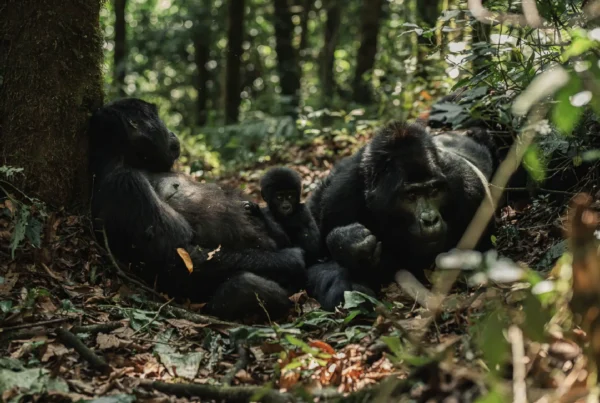
The next time you sit metres from a family of mountain gorillas, watching a silverback rest while juvenilles play in the canopy, remember the invisible team that made this moment possible. Trackers who rose before dawn, hiked for hours through difficult terrain, and found these animals so that you could share a brief, magical hour in their world. Their work is demanding, often thankless, and absolutely essential to the survival of mountain gorillas and the communities that depend on gorilla tourism.
Frequently Asked Questions
The global mountain gorilla population is approximately 1,100 individuals — one of the smallest populations of any great ape. They exist in two separate populations: one in the Virunga Massif spanning Uganda, Rwanda, and DRC; and one in Bwindi Impenetrable Forest (Uganda only). The population has grown from approximately 620 in the 1980s, largely due to tourism-funded conservation.
Uganda Wildlife Authority directs 20% of every gorilla permit fee to communities adjacent to Bwindi and Mgahinga. These funds pay for school construction, healthcare programmes, borehole maintenance, and community microfinance. Permit revenue also funds ranger salaries, anti-poaching patrols, and the research teams that monitor gorilla health daily.
The Batwa (also called Twa) are an indigenous forest people who lived inside Bwindi for thousands of years until it was gazetted as a national park in 1991. Conservation displaced them from their ancestral forest. Gorilla tourism revenue now funds Batwa cultural programmes and livelihoods. The Batwa Cultural Trail at Buhoma sector is run by the Batwa community and is one of the most authentic cultural experiences near Bwindi.
Mountain gorillas are classified as Endangered on the IUCN Red List — one step down from Critically Endangered, which they held until 2018. Their population has grown consistently since the 1980s, making them one of the few great ape populations increasing in number. This recovery is directly attributed to the conservation funding generated by gorilla tourism.
Uganda is home to the mountain gorilla (Gorilla beringei beringei), one of two subspecies of eastern gorilla. They live exclusively in the Virunga volcanic highlands (Uganda/Rwanda/DRC) and Bwindi Impenetrable Forest (Uganda only). Mountain gorillas are the only gorilla subspecies that cannot survive in captivity — every individual you can trek is a wild animal.