In 1994, Bwindi Impenetrable National Park was inscribed on the UNESCO World Heritage List, recognising it as a place of outstanding universal value for both its biodiversity and its significance as habitat for mountain gorillas. The inscription was a milestone for Ugandan conservation and for the global recognition of tropical forest ecosystems as irreplaceable heritage rather than simply unutilised land. Understanding what the World Heritage designation means — why Bwindi was chosen, what criteria it meets, and what practical difference the designation makes — adds depth to the experience of visiting one of Africa’s most celebrated natural landscapes.
What UNESCO World Heritage status means
The UNESCO World Heritage Convention, adopted in 1972, establishes a framework for identifying and protecting cultural and natural sites of outstanding universal value — places so significant that their conservation is considered a responsibility of the international community as a whole rather than of the country in which they are located alone. Natural World Heritage Sites are assessed against four criteria covering geological and geomorphological features, ecological processes, biodiversity, and habitat for threatened species. Sites must demonstrate outstanding universal value under at least one of these criteria and must also meet conditions of integrity and management that demonstrate effective protection.
Bwindi meets two of the four natural heritage criteria. It satisfies the biodiversity criterion, reflecting its extraordinary species richness including more than 1,000 plant species, 120 mammal species, 348 bird species, 220 butterfly species, and 27 frog species — more than double the numbers found in most comparable forest areas. It also satisfies the threatened species criterion, as the critical habitat of more than half the world’s mountain gorilla population and a range of other threatened species in the Albertine Rift biodiversity hotspot.
The Albertine Rift, the western arm of Africa’s Great Rift Valley running from Uganda through Rwanda, Burundi, and the Democratic Republic of Congo, is recognised as one of the most species-rich areas on earth. The combination of altitude, rainfall, and geological history has produced a landscape where species from East African savannah, Central African lowland forest, and montane environments overlap and interact, creating exceptional diversity within relatively small geographic areas. Bwindi sits at the heart of this biodiversity hotspot and represents its best-protected example.
The forest itself: what makes Bwindi ecologically extraordinary
Bwindi Impenetrable National Park covers 331 square kilometres of ancient montane forest that has remained largely undisturbed for at least 25,000 years, surviving the last glacial maximum as a forest refugium when most of East Africa’s forests contracted significantly. This antiquity explains much of its biodiversity: the long period of relative climatic stability has allowed the accumulation of endemic species adapted to Bwindi’s specific conditions, producing a flora and fauna with a higher proportion of unique elements than forests assembled from more recent colonisations.
The altitude range within the park — from approximately 1,160 metres in the Isiasha valley to 2,607 metres at the highest points — spans a complete altitudinal gradient of forest types from medium-altitude rainforest through montane forest to subalpine vegetation. This vertical diversity within a single park creates distinct ecological communities at different elevations, each with its own species assemblage, and the transitions between them produce the greatest diversity of overall species of any comparable area in East Africa.
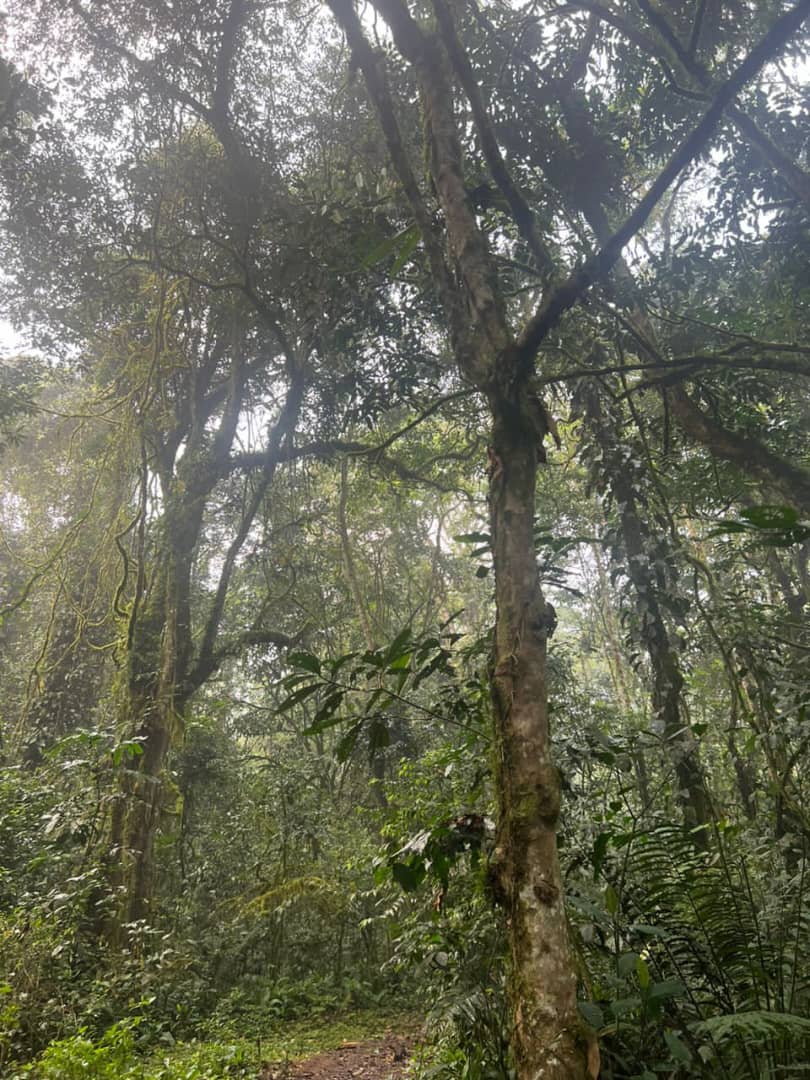
The impenetrability that gives the forest its name refers to the density of undergrowth and the difficulty of movement through vegetation that evolved without corridors for large-mammal passage. Unlike many tropical forests where occasional paths and clearings provide relatively easy walking, Bwindi’s forest interior is genuinely difficult to traverse without cutting tools, and many areas remain essentially unexplored by researchers outside of defined trails. This inaccessibility has protected the core of the forest from human disturbance and contributes to the stability of the gorilla population that depends on undisturbed interior forest for much of its range.
The gorilla population: why Bwindi is irreplaceable
Bwindi’s gorilla population is taxonomically and geographically distinct from the Virunga mountain gorilla population. Genetic analysis has confirmed that the Bwindi population has been separated from the Virunga population for long enough to develop distinct genetic characteristics, though both are classified as mountain gorillas (Gorilla beringei beringei) under the same subspecies designation. The separation means that the two populations cannot interbreed and must each be conserved independently — the loss of either population could not be compensated for by the survival of the other.
Bwindi’s gorilla population currently includes over 500 individuals across approximately 50 family groups, making it the largest single-site mountain gorilla population in the world. The park’s size relative to the Virunga sector means that the population is more spread across the landscape, with a higher proportion living in areas beyond regular research and tourism contact than in the more intensively monitored Virunga groups. This distribution provides some protection against localised threats but also means that population-level monitoring requires more extensive fieldwork than the geographically more compact Virunga sites require.
Threats to the World Heritage site
UNESCO World Heritage status does not immunise a site against threats — it establishes international visibility and creates obligations for the host country government to maintain the site’s outstanding universal value, but protection ultimately depends on national will and capacity rather than international designation. Bwindi faces several recognised threats that UNESCO and conservation partners monitor continuously.
The most persistent threat is pressure from communities surrounding the park whose land hunger, firewood needs, and traditional forest use practices bring them into conflict with park boundaries. Uganda’s southwestern highlands support some of the country’s highest rural population densities, and the agricultural land surrounding Bwindi is intensively cultivated. Boundary incursions for firewood collection, illegal cultivation, and bushmeat hunting have been documented along sections of the park boundary, and the patrol resources needed to address them comprehensively are not always available.
Climate change represents a longer-term threat through its effects on forest structure and species composition. Temperature increases and rainfall pattern changes may alter the altitudinal distribution of forest types, potentially compressing the montane forest habitats that mountain gorillas and other altitude-dependent species require. The park’s relatively small size limits the capacity for species to shift their ranges in response to climate-driven changes, as the distances involved in moving from lower to higher elevations within the park’s altitude gradient are constrained by the park’s boundaries.
What World Heritage status means for visitors
For visitors, the World Heritage designation provides an assurance that Bwindi has been independently verified as meeting the highest international standards for natural heritage significance and protection. It is a quality marker backed by decades of scientific assessment and an international framework of accountability. Visiting a World Heritage Site is a recognition of this significance and an engagement with the international conservation project that the designation represents.
The designation also places visits to Bwindi in a global context. The roughly 250 natural World Heritage Sites currently inscribed represent a small fraction of the world’s protected areas, chosen from thousands of candidates as those with genuinely exceptional universal significance. Bwindi sits in this select group alongside other African natural icons including Serengeti, Ngorongoro, Rwenzori Mountains, and the Virunga National Park in DRC — each representing a particular dimension of Africa’s extraordinary natural heritage that cannot be experienced anywhere else on earth.
Understanding Bwindi as a World Heritage Site enriches the gorilla encounter by framing it within the global significance of the place. The hour spent in the forest is not simply a wildlife experience — it is a visit to one of humanity’s designated natural wonders, a place that the international community has collectively agreed is worth protecting for all time. This larger context does not diminish the intimate, personal quality of the encounter but adds a dimension of shared human value to what is already an intensely individual experience.