The fact that humans share approximately 98.3 percent of their DNA with mountain gorillas is one of the most powerful educational hooks in conservation biology. For children who have just returned from a gorilla trek—or who are preparing for one—this number opens a door to questions about evolution, genetics, kinship, and what it means to be human. Approached well, the discussion moves from a surprising statistic to a genuine understanding of why gorilla conservation is not simply about saving an exotic animal but about protecting our closest living relatives.
What 98.3 percent DNA similarity actually means
The 98.3 percent figure refers to the similarity between human and gorilla genomes when the DNA sequences of both species are compared base-by-base. The human genome contains approximately three billion base pairs—the chemical letters of the genetic code—and about 2.7 million of those differ from the corresponding positions in the gorilla genome. That remaining 1.7 percent difference in sequence, combined with differences in gene expression (how genes are switched on and off) and structural variation (insertions, deletions, and rearrangements of larger DNA segments), is what separates a human from a gorilla.
For children aged 8 and above, a useful analogy is a very long recipe: human DNA and gorilla DNA are like two copies of the same enormous recipe book that are almost identical, but with slightly different instructions on a few pages. The same dishes appear—lungs, hearts, hands, eyes, brains—but the proportions and details differ in ways that produce very different outcomes. This framing makes the similarity feel concrete while acknowledging that 1.7 percent difference is enough to create two entirely distinct species.
Evolution and common ancestors: an accessible explanation
Humans and gorillas share a common ancestor that lived approximately 9 to 10 million years ago. This ancestor was neither human nor gorilla but a primate species from which multiple evolutionary lineages diverged over millions of generations. The chimpanzee lineage split from our own ancestor more recently—approximately 6 to 7 million years ago—which is why we share a slightly higher percentage of DNA with chimpanzees (98.7 percent) than with gorillas.
A useful visual for children is a family tree drawn very tall, with each horizontal branch showing a divergence point. Humans and gorillas share a branch far down the tree; humans and chimpanzees share a branch slightly higher up; all great apes share a branch higher still that separates them from other primates. This tree structure makes evolution’s mechanism—gradual divergence from shared ancestors—visually intuitive in a way that abstract percentages do not.
What gorillas and humans share behaviourally
The genetic similarity between gorillas and humans expresses itself in observable behaviours that children often find deeply affecting after a gorilla trek. Gorilla families have clear social bonds, with mothers carrying and nursing infants for up to three years, siblings playing together, and the silverback—the dominant adult male—maintaining group cohesion and protecting family members from threats. These behavioural parallels are not coincidental: they reflect shared evolutionary history and the social structures that helped both lineages survive in complex environments over millions of years.
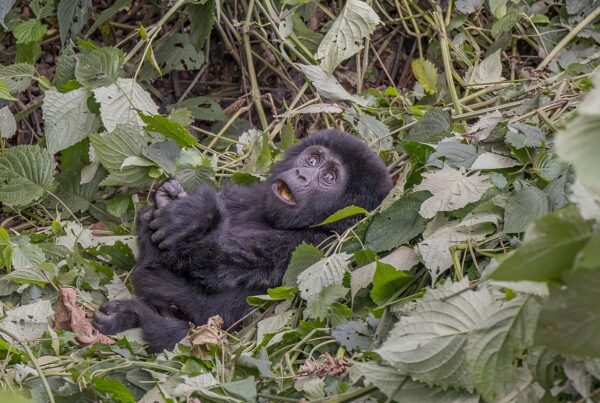
Gorillas show curiosity, problem-solving ability, grief (documented in research settings), and what appear to be individual personalities—consistent behavioural tendencies that researchers who spend extended time with gorilla families recognise and document. A child who watches a juvenile gorilla rolling in a nest, teasing a sibling, or seeking comfort from its mother after a minor alarm is not projecting human behaviour onto a different species—they are recognising genuinely shared emotional and social capacities that our DNA similarity helps explain.
Why this matters for conservation
Understanding the evolutionary and genetic kinship between humans and gorillas transforms the moral case for conservation. Protecting gorillas is not merely an act of charity toward a different kind of creature—it is, in a meaningful sense, protecting the living evidence of our own evolutionary history. Mountain gorillas are the closest thing to time travel available to living humans: observing them offers a window into the kind of social and ecological existence our shared ancestors lived millions of years ago. Children who understand this connection grow into adults who see wildlife conservation as part of the same project as human welfare—not a competing priority but an expression of the same values about what kind of world is worth inhabiting.
- Mountain Gorilla Silverback: What Makes a Silverback?
- The Children of Bwindi Who Grow Up With Mountain Gorillas Next Door
- Teaching children about gorillas before your Uganda family trek
- Mountain gorillas in children’s books, documentaries, and media: a curated guide
- How to explain endangered species to children: lessons from the mountain gorilla
- Teaching children about conservation through gorilla trekking stories
- Teaching children about conservation through gorilla trekking stories
- Teaching children about gorilla conservation: how young visitors understand the forest
- Meet the conservationist protecting mountain gorillas in the heart of the impenetrable forest.
- Why Adult Male Mountain Gorillas Stay Etched in Your Mind After Gorilla Habituation