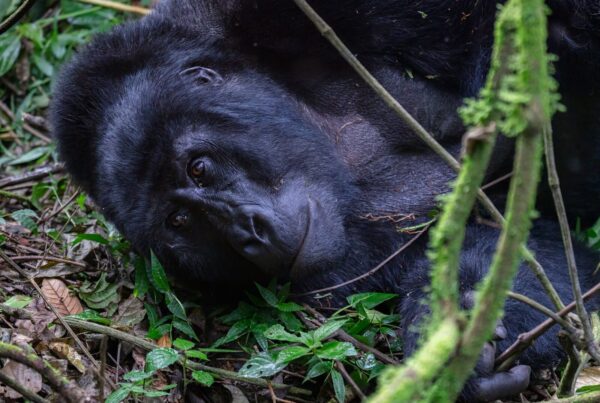
In the villages that ring Bwindi Impenetrable National Park, a generation of children is growing up with mountain gorillas as a permanent feature of their landscape. These children hear gorillas vocalising at dawn. They watch family groups moving along the forest edge during school breaks. Some of them — the children of rangers, trackers, and guides — grow up in households where gorilla behaviour is a regular topic of dinner conversation. Their relationship with these animals is nothing like the awed, occasionally tearful encounter that international tourists have after years of planning. It is quotidian, textured, and shaped by the particular intimacy of long familiarity. This post explores what it means to grow up beside mountain gorillas and how that proximity shapes the next generation of the conservation community around Bwindi.
The Everyday Reality of Gorilla Proximity
For children in Buhoma, Rushaga, Ruhija, and Nkuringo, gorillas are not exotic. They are, in the most literal sense, the neighbours. During the dry season when gorillas range more widely in search of food, it is not uncommon for gorilla families to move within 100 metres of village boundaries. Children walking to school in the early morning sometimes hear the deep rumble of silverback vocalisations from the forest edge. In areas where farms border the park, crop raiding by gorillas and other primates is part of the seasonal rhythm of farming life.
This proximity creates a very different kind of gorilla knowledge from the knowledge that comes from wildlife documentaries or pre-trek briefings. Children who have grown up alongside gorillas understand their behavioural patterns intuitively: they know that certain vocalisations signal agitation versus contentment, that family groups move in predictable directions at certain times of year, and that specific silverbacks have characteristic temperaments that can be read from a safe distance. This informal knowledge, transmitted across generations in forest-edge communities, is a resource that formal conservation training can build on but cannot create from scratch.
Conservation Education in Forest-Edge Schools
The schools adjacent to Bwindi — several of which were built or upgraded using gorilla tourism CRS revenue — have integrated gorilla ecology and conservation into their science and social studies curricula. Children in these schools learn the basics of mountain gorilla biology, the history of gorilla conservation in Uganda, the role of tourism revenue in community development, and the principles of responsible wildlife behaviour. They are, in effect, being trained as the next generation of conservation community members before they have made any formal career decisions.
The integration of conservation into school curricula was initiated by UWA community liaison officers working with school administrators in the early 2010s. The initial impetus was practical: children who understood why gorilla tourism was economically important for their communities would be less likely to engage in or tolerate behaviours — unauthorised forest entry, bushmeat eating, snare tolerance — that undermined conservation. The curriculum investment was a long-term conservation strategy disguised as education, and it appears to be working.
The Conservation Career Pipeline
Among the current generation of young adults in Bwindi-adjacent communities, conservation and tourism are now among the most aspired-to career paths. Survey data from 2025 found that among secondary school students in parishes adjacent to Bwindi, 28 percent listed “ranger,” “guide,” or “lodge manager” as their first-choice career. A decade earlier, the same survey found fewer than 10 percent expressing those preferences. The shift reflects both the visibility of conservation employment in these communities and the growing perception that conservation careers are stable, respectable, and financially viable.
We hire regularly from this career pipeline. Several of our junior guides and logistics staff are in their mid-20s, from communities adjacent to Bwindi, with childhood memories of watching gorilla trekking tourists arrive and imagining themselves in the guiding role. Their professional commitment to the work is shaped by that biographical connection — they are not just employed in gorilla tourism; they grew up in it.
What This Generation Will Determine
The children growing up in Bwindi-adjacent communities today will be the rangers, guides, lodge managers, community leaders, politicians, and farmers who determine the fate of mountain gorilla conservation over the next 30 to 40 years. Whether Bwindi remains a protected area that local communities support — or becomes a protected area that communities tolerate at best and undermine at worst — will depend significantly on whether these children grow up believing that conservation serves their interests. The evidence from the current generation is cautiously optimistic. Whether that optimism is warranted will be determined by the choices made about tourism quality, community benefit distribution, and conservation management in the years ahead.