There is a quality of attention that gorilla trekking demands that most modern life does not. From the moment the ranger group enters the forest, the protocol is clear: no phones ringing, no loud conversation, no sudden movements, minimal talking. The forest asks for quiet, and in responding to that request, many trekkers report an unusual and valuable shift in their awareness—a settling into the present moment that resembles meditation without being called that. This article explores the practice of deep listening as an experience available within gorilla trekking, and what that attention reveals about both the forest and oneself.
What the forest sounds like when you stop talking
Most people, entering a forest for the first time in silence, are surprised by how much they were not hearing while they were talking. Bwindi’s soundscape is extraordinarily layered. At the highest level, hornbills call across the canopy with deep, resonant booms that carry hundreds of metres through the trees. At mid-level, Rwenzori turacos give their distinctive rolling calls, and sunbirds produce thin, piercing notes as they move between flowering understorey shrubs. Closer to the ground, insects—crickets, cicadas, beetles—create a continuous backdrop of sound that fluctuates with temperature and humidity. Water is audible in almost every part of Bwindi: streams running over rocks, drips from saturated moss, the sound of rain arriving at the canopy several seconds before it reaches the ground.
Within this soundscape, gorilla presence announces itself through sounds that rangers read fluently: the deep chest-beat of a silverback announcing its position, the softer belch vocalisation that signals contentment within a feeding group, the sudden crashing of vegetation as a juvenile drops from a tree. Learning to hear these signals within the ambient forest sound is one of the joys of trekking with an experienced guide—it transforms the forest from a wall of green noise into a legible environment where meaning emerges through attention.
The embodied practice of forest movement
Moving quietly through dense forest requires attention to the body that is unusual in everyday life. Each footstep must be placed deliberately—heel first on firm ground, toes first on soft soil, testing weight before committing to a step. Branches that would snap loudly must be held aside and released slowly. The breath should be controlled enough to prevent heavy panting that disturbs wildlife. This level of physical mindfulness, sustained for several hours, has an effect that several traditions of contemplative practice describe: the mind, occupied with immediate physical demands, quiets the habitual chatter of planning, memory, and anxiety that fills most waking hours.
Practitioners of walking meditation in Buddhist, Quaker, and other traditions have long recognised that purposeful slow movement through a natural environment can induce states of alertness and calm that are difficult to achieve by sitting still. The gorilla trek, without claiming any contemplative intention, creates these conditions naturally through its protocol of quiet movement and heightened attention.
The moment of encounter as deep presence
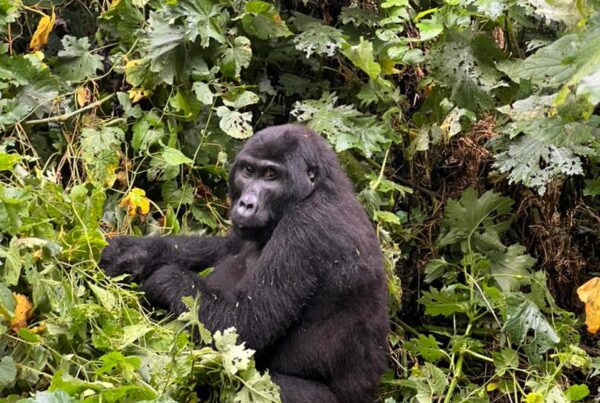
When the ranger signals that the gorilla group is close and the group stops, something shifts. The hour of one’s permission begins ticking. There is nowhere to be other than here. The phone in the pocket may be a camera, but its function in this moment is to witness, not to distract. The silverback is, at most, fifteen metres away, aware of the group’s presence and evaluating it with calm, steady intelligence. In this moment, the quality of attention that deep listening has prepared through the trek’s quiet hours reaches its purpose: complete, undivided, present-moment awareness of what is actually happening, stripped of commentary, anticipation, and retrospection.
Many trekkers report that this moment is the most fully present they have felt in years—possibly ever. The absence of distraction, the proximity of a being that commands absolute attention, and the brevity of the allowed time combine to create a quality of experience that ordinary life rarely affords. Deep listening in the forest is not a technique you bring to the trek; it is the gift the trek offers if you accept the conditions it places on your attention.
- Gorilla Group Formation and Dynamics: The Deep Bonds That Shape Life in the Forest
- The School in Bwindi That Teaches Children to Love the Forest
- Mindfulness and presence in the forest: the art of the slow gorilla trek
- Shinrin-yoku and forest bathing: applying the Japanese practice in Bwindi’s rainforest
- The sound of the forest: listening to Bwindi’s acoustic world
- Bwindi Impenetrable Forest – Gorilla Trekking in Uganda’s UNESCO Jungle
- Meet the conservationist protecting mountain gorillas in the heart of the impenetrable forest.
- 2020 Gorilla Baby‑Boom in the Impenetrable Forest
- Gorillas and Their Fascinating Social Structures: The Heartbeat of the Forest
- Uganda Primate Safaris: Journey Into the Forests Where We First Belonged