TALK TO AN EXPERT +256 716 068 279 WHATSAPP OPEN NOW.
Children & Family Education

Mountain gorilla infant development: the first five years of a gorilla’s life

Home / Travel News, Stories & Tips / Children & Family Education / Mountain gorilla infant development: the first five years of a gorilla’s life

The birth of a gorilla infant in a habituated family at Bwindi is an event that ripples through the entire conservation community — research teams, veterinary staff, community liaison officers and the guides who will lead visitors to that family for years to come. For visitors who encounter a family with a very young infant, the moment carries a particular emotional weight: the infant is simultaneously a conservation metric, a social fulcrum within the group and a small primate whose developmental trajectory over the next five years will be among the most intensively documented animal life histories in Africa.

Birth and the newborn period

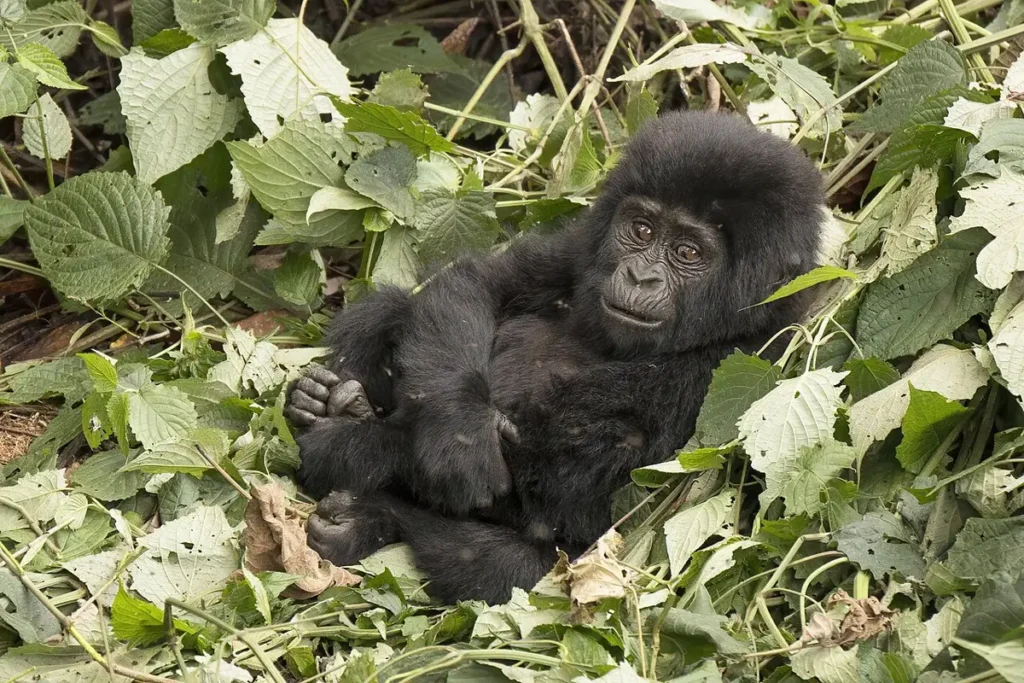
Mountain gorilla infants are born after an approximately 8.5-month gestation period, weighing roughly 1.8 kilograms — small relative to adult gorillas but comparatively large among primates for their birth weight to adult weight ratio. Newborns are neurologically immature by primate standards; they cannot support their own head weight and cling to their mother’s chest fur with a grip strength that is disproportionate to the rest of their physical capabilities. The mother cradles the infant with her arm for much of the first weeks; the infant’s eyes are open but visual coordination develops gradually. A newborn gorilla observed during a trek appears frail and pink-faced, often with a tuft of white rump hair that serves as an age indicator and disappears around two years of age.

Months three to six: the beginnings of independence

By three months, the infant begins to show the beginnings of independent movement — brief, wobbly attempts to move away from the mother before quickly returning to contact. The infant’s grip on the mother shifts from ventral (chest) carrying to dorsal (back) carrying as the infant grows heavier and the mother’s arm can no longer sustain prolonged cradling without fatigue. Back-riding, with the infant seated upright on the mother’s back and gripping her fur, becomes the primary transport mode by four to six months. During this period, other group members — particularly juvenile females — show intense interest in the infant, approaching for close inspection and occasionally attempting to touch or hold it, to varying degrees of maternal tolerance.

The first year: social learning begins

Gorilla infants begin tasting solid food in their first year, picking up and mouthing vegetation that their mother feeds on. This is exploratory and supplementary — milk remains the primary nutrition source through the first two years — but it is the beginning of dietary socialisation, the process by which the infant learns which plants are edible and how they are prepared (whether leaves are stripped from stems, whether bark is peeled, which fruits are taken whole versus broken open). The process is not instruction — gorilla mothers do not teach — but observation and imitation that gradually builds a functional knowledge of the family’s food repertoire. By twelve months, the infant’s dietary exploration is purposeful and covers most of the group’s regular plant species.

Years two and three: play and peer relationships

The period from eighteen months to three years is the most socially exuberant phase of gorilla infant development. Weaning, which begins in this period (the inter-birth interval for mountain gorillas is approximately four years), creates increasing independence from the mother’s constant physical proximity. Play with siblings, cousins and peers within the group — wrestling, chasing, climbing, mock displays — occupies a substantial proportion of waking time. Play is the developmental substrate for the physical coordination, social reading and dominance-negotiation skills that the gorilla will need as an adult. An infant at two years observed during a trek is often the most visually active individual in the group — perpetually in motion, investigating everything, apparently indifferent to the human observers watching from seven metres away.

Years four and five: the approach to juvenility

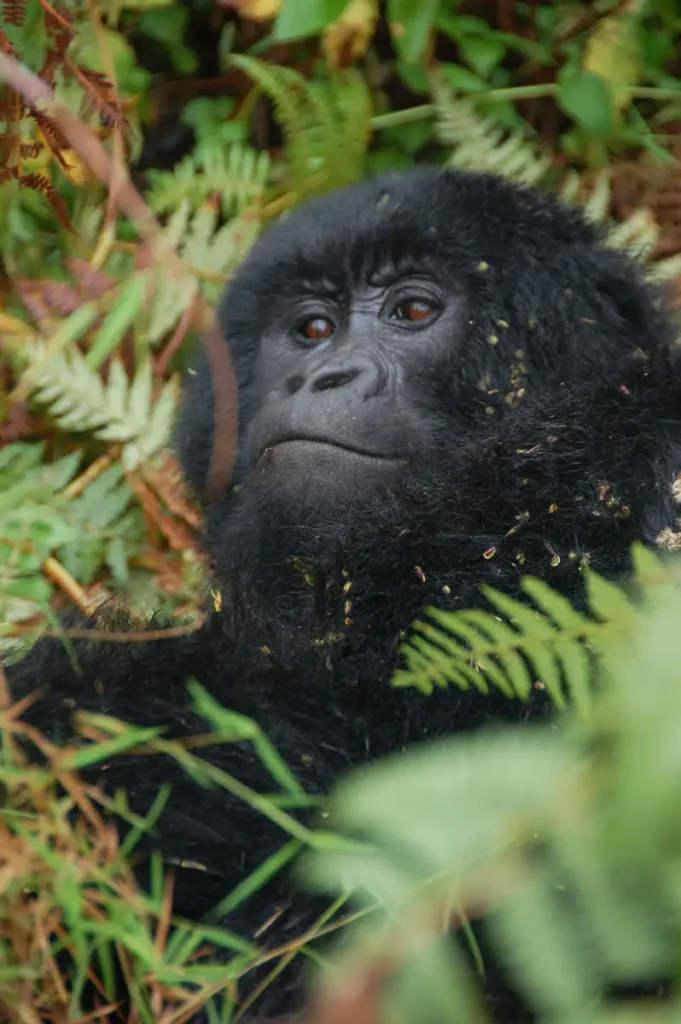
By four years, gorilla infants are designated juveniles in research classification systems — their social independence, physical development and behavioural repertoire have expanded beyond what “infant” captures. They travel independently of their mothers for sustained periods, forage effectively for most of their nutrition and are beginning to navigate the social complexity of their group as individuals rather than extensions of maternal status. Males in this age range begin to show the initial signs of the physical divergence that will eventually produce adult sexual dimorphism — a process that takes another decade before full silverback maturity. The four-to-five-year period is also when the white rump patch definitively fades, marking the transition from infant to juvenile in a way that is visible to researchers and, with experience, to visitors.

What this means for the conservation count

Each infant that survives the first year represents a meaningful contribution to the mountain gorilla population count. Infant mortality in the first year is not negligible — disease, predation, social instability during group fissions and silverback infanticide during transitions all represent risks that some infants do not survive. The survival of an infant through its first five years and into independent juvenility represents the successful execution of the reproductive and social biology that, across the whole population, produces the slow but consistent population growth that has raised Bwindi’s gorilla count from 320 individuals in 1989 to over 460 today. Each infant visible during a trek is a data point in that trajectory.

Ready to experience Uganda’s mountain gorillas in 2026? Secure your gorilla permits early and let us craft a seamless safari tailored to your travel style, preferred trekking sector, and accommodation level. From luxury lodges to well-designed midrange journeys, every detail is handled for you. Every itinerary is carefully planned to maximize your time in the forest while ensuring comfort, safety, and unforgettable encounters.

Have questions about gorilla permits, travel dates, or the best itinerary for you? Speak with a safari expert and get clear, honest guidance to plan your trip with confidence.

When is the last time you had an adventure? African Gorillas!!! Up Close With Uganda’s Wild Gorillas Touched by a Wild Gorilla: An Unforgettable Encounter Inside Gorilla Families: Bonds, Hierarchies & Jungle Life Face to Face With a Silverback: The Wild Encounter You’ll Never Forget