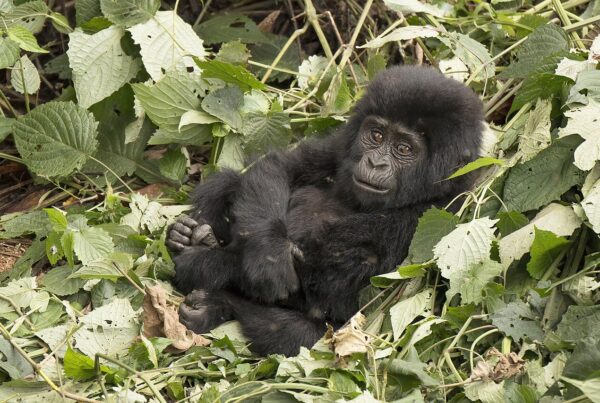
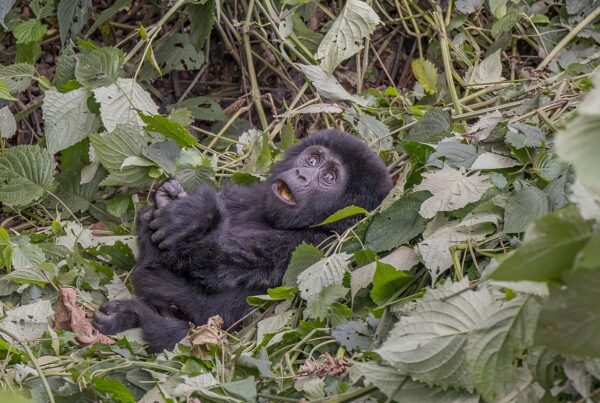
A child who has been told the story of the mountain gorilla — their near-extinction, the scientists and communities who fought to save them, their recovery from fewer than 250 individuals to over 1,000 today — carries something that no curriculum can fully replicate: a living example of what determined human effort on behalf of another species can achieve. Gorilla conservation is one of the most clear-cut conservation success stories of the twentieth century, and it is a story ideally suited to children because it is specific, emotionally resonant, involves real people with memorable names, and ends with hope rather than despair.
Why the gorilla story works for children
Good conservation education for children requires several things that the mountain gorilla story provides in abundance. It needs a protagonist that children can feel emotionally connected to — mountain gorillas, with their expressive faces, complex family structures, nurturing mothers, and playful juveniles, are among the most relatable animals on earth. It needs a clear threat that children can understand — habitat loss, poaching, human encroachment — without being so abstract as to feel overwhelming. And it needs a resolution that demonstrates the efficacy of human action.
The mountain gorilla story has all of these. The population collapse of the 1970s and 1980s — when the number of mountain gorillas fell to below 250 individuals and extinction within decades seemed plausible — provides the dramatic crisis that any good story needs. The scientists, rangers, local communities, and international organisations who responded to that crisis provide the human protagonists. And the population recovery — now exceeding 1,000 individuals and continuing to grow — provides the resolution. This is not a story that ends with “we are trying.” It is a story that ends with “we succeeded, and are succeeding still.”
Key figures children can engage with
Dian Fossey is the central human figure in mountain gorilla conservation history and one of the most compelling scientific biographies of the twentieth century. Her eighteen years of field research at Karisoke in the Rwandan Virungas, beginning in 1967, produced the first detailed understanding of mountain gorilla social behaviour — the nature of gorilla families, the personalities of individual animals, the complexity of their communication. She named the gorillas she studied, giving them identities that made them subjects rather than objects. Digit, Peanuts, Uncle Bert — her gorillas became known to a global public through her writings and the 1988 film Gorillas in the Mist.
Fossey’s story for children carries both inspiration and complexity. Her dedication to the gorillas — sustained through physical hardship, political instability, and personal isolation — demonstrates what passionate commitment to a cause looks like in practice. Her anti-poaching work, which brought her into violent conflict with poachers and local authorities, shows that conservation can require personal courage. Her murder in 1985 — almost certainly by poachers or those protecting poaching networks — demonstrates that the stakes of conservation can be genuine. How much of this complexity to share with younger children requires parental judgment, but even simplified versions of Fossey’s story convey the essential message: one person who cared enough to act made an enormous difference.
Ranger stories from Uganda and Rwanda provide more recent, locally grounded human figures who may resonate differently with different children. UWA rangers who have dedicated careers to protecting Bwindi’s gorillas, community members who have transitioned from subsistence farming to conservation work, young Ugandan conservationists — these figures ground the gorilla story in a contemporary African context that enriches the historical narrative Fossey provides.
The recovery as a success story framework
Conservation education too often leaves children with a sense of helplessness — the problems are so large, so systematic, so driven by forces beyond individual control, that the logical emotional response is despair or disengagement. The mountain gorilla recovery story is a direct counter-narrative to this tendency. It demonstrates that a species on the edge of extinction can recover. That protection, research, and community engagement work. That the trajectory of decline can be reversed.
The numbers are worth sharing with children old enough to engage with them. In 1989, there were approximately 320 mountain gorillas remaining in the wild. By 2018, the population had exceeded 1,000 — a tripling in thirty years achieved through sustained, determined conservation effort. This is not a story about nature recovering on its own. It is a story about what happens when humans decide to act on behalf of another species with adequate resources, scientific knowledge, and community support.
For children who respond well to systems thinking, the mechanisms of the recovery are also teachable: the establishment of protected areas (national parks), the habituation programme that made research and tourism possible, the tourism revenue that funded both park management and community development, the community buy-in that reduced poaching, the Gorilla Doctors veterinary programme that treats injured and ill animals. Each mechanism is a lesson in how human institutions and intentions translate into real-world outcomes for wild animals.
Books and resources for different ages
Picture books for younger children (ages 4–8) that engage with gorilla conservation include Gentle Giant: The Story of Koko the Gorilla and various picture books about the Fossey story adapted for early readers. The Mountain Gorilla by Anna Claybourne, part of the Animals on the Edge series, provides accessible non-fiction for children aged 7–10 with clear explanations of conservation status and recovery efforts.
For children aged 10 and up, Sy Montgomery’s Saving the Ghost of the Mountain — about snow leopard conservation — applies the same narrative structure that works so well for gorillas and can serve as a companion to gorilla-specific texts. Jane Goodall’s extensive writing for young readers, including Jane Goodall’s Animal World: Gorillas, provides accessible chimpanzee and ape science from one of the field’s most authoritative voices.
The Dian Fossey Gorilla Fund International operates educational programmes specifically designed for children and schools, including downloadable curriculum materials and virtual classroom visits. These resources are designed by conservation education specialists and tested with children across different educational contexts. They are available on the Fossey Fund website and are suitable for both home use and classroom deployment.
Using the trek itself as a teaching experience
For families undertaking a gorilla trek with children aged 15 and above (the UWA minimum age for standard trekking), the trek itself is the most powerful conservation education available. Briefing children before the trek on the history of the specific gorilla group they will visit — its habituation process, its named individuals, the composition of the family — creates a context of understanding that transforms what might otherwise be a spectacular but opaque wildlife encounter into a meeting with known individuals whose stories the child understands.
During the trek, encourage children to notice what rangers and trackers do — the signs they read, the radio communications they make, the careful management of the visitor group’s position relative to the gorillas. The invisible infrastructure of protection and monitoring that makes each gorilla encounter possible is a powerful lesson in what conservation work actually looks like on the ground, day after day.
After the trek, processing the experience with children through conversation and reflection consolidates what they have encountered. Questions worth asking: Which gorilla did you find most interesting to watch? What surprised you about the way they moved or behaved? Why do you think the rules about distance and noise matter? What would happen to the gorillas if the park wasn’t protected? These questions move children from experiencing the gorillas as a spectacle to thinking about them as subjects in a conservation story they can continue to follow, support, and eventually contribute to.
The wider lessons: from gorillas to conservation values
The gorilla story is a gateway to broader conservation values that children can apply across contexts. The concept of a species having intrinsic value — worth protecting regardless of its utility to humans — is most easily understood when the species is as recognisably sentient and socially complex as a mountain gorilla. Once a child genuinely grasps why a gorilla matters, the intellectual leap to why a beetle, a fish, or a plant matters is shorter and more navigable.
The relationship between biodiversity and human wellbeing — the way the forests that gorillas depend on also regulate water, sequester carbon, and support the livelihoods of millions of people — is another thread worth pulling for children who respond to systems thinking. The gorilla is not separate from the forest, the forest is not separate from the climate, and none of these are separate from the communities that live alongside them. Understanding this connectedness is the foundation of environmental literacy.
A child who leaves Uganda with a genuine attachment to the mountain gorillas and an understanding of how their survival has been secured carries that understanding into adulthood. They become the donors, the voters, the professionals, and the parents who sustain the support for conservation that the next generation of mountain gorillas will depend on. The hour in the forest at Bwindi is not just a travel experience — for a young person prepared to understand its meaning, it is an investment in a lifetime of environmental engagement.