She had not meant to use the word — a cathedral is a building, not a forest — but standing at the edge of the trail and looking up at the canopy of Bwindi Impenetrable Forest, the light filtering through multiple leaf layers, the columns of ancient trees rising into a vaulted green ceiling, the acoustic presence of a space that absorbed sound the way a cathedral absorbs it and returned it differently, the word arrived before any other word did, and it was accurate in the way that the best descriptions of places are accurate not because they are technically precise but because they capture something about the experience that precision cannot. Bwindi is one of the oldest forests on Earth — it survived the last Ice Age when most African forests did not. Plan your visit with a gorilla trekking permit and book a 7-day Uganda gorilla safari.
- Age: Bwindi has been forested for at least 25,000 years — it survived the last Ice Age’s drying of Africa when many surrounding forests collapsed; this age is visible in its extraordinary species density
- Biodiversity: over 1,000 flowering plant species; 120 mammal species; over 350 bird species including 23 Albertine Rift endemics; 220 butterfly species
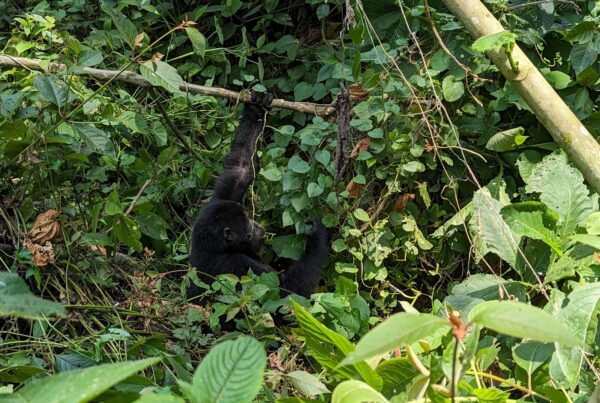
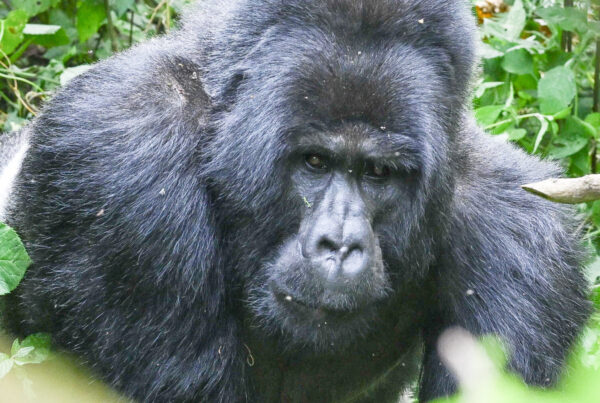
- Mountain gorillas: approximately half the world’s mountain gorilla population lives in Bwindi; the other half in the Virunga volcanoes shared between Rwanda, DRC, and Uganda
- UNESCO status: Bwindi is a UNESCO World Heritage Site; listed in 1994; recognised for its extraordinary biodiversity and as the primary habitat of the mountain gorilla
She had not meant to use the word. A cathedral is a building, not a forest. But standing at the edge of the trail and looking up at the canopy of Bwindi Impenetrable Forest — the light filtering through multiple leaf layers, the columns of ancient trees rising into a vaulted green ceiling, the silence that is not actually silence but the layered sound of the forest operating at its ordinary volume — she reached for cathedral and could not find a better word for what she was standing inside.
The comparison is made often enough that it has become one of the standard descriptions of the Bwindi experience. Not because the forest looks like a cathedral — it does not — but because the quality of presence it induces is similar. The scale that makes you feel small without making you feel diminished. The accumulated time that makes your own span of years feel brief without making you feel insignificant. The sense that you have entered something that has its own purpose, its own logic, its own integrity that exists entirely independently of whether you are there to appreciate it.
What Ancient Forests Do to Human Attention
Bwindi Impenetrable National Park has been continuously forested for more than 25,000 years. During the Pleistocene, when most of East Africa’s forests contracted dramatically as ice ages cooled and dried the climate, Bwindi was a forest refuge — one of the places where the biodiversity of a continent was preserved through the long cold. The trees growing in Bwindi today are the descendants of trees that survived that contraction, in a lineage of continuous forest cover that extends through documented human history, before it, and into a geological past that dwarfs any human frame of reference.
This continuity is not visible in the way that a cathedral’s visible age is visible — there are no inscriptions on the trees recording when they were planted, no architectural styles that date the construction. But it is present in other ways: in the extraordinary species diversity that results from 25,000 years of ecological continuity, in the complexity of the vegetation structure that is the visual signature of an undisturbed primary forest, and in the specific quality of the air and the light and the silence that ancient forests have and younger forests do not yet possess.
The Spiritual Dimension Without the Supernatural
The cathedral comparison is made, typically, by people who do not mean it in a religious sense. They are reaching for the quality of attention the forest induces — the involuntary heightening of awareness, the shift from habitual perception to something more awake and more receptive, that both great religious buildings and great wild places produce. This quality does not require any supernatural explanation. It is the ordinary response of a human nervous system, calibrated over hundreds of thousands of years of evolution in environments like this one, to an environment it recognises as significant.
The gorilla encounter that Bwindi makes possible adds a specific dimension to this quality of attention: an encounter with another form of consciousness in the space that produces it. You are not just moved by the forest. You are moved by the forest in the company of a great ape family that has been moving through this same forest for generations, for whom the forest is home rather than pilgrimage destination.
The $800 Entry to the Cathedral
The Uganda gorilla permit at $800 in 2027 is the entry to the forest that the visitor described as a cathedral. It is not the entry to a place of worship — it is the entry to a place of presence, of age, of biological richness, and of the encounter with gorillas that is Bwindi’s most extraordinary offering. The word cathedral was reached for because no smaller word was sufficient. Contact us to book your entry. No smaller experience will be sufficient either.
Why is Bwindi called “Impenetrable” Forest?
The name “Impenetrable” has a specific historical and physical basis. Historical usage: the name was used by early explorers and hunters to describe the density of the vegetation below the canopy; the ground layer of Bwindi has an extremely thick undergrowth of climbing plants, ferns, and stinging nettles through which movement without a trail or machete is genuinely nearly impossible. The physical reality: the valley bottoms where gorillas sometimes range have particularly thick vegetation; the steep slopes add to the difficulty of movement; rangers who track gorillas off-trail routinely use machetes to open passage. For trekkers: the established gorilla trekking trails at Buhoma, Ruhija, Rushaga, and Nkuringo are cleared and maintained; the “impenetrability” is experienced when the gorillas move into valley thicket and the group follows — this is when the name becomes viscerally clear.
How old is Bwindi Forest and what makes it biologically special?
Bwindi’s age is the source of its extraordinary richness. The Ice Age survival: approximately 25,000 years ago, during the Last Glacial Maximum, Africa’s climate dried significantly; most forests retreated or disappeared; Bwindi and a few other sites persisted as “refugia” — isolated islands of habitat; species that could not survive elsewhere persisted in these refugia and speciated (evolved into new forms). The result: 25,000 years of continuous forest means 25,000 years of evolutionary divergence; the 23 Albertine Rift endemic birds found at Bwindi evolved in these refugia; the extraordinary invertebrate diversity reflects the same history. Species density: the 330+ km2 of Bwindi holds more mammal and bird species per square kilometre than almost any comparable forest area in Africa; the high elevation (1160-2607m) adds montane-forest specialists to the lowland forest species creating an altitudinal layering of biodiversity that few sites match.
What else can I see in Bwindi besides gorillas?
Bwindi has exceptional wildlife beyond the gorillas. Other primates: black-and-white colobus, red-tailed monkey, L’Hoest’s monkey, and olive baboon; chimpanzees are present but not habituated for tourism at Bwindi (the main chimp trekking is at Kibale Forest). Birds: the birding at Bwindi is world-class; the African green broadbill, Grauer’s broadbill, Grauer’s warbler, and Shelley’s crimsonwing are Albertine Rift endemics found here; the Uganda birding safari specialist community values Bwindi very highly. Butterflies: 220 species; the forest glades and stream banks attract large congregations of forest-specialist species. Forest walks: non-gorilla forest walks are available at Buhoma with rangers; the Munyaga River trail and the waterfall trail provide birding and primate viewing opportunities for visitors who have additional days after their gorilla trek.
How does Bwindi compare to the Virunga volcanoes as a gorilla destination?
Both sites have mountain gorillas but offer distinctly different experiences. Bwindi: complex, multi-layered rainforest terrain; steep valleys and ridges; no volcano hiking; higher biodiversity overall; all four sectors (Buhoma, Ruhija, Rushaga, Nkuringo) give access to more than 20 habituated families; permits USD 800. Virunga (Rwanda): open afromontane habitat at higher altitude; the bamboo zone is distinctive; shorter treks on average because habitat is less dense; combines well with Volcanoes NP hiking; permits USD 1,500 (Rwanda). Virunga (DRC): permits cheaper but security considerations apply; only for experienced travellers with current security information. Which to choose: Bwindi is the most accessible and most logistically straightforward; the experience of the forest itself at Bwindi is more immersive than the more open Rwandan volcanic slopes; most first-time gorilla trekkers choose Bwindi for this reason.
What is the best time of year to trek gorillas in Bwindi?
Gorilla trekking at Bwindi operates year-round but two seasons are generally preferred. Dry seasons (June-September, December-February): trails are drier and less slippery; easier hiking; better photography with less obscuring vegetation; these months are peak season and permits sell out months in advance. Wet seasons (March-May, October-November): Bwindi receives rain year-round but these periods have heavier rainfall; the forest is more lush and more atmospheric; gorillas are still found daily; permits are easier to obtain; prices are sometimes lower for accommodation. Best time overall: June-September is Uganda’s most reliable dry period; this is the best time for gorilla trekking combined with a Queen Elizabeth NP safari or Kibale chimp trek; book at least 3-4 months ahead for this period.
- Why Bwindi Forest Was Described as a Cathedral by a First-Time Visitor
- Uganda Travel Tips for First-Time Visitors: What You Need to Know Before You Go
- New Eco-Lodge Opens Inside Bwindi Forest in 2026: First Look
- Gorilla Trekking Uganda for First-Time Africa Visitors
- Uganda’s Entebbe International Airport: arrival guide for first-time visitors
- Bwindi Impenetrable Forest – Gorilla Trekking in Uganda’s UNESCO Jungle
- Uganda Primate Safaris: Journey Into the Forests Where We First Belonged
- Chimpanzees Confirmed in Bwindi Forest
- Bwindi Forest: What Happened to the White-Bellied Duiker?
- Bwindi Forest Gorilla Trekking: An Unforgettable Journey