Updated
gorilla trekking Uganda right moment is one of Africa’s most extraordinary wildlife experiences, connecting travellers with mountain gorillas in their natural forest habitat. Talk to people who have done gorilla trekking in Uganda and ask them whether the timing was right — ask how long they waited before going, whether they felt ready when they went, whether the trip came at a good time in their life — and what you hear, again and again, is some version of the same answer: it came at exactly the right moment, and that moment came only because they finally decided to go. How to book your Bwindi gorilla trek and start a Uganda safari.
- Mountain gorilla population: 1,063 individuals (2018 census); the only great ape whose population is increasing; Uganda holds approximately 400-450
- Permit availability: Bwindi has approximately 20+ habituated families and over 100 permits per day; Mgahinga has one family (Nyakagezi)
- Physical demand: moderate; suitable for most reasonably healthy adults; no technical skill required; walking poles provided
- Duration of trek: variable 1-8 hours depending on gorilla location; the 60 minutes with the gorillas is fixed
Talk to people who have done gorilla trekking in Uganda and ask them: was the timing right? Ask them how long they waited before going, whether they felt ready when they went, whether the trip came at a good time in their life. What you hear, again and again, is some version of the same thing: it arrived exactly when it needed to. Not because the timing was perfect — it rarely was — but because the trip has a quality of meeting you where you are, of delivering exactly the thing you did not know you needed until you were in it.
Gorilla Trekking Uganda: The Trip That Always Arrives at the Right Moment
The Trip That Reads the Room
There is a category of experience that seems to understand what you need from it. These are the experiences that travelers return to in conversation, that they recommend not just as good trips but as important ones — trips that shifted something, clarified something, restored something. Gorilla trekking in Uganda falls into this category with a consistency that is unusual.
People go for different reasons. Some go as a celebration — a milestone birthday, an anniversary, a retirement. Some go because they have loved wildlife their whole lives and this is the apex. Some go because they need a reset — because ordinary life has become too loud and something in them needs a different kind of quiet. Some go because they made a promise to themselves years ago and it is finally time. And all of them — from different starting points, with different expectations — report the same essential thing: the trip gave them what they needed.
Why the Forest Does This
Bwindi Impenetrable Forest is 25,000 years old. It has outlasted ice ages, empires, and the full arc of human history as we know it. Walking inside it, you feel that continuity as something physical — the density of the vegetation, the age of the trees, the layered soundscape of a forest that has never been quiet. The forest does not care about your problems or your context. It simply is, with a completeness that puts ordinary concerns in their proper perspective.
The gorillas extend that quality. They are unhurried. They do not perform. A silverback may spend fifteen minutes simply sitting, chewing leaves, occasionally glancing at your group with calm authority. There is no schedule here, no urgency, no anxiety about the future. Just the present moment, fully inhabited. For travelers who spend most of their lives in the opposite condition, the contrast is not just pleasant — it is genuinely restorative.
The Moment That People Remember
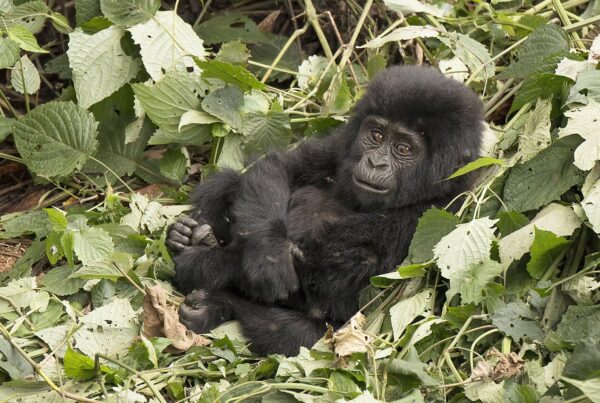
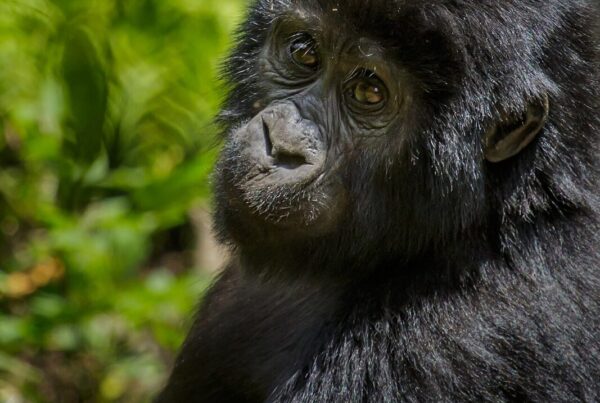
Every gorilla trek produces a moment that the person carries permanently. It is different for everyone — the juvenile that approaches within a meter and studies you with enormous dark eyes. The mother nursing her infant while watching you with an expression of composed attention. The silverback rising to his full height, not in aggression, just in the ordinary movement of a very large animal through his world. The moment when a gorilla and a human make direct eye contact and something passes between them that cannot be named but will never be forgotten.
These moments happen within the permitted hour — one hour per trekking group per gorilla family per day, with a maximum of eight trekkers. The $800 permit for international tourists in 2027 secures that hour. Most people describe it as the best $800 they ever spent, not because the calculation is rational, but because the experience operates on a register that transcends calculation.
Before and After the Trek
The trek itself is framed by a Uganda that enhances it. The drive from Entebbe or Kampala through the highlands of western Uganda — the Kigezi region, folded green hills that rival any landscape on Earth. The lodge at the forest edge, where the sounds of the night forest come through the window. The ranger briefing over breakfast, the introduction to the family you will visit. And after the trek, the walk back to camp, the lunch in the forest, the afternoon watching birds from a deck that overlooks the hills.
Uganda has 1,066 bird species. Bwindi alone has over 350 species, including 23 Albertine Rift endemics found nowhere else on Earth. For birders, the trip within the trip is extraordinary. For everyone else, the birds are part of the texture of the place — the sound of the forest, the movement in the canopy, the flash of color in the undergrowth — that makes Bwindi more than just a destination for gorilla encounters.
The Right Moment Is Now
There is a version of this that says: wait for the right moment. Wait until your life is more settled, your finances more comfortable, your schedule more open. And there is wisdom in preparation. But there is a trap in waiting for the perfect moment that never comes, in holding the trip in reserve for a readiness that feels perpetually one step away.
The trip that always arrives at the right moment arrives because you bring it. The rightness is not in the external circumstances. It is in the act of choosing to go — of deciding that this is worth prioritizing, worth planning around, worth the cost and the distance and the complexity. That decision itself is part of what the trip delivers. It is the first step of the transformation, and it happens not in Uganda but here, in the ordinary moment of filling in a booking form and committing to go.
Your Moment Is Available
Gorilla trekking permits in Uganda are available for 2027. The forest is intact. The gorilla families are thriving — the global mountain gorilla population has grown to over 1,100 individuals, the only great ape species with an increasing population. The rangers who will lead your trek have spent careers in this forest, know its families by name, and will give you an experience that no guidebook can adequately prepare you for.
The trip that always arrives at the right moment is waiting for you to give it a moment to arrive into. Book it. Find out what the forest knows about what you need. It has had 25,000 years to get good at this.
How do people typically describe what the gorilla encounter actually felt like?
The accounts are strikingly consistent across very different kinds of people. The scale: the first sight of a silverback mountain gorilla in forest — a 170-200kg animal moving through the undergrowth with complete self-possession — recalibrates your sense of what large means. The eye contact: mountain gorillas make direct eye contact; they hold it; this is the moment that stays; a gaze from an animal that shares 97% of your DNA, lives in complex family groups with decades-long relationships, and processes the world through an intelligence recognisably similar to ours. The silence: guides signal quiet in the presence of the gorillas; the absence of narration forces full presence; many visitors describe this as unusual in modern travel — a moment without a layer between you and the experience. After: the walk back through the forest is described as almost dreamlike; the conversation in the vehicle on the way back is usually very quiet for the first fifteen minutes.
Why do people say gorilla trekking always comes at the right moment?
The phrase “right moment” is a post-hoc rationalisation of a decision they made regardless. The mechanism: any significant experience in an unusual context creates meaning from the life you bring to it; if you go after a hard year, the experience becomes about perspective; if you go during a good year, it becomes about celebration; if you go uncertain about a decision, three days in a forest with limited connectivity tends to clarify. What is actually true: the moment did not arrive; they made the decision and created the moment; that is the observation worth keeping — not that timing is destiny but that most meaningful experiences are reached by deciding to reach them rather than waiting for readiness that was never going to announce itself.
What does a 7-day Uganda gorilla safari itinerary look like?
A 7-day trip covers Bwindi with time to see other Uganda wildlife. Day 1: fly into Entebbe; hotel near airport; no internal travel this day. Day 2: road transfer or charter flight to Bwindi; 7-9 hour drive via Kampala and Kabale if driving; 45-minute charter to Kihihi or Kisoro airstrip if flying; lodge check-in at Bwindi; afternoon forest walk or village visit. Day 3: gorilla trekking; the full day given to the permit and trek. Day 4: option of a second permit if available and budget allows; or transfer to Queen Elizabeth NP for game drives (tree-climbing lions, hippos, buffaloes, and excellent birding). Days 5-6: Queen Elizabeth NP game drives and the Kazinga Channel boat safari. Day 7: morning game drive; transfer to Entebbe for evening flight home.
Is gorilla trekking worth USD 800 for the permit?
This is the most common pre-trip question and the least-asked post-trip question. What USD 800 pays for: access to one of only four places on Earth where you can spend time with wild mountain gorillas; a species with a total world population of 1,063 individuals; 60 minutes in the physical presence of animals that no other country and no safari circuit offers. The comparison: a 5-night Maasai Mara safari costs a similar amount and offers excellent wildlife but nothing with the specific weight of a gorilla encounter. Conservation return: permit revenues fund Uganda Wildlife Authority ranger operations; 20% goes directly to Bwindi community projects; gorilla tourism is the economic mechanism that makes conservation viable in a densely populated region; spending USD 800 on a permit is a direct contribution to the reason mountain gorilla populations are increasing. Post-trip assessment: the near-universal verdict is that it was worth it; the ones who regret are those who did not go.
What age is appropriate for children on a gorilla trek?
There is a firm minimum age and practical considerations beyond it. Minimum age: Uganda Wildlife Authority requires a minimum age of 15 for gorilla trekking; this applies at all Uganda gorilla trekking sites; it is a health and safety rule (children have immune systems more susceptible to transmitting diseases to gorillas). Ages 15-17: teens who are physically fit and interested in wildlife tend to have exceptional experiences; the challenge and the encounter both land well at this age; a full-priced permit is required. The physical test: for any age, the main variable is fitness for a multi-hour walk on steep terrain; a 15-year-old who hikes regularly will manage better than a 40-year-old who does not exercise; discuss fitness honestly with your operator when booking.
- Lake Victoria Fishing Trip
- What Makes Uganda Gorilla Trekking Different from Any Other Wildlife Trip
- Is Uganda Gorilla Trekking Right for You? The Honest Self-Assessment
- Uganda Gorilla Trekking from London: The Full Trip Plan from Heathrow
- Uganda Gorilla Trekking Near Lake Bunyonyi: Lodges and Day Trips
- 3-Day Bwindi Gorilla Trekking Itinerary: Fly-In Express Trip
- Gorilla Trekking Anniversary Trip: Milestone Celebration Ideas in Uganda
- Gorilla Trekking Gift Experiences: How to Give the Trip of a Lifetime
- Gorilla Trekking Boots: How to Choose the Right Pair
- Uganda Safari Documentaries: What to Watch Before Your Trip