Updated
gorilla trekking Uganda lasting value investment is one of Africa’s most extraordinary wildlife experiences, connecting travellers with mountain gorillas in their natural forest habitat. Most expensive purchases are worth their price at the moment of acquisition and decline in perceived value from that point — but mountain gorilla trekking in Uganda is the opposite: the experience delivers its most immediate return on the morning of the trek and then compounds in memory, in the telling, and in the way the person who went understands what they are capable of and what the natural world actually contains for the rest of their life. Plan a 7-day Uganda gorilla safari, check the gorilla trekking cost breakdown, and book through an accredited Uganda tour operator.
- Permit cost: USD 800 per person; fixed; all other trip costs are variable around this
- Return visitors: a measurable proportion of people who do gorilla trekking return within 5 years — an unusually high rate for a discretionary trip at this price point
- No substitute: mountain gorillas exist in the wild only in Uganda, Rwanda, and DRC; the Bwindi encounter is not a more expensive version of a cheaper option — it is the only option
- Conservation compound: the gorilla population is growing (254 individuals in 1981; 1,063 in 2018) partly because tourism revenue funds the ranger patrols that protect them; visiting maintains the conditions for future visits
Most expensive purchases are worth their price at the moment of acquisition and decline in perceived value from that point. The new appliance is most satisfying the week you get it. The holiday is most satisfying the week you return, before the photographs fade from social media and the tan fades from your skin. The premium experience is most satisfying in the immediate glow of having had it, and then gradually recedes into the general inventory of pleasant things you have done.
The gorilla trekking experience follows the opposite trajectory. It is genuinely extraordinary at the moment of the encounter — nobody who has done it describes the immediate experience as disappointing. But its perceived value increases over time rather than decreasing. The memory that was vivid in the week after the trek is still vivid five years later. The story that was worth telling once becomes worth telling again because listeners who have not been there are reliably captivated by it. The perspective shift that was acute in the days after the experience becomes a permanent feature of the framework through which you see the natural world.
The Trip That Earns Its Price Every Year You Remember It
The Mathematics of Appreciating Experience
If an experience continues to produce value long after the initial expenditure, the cost per unit of value decreases over time. The $800 permit paid in 2027 produces experiential value in 2027, in 2032, in 2037, in 2042, and beyond — not the same value each year, but a continuing return on the initial investment. The permit that cost $800 in 2027 may be delivering experiential value at something like $50 per year over twenty years of vivid memory — a remarkably good return by the standards of any experience or possession.
This is not an argument that every experience appreciates over time. Most do not. The specific experiences that appreciate are those that are genuinely novel, emotionally intense, and meaning-saturated — the properties that create durable rather than fading memories. Gorilla trekking in Bwindi scores highly on all three dimensions, which is why its memory depreciates so slowly and why veterans of the experience describe it with the same vividness ten years later as in the weeks immediately after.
The Annual Dividend
The regular dividend that the gorilla trekking experience pays is informal but real: the moment when someone mentions Africa, or conservation, or wildlife, or extraordinary experiences, and you have the specific, particular, earned story of having been in Bwindi with a gorilla family. The story enriches the conversation in ways that few other experiences can match. It is not performance — it is genuine testimony, offered when it is relevant, that comes from something that actually happened to you in the specific forest that most of the people you talk to have never been.
This dividend has no financial value. But it has genuine social value — the social currency of having seen something real and extraordinary that others have not, and being able to describe it honestly rather than having to perform someone else’s account. The story is yours because you were there. That ownership pays dividends in conversations for years.
The Investment Case for $800
Framed as an investment in future experiential value rather than as a current-period expenditure, the $800 gorilla permit looks different. The total cost of the trip — $2,500-$3,500 from Europe — buys an experience whose value increases over time and whose memory pays ongoing dividends in the form of perspective, story, and personal framework. By this measure, the gorilla trek is among the best investments available in the experience market. Contact us for 2027 availability and let us help you make this investment.
Why does gorilla trekking feel worth it years later when other trips do not?
The answer is in the structure of the experience. Attention intensity: gorilla trekking demands full attention — the physical challenge of the forest, the tracking, the sudden arrival in the presence of the gorillas — attention is not divided or wandering at any point; high-attention experiences form more durable memories. Novelty: the encounter with a mountain gorilla in Bwindi is unlike anything in most people’s experience base; novel experiences are encoded more distinctly than familiar ones. Emotional response: the gorilla encounter consistently produces strong emotional responses — awe, recognition, something close to kinship — that are themselves memorable. The story structure: a gorilla trek has a clear narrative arc (preparation, ascent, encounter, descent) that is easy to retell and relive; experiences with clear story structure are recalled more vividly and more often.
What does gorilla trekking in Bwindi actually involve physically?
The physical experience is specific and worth knowing in advance. Duration: 1-8 hours total from the park gate; the gorilla location varies each day; the 60-minute encounter is fixed once the gorillas are found; the average trek at Buhoma sector is 2-4 hours round trip. Terrain: Bwindi forest is steep, dense, and muddy in wet seasons; there are no maintained paths to the gorillas — rangers cut through fresh vegetation each day; walking poles are provided and strongly recommended. Fitness requirement: reasonable fitness; not mountaineering or marathon fitness; people in their 60s and 70s complete treks regularly; a porter (USD 15-20) carries your bag and provides physical support on steep sections. What you wear: long sleeves and trousers for nettles and insects; waterproof boots; gardening gloves; see full packing list.
What makes the 60 minutes with gorillas so memorable?
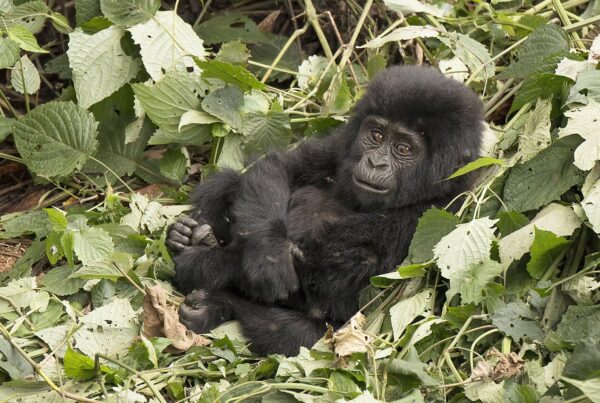
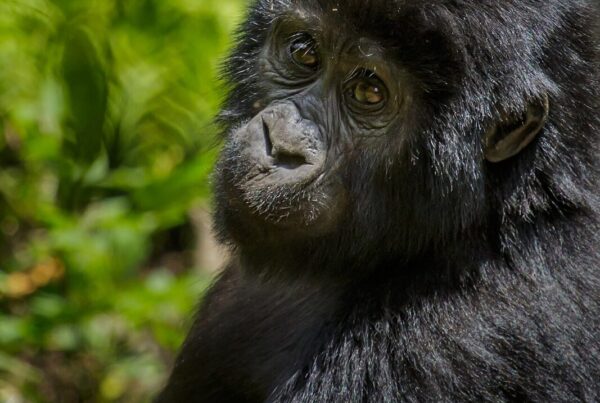
The encounter is different from what most people expect a wildlife encounter to be. The gorillas are habituated: the families in Bwindi have been accustomed to human presence over years of dedicated ranger work; they do not flee or become aggressive; they continue their normal family behaviour — feeding, grooming, playing, nursing — while humans observe from close range. The proximity: the regulation distance is 7 metres; gorillas occasionally approach closer; the silverback may pass within arm’s reach; this is not staged — it is the family moving normally through its territory. The eye contact: what people consistently describe as the most striking moment is direct eye contact with an adult gorilla — the recognition of an intelligence behind the eyes that is close enough to human to be unsettling; this is unique to the great apes and cannot be replicated in any zoo or film context.
How does gorilla trekking compare to other top African wildlife experiences in terms of value?
Comparison with known benchmark experiences. Serengeti migration safari (Tanzania): USD 5,000-15,000 per person for a premium migration camp experience; a world-class experience but not a unique species encounter — wildlife is shared with many vehicles; replicable across multiple operators and price points. Okavango Delta mokoro safari: USD 1,000-3,000 per person per day for top camps; exceptional but not species-unique. Rwanda gorilla permit: USD 1,500 per person for the same mountain gorilla encounter; Uganda at USD 800 is 47% cheaper for the identical product — the Bwindi forest is arguably more atmospheric. Antarctic expedition: USD 8,000-20,000 per person; the gold standard of “once in a lifetime” travel; the gorilla encounter is the African equivalent at a fraction of the cost. The conclusion: for a genuinely unique wildlife encounter that cannot be had elsewhere at any price, USD 800 for a gorilla permit at Bwindi represents value that is hard to match in experiential travel.
What Uganda experiences can I add to make the trip worth the journey?
Uganda rewards those who extend the trip. Chimpanzee trekking: Kibale Forest chimp trek on the same trip as Bwindi gorilla trekking makes Uganda’s “primate trail” — the only place on Earth where both great ape species can be trekked in one itinerary. Queen Elizabeth NP: QENP connects Kibale and Bwindi geographically; add 2-3 nights for tree-climbing lions at Ishasha, Kazinga Channel boat, and the wildlife-rich Kasenyi plains. Murchison Falls: Murchison Falls NP and the Nile boat safari for the most dramatic waterfall in Africa and hippos at close range. Kidepo: Kidepo Valley NP by charter flight for Uganda’s most remote and spectacular savannah. Full planning: 7-day gorilla safari and accredited Uganda operators.
- The Trip That Earns Its Price Every Year You Remember It
- Are Gorilla Permits Getting More Expensive Every Year? Price Trends Explained
- New Year New Adventure: Gorilla Trekking Uganda 2027 Resolution Trip
- Gorilla Trekking Uganda: The Trip You Will Remember on Your Deathbed
- Lake Victoria Fishing Trip
- What Makes Uganda Gorilla Trekking Different from Any Other Wildlife Trip
- Uganda Gorilla Trekking from London: The Full Trip Plan from Heathrow
- Uganda Gorilla Trekking Near Lake Bunyonyi: Lodges and Day Trips
- Uganda Gorilla Trekking 2026: Permit Prices, Dates and What Changed
- 3-Day Bwindi Gorilla Trekking Itinerary: Fly-In Express Trip