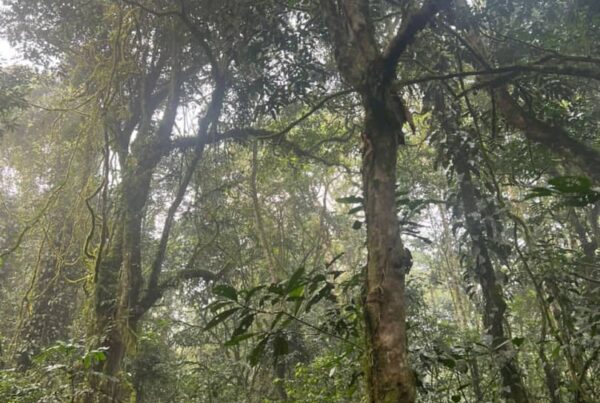
She had not meant to use the word. A cathedral is a building, not a forest. But standing at the edge of the trail and looking up at the canopy of Bwindi Impenetrable Forest — the light filtering through multiple leaf layers, the columns of ancient trees rising into a vaulted green ceiling, the silence that is not actually silence but the layered sound of the forest operating at its ordinary volume — she reached for cathedral and could not find a better word for what she was standing inside.
The comparison is made often enough that it has become one of the standard descriptions of the Bwindi experience. Not because the forest looks like a cathedral — it does not — but because the quality of presence it induces is similar. The scale that makes you feel small without making you feel diminished. The accumulated time that makes your own span of years feel brief without making you feel insignificant. The sense that you have entered something that has its own purpose, its own logic, its own integrity that exists entirely independently of whether you are there to appreciate it.
What Ancient Forests Do to Human Attention
Bwindi Impenetrable National Park has been continuously forested for more than 25,000 years. During the Pleistocene, when most of East Africa’s forests contracted dramatically as ice ages cooled and dried the climate, Bwindi was a forest refuge — one of the places where the biodiversity of a continent was preserved through the long cold. The trees growing in Bwindi today are the descendants of trees that survived that contraction, in a lineage of continuous forest cover that extends through documented human history, before it, and into a geological past that dwarfs any human frame of reference.
This continuity is not visible in the way that a cathedral’s visible age is visible — there are no inscriptions on the trees recording when they were planted, no architectural styles that date the construction. But it is present in other ways: in the extraordinary species diversity that results from 25,000 years of ecological continuity, in the complexity of the vegetation structure that is the visual signature of an undisturbed primary forest, and in the specific quality of the air and the light and the silence that ancient forests have and younger forests do not yet possess.
The Spiritual Dimension Without the Supernatural
The cathedral comparison is made, typically, by people who do not mean it in a religious sense. They are reaching for the quality of attention the forest induces — the involuntary heightening of awareness, the shift from habitual perception to something more awake and more receptive, that both great religious buildings and great wild places produce. This quality does not require any supernatural explanation. It is the ordinary response of a human nervous system, calibrated over hundreds of thousands of years of evolution in environments like this one, to an environment it recognises as significant.
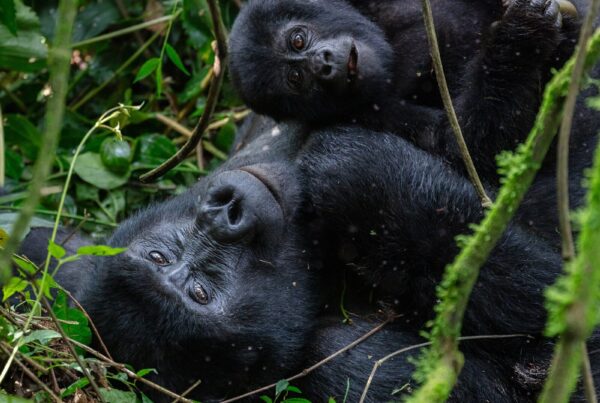
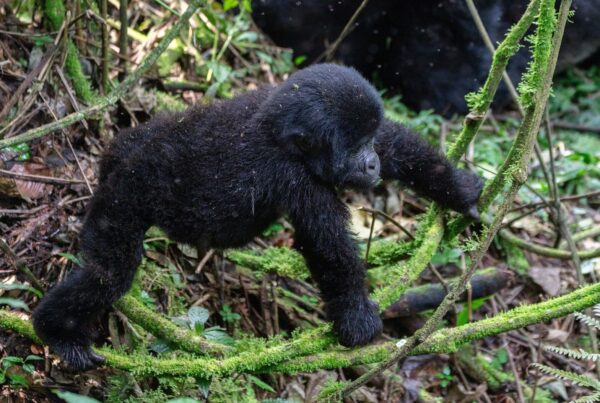
The gorilla encounter that Bwindi makes possible adds a specific dimension to this quality of attention: an encounter with another form of consciousness in the space that produces it. You are not just moved by the forest. You are moved by the forest in the company of a great ape family that has been moving through this same forest for generations, for whom the forest is home rather than pilgrimage destination.
The $800 Entry to the Cathedral
The Uganda gorilla permit at $800 in 2027 is the entry to the forest that the visitor described as a cathedral. It is not the entry to a place of worship — it is the entry to a place of presence, of age, of biological richness, and of the encounter with gorillas that is Bwindi’s most extraordinary offering. The word cathedral was reached for because no smaller word was sufficient. Contact us to book your entry. No smaller experience will be sufficient either.
Frequently Asked Questions
Uganda is home to the mountain gorilla (Gorilla beringei beringei), one of two subspecies of eastern gorilla. They live exclusively in the Virunga volcanic highlands (Uganda/Rwanda/DRC) and Bwindi Impenetrable Forest (Uganda only). Mountain gorillas are the only gorilla subspecies that cannot survive in captivity — every individual you can trek is a wild animal.
The standard gorilla trekking permit gives you exactly 1 hour with the gorilla family. This time begins when you make first contact with the family — the ranger signals the start. The Gorilla Habituation Experience gives 4 hours with a semi-wild family. The walk to find the gorillas can take 30 minutes to 5 hours depending on where the family has moved.
Stay calm, crouch down slowly, avoid direct eye contact, and remain quiet. Do not run — running triggers a chase response. Rangers accompanying your group manage close approaches. Habituated gorillas are accustomed to humans and almost never make contact, but a charging silverback is managed by staying still and following ranger instructions immediately.
A maximum of 8 visitors per habituated gorilla family per day for standard trekking. The Gorilla Habituation Experience has a maximum of 4 visitors per family per day. These limits are set by UWA to minimise stress on the gorilla families and maintain the quality of the experience.
Uganda is home to the mountain gorilla (Gorilla beringei beringei), one of two subspecies of eastern gorilla. They live exclusively in the Virunga volcanic highlands (Uganda/Rwanda/DRC) and Bwindi Impenetrable Forest (Uganda only). Mountain gorillas are the only gorilla subspecies that cannot survive in captivity — every individual you can trek is a wild animal.