Happiness research is a notoriously uncertain science. The metrics that attempt to quantify human wellbeing — GDP per capita, life expectancy, social support, freedom to make life choices, generosity, and perceptions of corruption — combine objective measures with subjective self-reporting in ways that make cross-national comparison genuinely difficult. Uganda, by most conventional economic measures, should not rank highly on any happiness index. Its per-capita income is among the lower quartile in sub-Saharan Africa. Its healthcare system is under-resourced. Its infrastructure has significant gaps. And yet, consistently across surveys that measure self-reported wellbeing and life satisfaction, Ugandans express levels of happiness and social connection that surprise researchers who expected different results.
Understanding why requires looking beyond the metrics to the social structures, cultural values, and daily practices that make a life feel worth living — things that income statistics simply cannot capture.
The Social Infrastructure
Uganda’s social organisation is built around family and community networks of remarkable density and durability. The extended family system that structures Ugandan social life is not merely a safety net for the economically vulnerable; it is the primary social institution through which most Ugandans navigate the world. Weddings, funerals, illness, harvest celebrations, business ventures, education financing, childcare, and elder support all flow through extended family networks rather than through state institutions or commercial service providers.
This social density has costs — obligations to family networks can constrain individual choices and economic mobility in ways that market-economy frameworks do not accommodate well. But the benefits are equally real. A Ugandan with a functioning family network is never entirely alone in adversity. The social support that in high-income countries is provided by insurance systems, pension schemes, and state welfare programmes is provided in Uganda by aunts, cousins, neighbours, and church communities. The system is less efficient and less reliable than formal institutions, but it is also warmer, more immediate, and more personally meaningful.
The Role of Religion
Uganda is one of the most religiously observant countries in the world. Christianity and Islam together claim the active allegiance of the overwhelming majority of Ugandans, and religious practice — weekly attendance at services, participation in prayer groups and religious community activities, the integration of religious frameworks into daily decision-making — is the norm rather than the exception across social classes, regions, and generations.
The happiness research literature consistently finds that regular participation in religious community is one of the strongest predictors of subjective wellbeing — stronger, in many studies, than income beyond a basic sufficiency threshold. Uganda’s high levels of religious participation translate into high levels of the community bonding, regular social ritual, shared meaning-making, and sense of being known and supported by others that religious community provides. The correlation between Uganda’s religious observance and its wellbeing scores may not be coincidental.
Children and Family as Sources of Meaning
Uganda has one of the highest fertility rates in the world, with an average of approximately five children per woman. This is, in population economics terms, both a development challenge and a reflection of values in which children represent the primary source of meaning, status, and social security. Ugandan parents — particularly mothers — invest enormous emotional and practical resources in their children, and the returns on this investment, in terms of relationship satisfaction and sense of purpose, are substantial.
Research on subjective wellbeing consistently finds that having children is associated with higher moment-to-moment happiness in contexts where children are seen as intrinsically valuable rather than primarily as economic burdens. Uganda’s cultural context, in which children are celebrated, named with ceremony, and integrated into the full social fabric of family and community life from birth, creates conditions in which parenting generates the kind of meaning that wellbeing researchers look for.
The Ubuntu Dimension
The southern and eastern African concept of ubuntu — roughly translated as “I am because we are” — captures something real about the philosophical orientation that shapes social life in Uganda and many neighbouring countries. The individual is understood as constituted by relationships rather than existing prior to them; to be a person is to be embedded in a web of social obligations and connections that define identity and meaning.
This orientation is not naive or without its tensions. The obligations of extended family networks can be genuinely burdensome; the community pressure that enforces social norms can constrain individual freedom in ways that are experienced as oppressive rather than supportive. But the ubuntu framework also produces a kind of social richness — the sense of being genuinely known, genuinely needed, and genuinely embedded in something larger than oneself — that individualistic societies often struggle to generate even with much greater material resources.
Music, Dance, and Celebration
Uganda’s cultural life is rich in ways that wellbeing research has difficulty capturing but that are immediately apparent to visitors. The density and frequency of celebrations — of weddings, naming ceremonies, funerals that become reunion events, sports victories, religious festivals, and the dozens of smaller occasions that give communities reason to gather — creates a rhythm of social celebration that is notably more frequent than in high-income societies where formal celebration has been largely squeezed out by economic time pressure.
Music is ubiquitous in Uganda. The tradition of live music in social gathering spaces, the centrality of singing in religious worship, the use of music and dance in community ceremonies, and the increasingly vibrant contemporary music scene centred in Kampala all contribute to a cultural environment in which music is a daily rather than occasional presence. The wellbeing benefits of music — particularly communal music-making and music participation rather than passive consumption — are well-documented in the research literature.
The Gorilla Effect
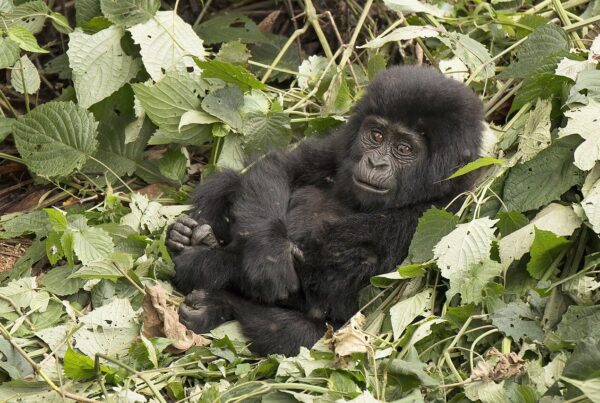
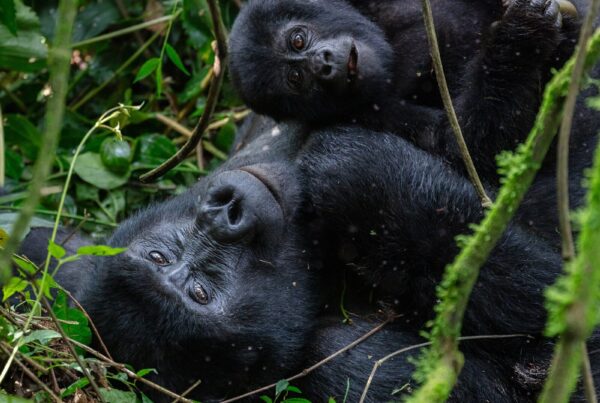
Communities adjacent to Uganda’s national parks — particularly around Bwindi Impenetrable Forest, where gorilla trekking generates substantial economic activity — have experienced measurable improvements in material wellbeing over the past two decades. The $800 gorilla permits of 2027 represent the current endpoint of a pricing and revenue-sharing evolution that has channelled meaningful income into communities that had little formal economic infrastructure a generation ago.
The wellbeing effects of this economic development appear to go beyond the direct income effect. Communities that participate in the management of community revenue funds report higher levels of social cohesion and sense of agency than communities that receive benefits passively. The process of collective decision-making about how to use shared resources — building a school, repairing a road, establishing a health post — generates the kind of civic engagement that is itself associated with higher wellbeing independent of the specific outcomes achieved.
What Visitors Notice
The most commonly reported observation of visitors to Uganda — more consistent even than comments about the gorillas or the landscapes — is the warmth and openness of Ugandan people. Travellers who have visited other East African countries often note a quality of social ease in Uganda that they struggle to attribute to any specific cause. People greet strangers, engage in conversation readily, and exhibit a kind of relaxed sociability that feels genuinely different from the more guarded interactions characteristic of urbanised, individualised societies.
This is not performance. It reflects the same social orientation that the happiness research picks up in survey data: a culture in which social connection is the primary good and in which strangers are potential members of the social network rather than threats to be assessed. Whether this quality will survive the pressures of rapid urbanisation, economic modernisation, and the individualising effects of digital connectivity is one of the more interesting questions in Uganda’s social future.
Frequently Asked Questions
Uganda is home to the mountain gorilla (Gorilla beringei beringei), one of two subspecies of eastern gorilla. They live exclusively in the Virunga volcanic highlands (Uganda/Rwanda/DRC) and Bwindi Impenetrable Forest (Uganda only). Mountain gorillas are the only gorilla subspecies that cannot survive in captivity — every individual you can trek is a wild animal.
The standard gorilla trekking permit gives you exactly 1 hour with the gorilla family. This time begins when you make first contact with the family — the ranger signals the start. The Gorilla Habituation Experience gives 4 hours with a semi-wild family. The walk to find the gorillas can take 30 minutes to 5 hours depending on where the family has moved.
Stay calm, crouch down slowly, avoid direct eye contact, and remain quiet. Do not run — running triggers a chase response. Rangers accompanying your group manage close approaches. Habituated gorillas are accustomed to humans and almost never make contact, but a charging silverback is managed by staying still and following ranger instructions immediately.
A maximum of 8 visitors per habituated gorilla family per day for standard trekking. The Gorilla Habituation Experience has a maximum of 4 visitors per family per day. These limits are set by UWA to minimise stress on the gorilla families and maintain the quality of the experience.
Uganda is home to the mountain gorilla (Gorilla beringei beringei), one of two subspecies of eastern gorilla. They live exclusively in the Virunga volcanic highlands (Uganda/Rwanda/DRC) and Bwindi Impenetrable Forest (Uganda only). Mountain gorillas are the only gorilla subspecies that cannot survive in captivity — every individual you can trek is a wild animal.