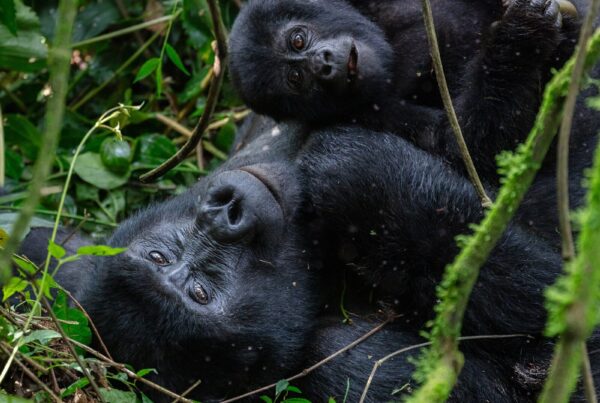
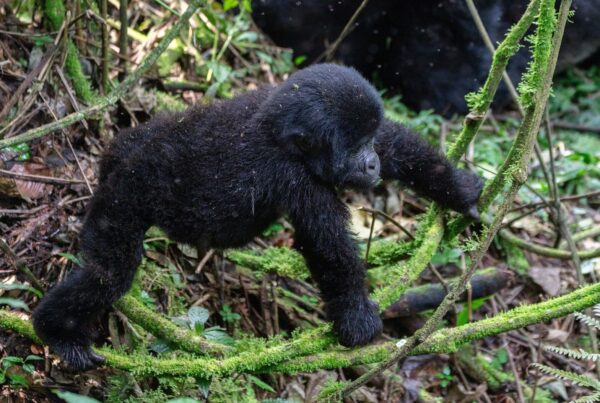
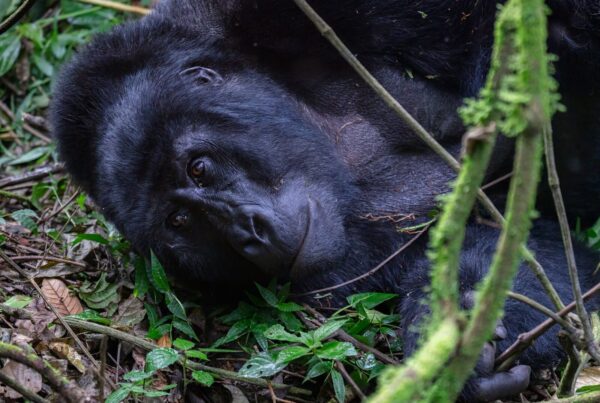
Mountain gorillas share approximately 98.3% of their DNA with humans, and nowhere is this relationship more visible than in the face — the nose shape, the arrangement of the brow ridge, the expression in the eyes, and the individualized features that are as distinct from gorilla to gorilla as human faces are from person to person. Researchers and rangers identify individual gorillas by their nose prints, which are as unique as human fingerprints. The face-to-face encounter that gorilla trekking provides makes this similarity immediate and undeniable in a way that no documentary can replicate. See the gorilla families guide to understand the individuals behind those faces, and the Bwindi overview for where the encounter happens.
- Shared DNA: approximately 98.3% — among the closest of any two species on Earth
- Individual identification: researchers identify gorillas by nose print shape — unique to each individual
- Facial muscles: gorillas share the same facial muscle groups used for human expressions
- Eye colour: brown irises, with visible sclera (whites) — unusual among non-human primates
- Expressions documented: fear grimace, play face, lip smacking (contentment), pout (distress)
Mountain gorillas share approximately 98.3% of their DNA with humans, and nowhere is this relationship more visible than in the face — the nose shape, the arrangement of the brow ridge, the expression in the eyes, and the individualized features that are as distinct from gorilla to gorilla as human faces are from person to person. Researchers and rangers identify individual gorillas by their nose prints, which are as unique as human fingerprints. The face-to-face encounter that gorilla trekking provides makes this similarity immediate and undeniable in a way that no documentary can replicate. See the gorilla families guide to understand the individuals behind those faces, and the Bwindi overview for where the encounter happens.
- Shared DNA: approximately 98.3% — among the closest of any two species on Earth
- Individual identification: researchers identify gorillas by nose print shape — unique to each individual
- Facial muscles: gorillas share the same facial muscle groups used for human expressions
- Eye colour: brown irises, with visible sclera (whites) — unusual among non-human primates
- Expressions documented: fear grimace, play face, lip smacking (contentment), pout (distress)
Gorilla human similarities are scientifically established — mountain gorillas share 98.3 percent of their DNA with humans — but it is the face-to-face encounter that makes these similarities viscerally real for most people. Researchers, photographers, and trekking visitors who have spent time in close proximity to mountain gorillas consistently describe the same experience: looking into a gorilla’s face and being confronted with an intelligence and an emotional presence that is unmistakably familiar. The faces of gorillas and humans are separated by millions of years of separate evolution, yet the similarities are so striking that even casual observers, looking at comparative photographs, immediately recognise them.
The eyes: where recognition begins
The most immediately striking similarity between gorilla faces and human faces is in the eyes. Mountain gorillas have deep-set, forward-facing eyes with brown irises and visible whites, arranged in a face with the same basic structure as a human face — eyes above a nose, nose above a mouth, all framed by a head of approximately human proportions. The forward-facing eyes of both species are an evolutionary adaptation for depth perception — essential for a life spent moving through complex three-dimensional environments like forest canopy or rocky terrain. But beyond the functional similarity, the expressiveness of gorilla eyes — the way they communicate attention, curiosity, calculation, and emotion — is startlingly human.
The gaze: assessment and recognition
Primatologists who study gorilla behaviour describe the gorilla gaze as functionally similar to the human gaze in several important respects. Gorillas make deliberate eye contact to communicate dominance, challenge, interest, and recognition. They follow the direction of other individuals’ gazes to understand what those individuals are attending to — a cognitive ability called gaze-following that is present in humans and great apes but absent in most other animals. And in close encounters with trekking visitors, habituated gorillas make direct eye contact with humans in a way that primatologists describe as a genuine assessment — the gorilla is reading the human’s posture and intention just as the human is reading the gorilla’s.
The nose: individual identity and family resemblance
Gorilla noses are as individually distinctive as human noses. Just as no two human faces are identical, no two gorillas have the same nasal features. Gorilla researchers use nose prints — detailed photographs of the distinctive ridges and wrinkles on each gorilla’s nose — to identify individuals in the field, in exactly the same way that human faces can be recognised in a crowd. Side-by-side photographs of gorilla nose prints and human nose prints reveal a structural similarity in the patterns of the nasal bridge and nostrils that reflects the shared evolutionary heritage of the two species.
The nose as an identifier
The use of nose prints for gorilla identification — developed by Dian Fossey during her pioneering research in the Virungas in the 1960s and 1970s — has been adopted by every gorilla research project in Africa. Each habituated gorilla in Bwindi and Mgahinga has a detailed nose print photograph in the Uganda Wildlife Authority’s database, allowing rangers to confirm the identity of every individual they encounter during daily monitoring. This identification system, based on a facial feature that is similarly individual in humans, is one of the many practical applications of the face-to-face similarity between the two species.
The mouth: expression and communication
Gorilla facial expressions use many of the same muscle groups as human expressions, and the resulting similarities are clearly visible in comparative photography. A gorilla in play shows an open-mouth expression that is structurally identical to the human smile. A gorilla in threat display — lips pressed together, jaw forward — uses facial muscles and an arrangement that any human observer reads instinctively as aggression. A gorilla mother looking at her infant uses a soft, relaxed facial expression that anyone who has watched a parent watching a sleeping child will immediately recognise.
Emotional expression across species
The similarity in emotional expression between gorillas and humans reflects the deep evolutionary history of facial expression as a communication system. Researchers studying primate facial communication have identified a set of core expressions — fear, threat, play, affiliative contact — that are present across all the great apes, including humans, and that use homologous facial muscles in each species. This shared system of expression is why human observers can read gorilla facial expressions accurately without any specialist training — the system is the same one we use ourselves.
The hands: tools, gesture, and touch
Gorilla hands are structurally nearly identical to human hands. Five fingers with nails rather than claws, an opposable thumb, and a palm and finger structure that allows a range of grip types including the precision grip used by humans for fine manipulation. Photographs of gorilla hands and human hands side by side show a similarity so complete that, stripped of context and skin colour, it can be genuinely difficult to tell which is which. Gorillas use their hands for feeding, for social grooming, for play, for communication, and for tool use — exactly the same range of activities for which human hands are most commonly employed.
Gorilla fingerprints
Like humans, gorillas have unique fingerprints. The ridge patterns on gorilla fingertips are as individually distinctive as human fingerprints, and are formed by the same developmental processes in the embryo. This similarity — purely functional in humans, where fingerprints have become a forensic identification tool — is simply one of the many anatomical details that reflect the shared ancestry of the two species. Side-by-side photographs of gorilla fingerprints and human fingerprints show the family resemblance in the ridge patterns clearly, even to a non-specialist observer.
The brain: structure and function
While photographs cannot directly show brain structure, the behavioural evidence of brain similarity between gorillas and humans is visible in every aspect of gorilla life that can be documented photographically. Tool use — gorillas using sticks to measure water depth, using leaves as umbrellas in rain, using rocks to crack nuts — demonstrates a cognitive flexibility that reflects a brain of significant complexity. Social learning — young gorillas learning feeding techniques and social behaviours by observing adults — demonstrates the same capacity for cultural transmission that underlies human civilisation. And the emotional range visible in gorilla faces — play, grief, affection, frustration, curiosity — reflects an inner life that neuroscientists increasingly recognise as functionally comparable to the human emotional system.
What the similarity means for conservation
The visible similarity between gorilla faces and human faces is not merely a curiosity. It is, according to many conservationists, one of the most powerful tools available for communicating the importance of gorilla protection to public audiences who have no direct experience of the animals. When people see a photograph of a gorilla mother holding her infant and recognise the universality of the gesture — when they look into a gorilla’s eyes and feel the weight of another intelligence meeting their own — something changes in their relationship with the idea of species loss. The face-to-face similarity between gorillas and humans makes gorilla conservation emotionally legible in a way that the conservation of less charismatic species is not.
The best way to experience this similarity is in person. A gorilla trekking permit in Bwindi Impenetrable Forest gives you one hour with a habituated mountain gorilla family — close enough to see the detail in their faces, to meet their gaze, and to understand in the most direct possible way what those shared millions of years of evolutionary history look like. Contact our team to arrange your permit and safari.
Why do gorilla faces look so similar to human faces?
Gorillas and humans share approximately 98.3% of their DNA because we share a common ancestor that lived roughly 8–10 million years ago. The facial structures — the position of the eyes, the shape of the nasal cavity, the jaw, the forehead — evolved from the same ancestral template. The differences are largely in proportion: gorillas have more pronounced brow ridges, a longer jaw, a flatter nose, and a larger skull to accommodate larger jaw muscles. The underlying bone and muscle architecture is remarkably similar.
How do researchers identify individual gorillas by face?
The primary identification method is nose print mapping — the shape of the nostrils and the distinctive crease patterns on the nose bridge are unique to each gorilla, equivalent to human fingerprints. Researchers also note ear shape, brow ridge profile, eye spacing, and any distinctive markings. Long-term field researchers develop the ability to recognise gorillas by face as easily as they recognise human colleagues — a skill that takes months of observation to develop but that rangers at Bwindi demonstrate reliably every morning when they locate and identify family members from a distance.
Do gorillas recognise human faces?
Habituated mountain gorillas show clear recognition of familiar individuals. Researchers who work with a family over years report that the gorillas distinguish them from strangers — responding more calmly to familiar researchers than to new faces. This includes distinguishing between individual humans by face. The extent of this facial recognition is an active area of primate cognition research. What is not in doubt is that gorillas pay close attention to human faces and respond to direct eye contact with social signals — making eye contact deliberately while passing as a sign of dominance, or looking away to signal that contact is not a threat.
What facial expressions do mountain gorillas make?
Mountain gorillas produce a range of documented expressions: the play face (mouth open, teeth covered by lips) signals play intention; the fear grimace (lips pulled back to show teeth) signals submission or fear; lip smacking and soft grunting indicate contentment during feeding or grooming; the pout face (pursed lips) appears in juveniles signalling distress. These expressions use the same underlying facial muscle groups as human expressions, though the specific muscle movements differ. During a gorilla trek you will typically see contentment expressions (the family is habituated and calm) and play expressions from juveniles.
Is looking a gorilla in the eyes dangerous?
Prolonged direct eye contact with a silverback is interpreted as a dominance challenge and should be avoided. Rangers brief every trekking group to avoid sustained eye contact with the dominant male. Brief, natural eye contact happens inevitably during a trek and is not dangerous — the concern is sustained staring, which reads as aggression in great ape social signalling. Looking away slowly (not turning away rapidly) is the appropriate response when a silverback makes eye contact. The gorillas’ tolerance for visitor presence is built on the principle that visitors pose no social threat.
- Uganda Gorilla Permit Categories: Foreign Resident vs Non-Resident vs East African
- Gorillas Grieve: They Have Been Seen Sitting Beside Dead Group Members
- The 12 Most Famous Silverback Gorillas in Uganda: Faces and Names
- New Eco-Lodge Opens Inside Bwindi Forest in 2026: First Look
- The Craft Cooperative Funded by Gorilla Tourists: 80 Women Inside
- The Researcher Who Spent 10 Years Living Beside the Rushegura Family
- What Happens Inside a Gorilla Family When the Silverback Dies
- The Sick Gorilla That Was Treated by Vets While Tourists Waited Outside
- Gorilla Trekking Uganda for East African Residents: The Regional Permit Rate
- The Ugandan Music Scene Nobody Outside Africa Knows About
Why do gorilla faces look so similar to human faces?
Gorillas and humans share approximately 98.3% of their DNA because we share a common ancestor that lived roughly 8-10 million years ago. The facial structures — the position of the eyes, the shape of the nasal cavity, the jaw, the forehead — evolved from the same ancestral template. The differences are largely in proportion: gorillas have more pronounced brow ridges, a longer jaw, a flatter nose, and a larger skull to accommodate larger jaw muscles. The underlying bone and muscle architecture is remarkably similar.
How do researchers identify individual gorillas by face?
The primary identification method is nose print mapping — the shape of the nostrils and the distinctive crease patterns on the nose bridge are unique to each gorilla, equivalent to human fingerprints. Researchers also note ear shape, brow ridge profile, eye spacing, and any distinctive markings. Long-term field researchers develop the ability to recognise gorillas by face as easily as they recognise human colleagues — a skill that takes months of observation to develop but that rangers at Bwindi demonstrate reliably every morning when they locate and identify family members from a distance.
Do gorillas recognise human faces?
Habituated mountain gorillas show clear recognition of familiar individuals. Researchers who work with a family over years report that the gorillas distinguish them from strangers — responding more calmly to familiar researchers than to new faces. This includes distinguishing between individual humans by face. The extent of this facial recognition is an active area of primate cognition research. What is not in doubt is that gorillas pay close attention to human faces and respond to direct eye contact with social signals — making eye contact deliberately as a sign of dominance, or looking away to signal that contact is not a threat.
What facial expressions do mountain gorillas make?
Mountain gorillas produce a range of documented expressions: the play face (mouth open, teeth covered by lips) signals play intention; the fear grimace (lips pulled back to show teeth) signals submission or fear; lip smacking and soft grunting indicate contentment during feeding or grooming; the pout face (pursed lips) appears in juveniles signalling distress. These expressions use the same underlying facial muscle groups as human expressions. During a gorilla trek you will typically see contentment expressions and play expressions from juveniles.
Is looking a gorilla in the eyes dangerous?
Prolonged direct eye contact with a silverback is interpreted as a dominance challenge and should be avoided. Rangers brief every trekking group to avoid sustained eye contact with the dominant male. Brief, natural eye contact happens inevitably during a trek and is not dangerous — the concern is sustained staring, which reads as aggression in great ape social signalling. Looking away slowly (not turning away rapidly) is the appropriate response when a silverback makes eye contact. The gorillas’ tolerance for visitor presence is built on the principle that visitors pose no social threat.
- Uganda Gorilla Permit Categories: Foreign Resident vs Non-Resident vs East African
- Gorillas Grieve: They Have Been Seen Sitting Beside Dead Group Members
- The 12 Most Famous Silverback Gorillas in Uganda: Faces and Names
- New Eco-Lodge Opens Inside Bwindi Forest in 2026: First Look
- The Craft Cooperative Funded by Gorilla Tourists: 80 Women Inside
- The Researcher Who Spent 10 Years Living Beside the Rushegura Family
- What Happens Inside a Gorilla Family When the Silverback Dies
- The Sick Gorilla That Was Treated by Vets While Tourists Waited Outside
- Gorilla Trekking Uganda for East African Residents: The Regional Permit Rate
- The Ugandan Music Scene Nobody Outside Africa Knows About