Updated
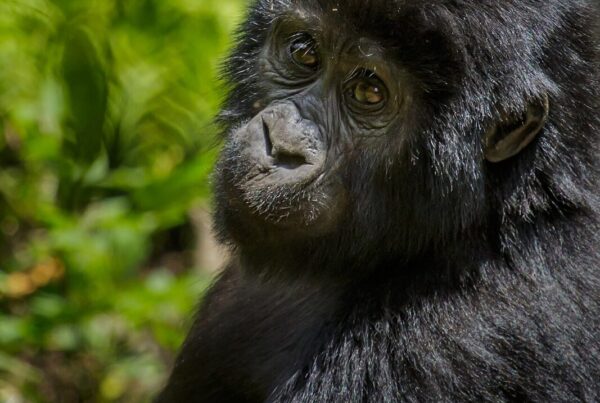
gorilla nose print unique fingerprint individual identification is a subject central to Uganda’s wildlife tourism, where mountain gorilla conservation and responsible visitor experiences go hand in hand. A gorilla’s nose print is as unique as a human fingerprint, and field researchers use nasal print identification as one of their primary tools for telling individual mountain gorillas apart. The specific pattern of ridges, folds, and the shape of the nostrils on each gorilla’s nose is individually distinctive in the way that fingerprints are distinctive for humans — no two are identical, the patterns remain stable throughout an individual’s life, and the differences are reliable enough to be used for accurate identification across years and decades of research. This fact sits alongside gorilla fingerprints, voice prints, and face shape as part of a picture of extraordinary individual distinctiveness in a species that, at first glance, might seem to have uniformly black faces and identical black fur.
A Gorilla’s Nose Print Is as Unique as a Human Fingerprint
What Makes Nose Prints Unique
The ridge patterns of a gorilla’s nose arise from the same developmental process that produces human fingerprints: random variation during fetal development in the organisation of skin structures. The specific arrangement of ridges, the depth and direction of wrinkles, the nostril shape, and the nasal bridge profile are determined by a combination of genetic factors and random variation in development. The genetic component ensures that related individuals share some nasal features; the random developmental variation ensures that no two individuals are identical.
Researchers who work with gorillas routinely can identify animals by face alone, the way experienced keepers at any zoological facility learn to distinguish individually animals that look similar to novices. For researchers working with large groups across a wide range, or for new members joining a long-term research team, the nose print provides a systematic and trainable identification method.
How Nose Prints Are Collected and Used
The practical collection of nose prints requires either clear photographs of the nose from a consistent angle (typically a frontal or slightly elevated angle) or, in some research contexts, direct physical impressions taken during veterinary examinations or sedation. For habituated gorillas that allow close approach, clear nose photographs can be taken during routine monitoring visits without any physical contact.
Database Management
Long-term research programmes like those at Karisoke (Virunga massif) and at Bwindi maintain photographic databases of individual gorilla identifications that include nose photographs as key reference images. These databases are updated continuously as new individuals are born and added to the monitoring population, and as new researchers join the team who need to learn individual identifications.
The Karisoke database, which extends back to the work of Dian Fossey in the late 1960s, includes nose print references for hundreds of gorillas across five decades. The database allows researchers to track lineages, monitor population dynamics, and answer questions about gorilla social structure and life history that would be impossible without consistent individual identification.
AI-Assisted Identification
Recent research has developed automated gorilla identification systems that use machine learning to match nose photographs against reference databases. These systems — analogous to the facial recognition technology developed for human faces — can process large numbers of photographs quickly and identify individuals with high accuracy, reducing the time required for manual identification in large population surveys. The input to these systems is the nose print: the specific pattern of features that makes each gorilla’s face identifiable.
Individual Recognition and What It Enables
The ability to identify gorillas individually over long periods is the foundation of everything that makes mountain gorilla research scientifically valuable. Population size estimates, survival rates, reproductive histories, social network analyses, health monitoring — all of these require knowing which animal is which, consistently, across time.
Longitudinal Research
The mountain gorilla research at Bwindi and the Virungas is among the longest continuously running primate studies in the world. Researchers have documented the lives of specific individuals for over 50 years. This longitudinal depth allows analyses that are impossible in shorter studies: the relationship between early social experience and adult fitness, the long-term consequences of social rank changes, the transgenerational transmission of behaviour patterns. All of it depends on individual identification — and nose prints are part of how that identification is achieved and maintained.
The Broader Pattern: Individual Distinctiveness in Gorillas
The nose print is one of several individually distinctive features in mountain gorillas. Face shape, ear size and shape, body scarring from past injuries, the specific pattern of fur whorls, and voice characteristics are all individually variable and used by experienced researchers and guides for identification.
This individual distinctiveness is not accidental. It is a product of genetic diversity (essential for a healthy population) and developmental variation that is a feature of cognitively complex social animals. In social species, individual recognition of group members is adaptive — knowing who is who is necessary for managing social relationships, remembering past interactions, and making decisions about cooperation and competition based on individual histories.
The gorillas know each other as individuals. The guides who work with habituated groups also know them as individuals. The researchers who have been monitoring specific families for years know them as individuals. The nose that makes each gorilla’s face unique is part of the apparatus of individuality that makes gorilla social life — and gorilla research — possible.
Identifying Gorillas on a Trek
Your guide will know the individual animals in the family you visit and will point out specific individuals by name — or by description, since not all animals have formal names in all research contexts. The differences that your guide uses for identification — “that is the largest female, she has a scar on her right shoulder; that younger one is her daughter, born three years ago” — are the same kinds of features that researchers encode formally in their identification databases.
The gorilla looking back at you during your hour in Bwindi is a specific individual — not a representative of a species, but a specific animal with a specific history, a specific social position, and a specific nose. Pay attention to the nose. It is as individual as your own.
Uganda gorilla trekking permits are $800 per person. Contact Uganda Gorilla Trekking to book your permit and plan your visit to Bwindi Impenetrable National Park.