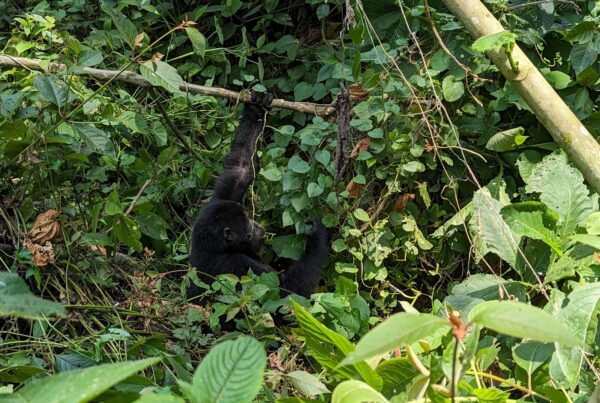
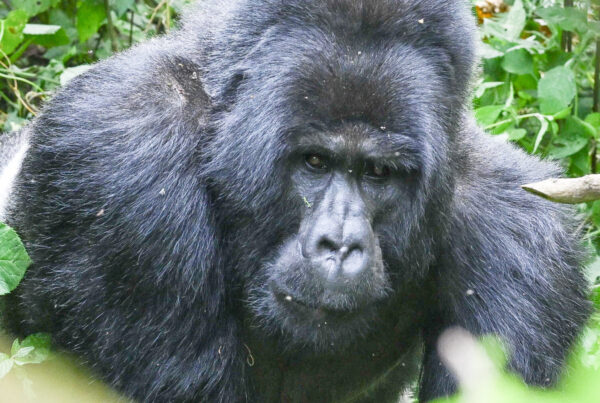
The 98.3% shared DNA between mountain gorillas and humans is an abstraction until you watch a mother carry her infant exactly as a human mother does, or see a silverback use a branch as a walking stick to cross a stream, or notice a juvenile make a play face at a sibling in the same facial expression your child makes before chasing you around the garden. The behavioural parallels that visitors observe during gorilla trekking are not anthropomorphism — they are the product of shared evolutionary history expressed in shared neurology, musculature, and social structure. See the gorilla families guide for the individual animals in each family, and the Bwindi overview for how to observe them.
- Shared DNA: ~98.3% — the closest great ape relative to humans alongside chimpanzees and bonobos
- Tool use: documented in mountain gorillas — sticks for depth testing water, logs as bridges
- Nest building: each individual builds a new sleeping nest from vegetation every night
- Infant carrying: mothers hold newborns ventrally (front-facing against the chest) for the first months of life, identical to human carrying
- Mourning: gorilla groups show documented grieving behaviour after the death of family members
Gorilla human behaviour parallels are observed by every visitor who spends time with a habituated mountain gorilla family in Bwindi Impenetrable Forest. The 98.3 percent shared DNA between gorillas and humans is not an abstract statistic — it is visible in real time during a gorilla trek, in the specific moments when a gorilla does something that is so recognisably human that the visitors watching it instinctively laugh, gasp, or fall silent. These nine behaviours, all documented in habituated gorilla families in Uganda, are the ones that most reliably produce the “they’re just like us” response that gorilla guides hear from trekking groups on a daily basis.
1. A mother comforting a distressed infant
When a young gorilla infant is distressed — separated briefly from its mother, startled by an unusual sound, or injured in a fall — the mother’s response is immediate and unmistakable. She gathers the infant, holds it against her chest, and makes a series of soft, low vocalisations that primatologists describe as reassurance calls. The physical posture — the mother’s arms wrapped around the infant, the infant pressing its face into the mother’s chest — is structurally identical to the way a human parent comforts a frightened child. Visitors who see this moment during a trek consistently identify it as one of the most emotionally powerful experiences of the encounter.
2. Teenagers sulking after being disciplined
Mountain gorilla social groups have clear rules about behaviour, and silverbacks enforce these rules with a combination of physical displays and direct intervention. When a juvenile gorilla is disciplined by the silverback — pushed away from a feeding site it was monopolising, prevented from a behaviour that was creating disruption in the group — the juvenile’s response is frequently sulky and recognisable: it moves away, sits with its back to the silverback, and adopts a posture of disengagement that gorilla guides consistently describe to their trekking groups as “exactly what a teenager does when they’ve been told off.” The accuracy of this description is one of the most reliable sources of laughter in trekking encounters.
3. Yawning when bored
Mountain gorillas yawn — wide, unambiguous, teeth-baring yawns that are functionally and structurally identical to human yawns. Like human yawning, gorilla yawning occurs most frequently when the animal is transitioning between activity states — finishing a feeding period and preparing to rest, or waking from sleep and beginning to move. The function of yawning in great apes (as in humans) is not fully understood, but its social contagion has been documented in gorillas: one gorilla yawning in a group can trigger yawning in other group members, in exactly the same way that human yawning is contagious. Trekkers who observe a gorilla yawn and find themselves responding with their own yawn have experienced this cross-species contagion in person.
4. Playing games with objects
Young gorillas engage in object play — picking up items in their environment, examining them, manipulating them, using them in ways that have no immediate functional purpose. Sticks, leaves, stones, and pieces of bark are all subjects of this kind of exploratory play. Observers who watch a young gorilla spending ten minutes examining a fallen branch from multiple angles, poking it, sitting on it, dragging it, and finally losing interest and moving on, report a quality of purposeless curiosity in the behaviour that is so recognisably childlike that it is difficult to watch without smiling.
5. Grooming as social bonding
Social grooming in mountain gorillas — one individual methodically sorting through another’s fur, removing parasites and debris — functions primarily as a social bonding behaviour rather than a purely hygienic one. The time that gorillas spend grooming each other is far in excess of what would be needed for purely functional parasite removal, and researchers have documented that grooming alliances in gorilla groups correspond closely to social bonds — gorillas groom the individuals they are close to, and the amount of grooming exchanged between two individuals reflects the strength of their social relationship. This use of physical contact to maintain social bonds is one of the gorilla behaviours that most clearly parallels human behaviour, where touch is similarly central to the maintenance of close relationships.
6. Sharing food
Mountain gorillas are primarily folivores whose diet does not normally require sharing — there is enough vegetation in their habitat that competition over food is not usually necessary. But in specific contexts — when a particularly desirable food item is scarce or when an individual is being generous to a dependent — food sharing does occur in gorilla groups. A mother allowing her weaned but still-dependent juvenile to share her food. A silverback tolerating the approaches of group members to a particularly desirable fruit. These moments of gorilla generosity, small in scale but clear in their social function, create a recognisably human-parallel behaviour that visitors observe with surprise and delight.
7. Making a specific face at things they do not like
Mountain gorillas produce a distinctive facial expression when confronted with something they find distasteful — a smell they do not like, a food item that is not to their preference, the presence of something in their environment that makes them uncomfortable. The expression — lips pursed, nostrils wrinkled, head pulled slightly back — is structurally so similar to the human “disgust face” that trekking visitors recognise it immediately and without prompting. The similarity reflects the shared evolutionary heritage of facial expression as a communication system: the disgust face is one of the universal facial expressions found across all human cultures, and its presence in gorillas reflects the deep antiquity of this expression in primate social communication.
8. Being nervous about the same things
Mountain gorillas are calm about most aspects of their environment but reliably nervous about a small number of specific stimuli. Snakes produce a strong avoidance response — gorillas encountering a snake in the undergrowth will alarm-call and move away rapidly. Unfamiliar sounds at close range produce the same watchful, frozen response that unfamiliar sounds produce in humans in dark environments. And large, unexpected movements produce a startle response — a sudden flinch, a rapid scan of the environment for the source of the disturbance — that is physically identical to the human startle response. The shared threat detection mechanisms of gorillas and humans reflect the common predator environment that shaped the evolution of both species.
9. A father being gentle with his youngest child
Perhaps the behaviour that most consistently produces strong emotional responses in trekking visitors is the interaction between a silverback and the youngest infant in his family group. Mountain gorilla silverbacks are often described in terms of their size, power, and authority — which are real and impressive — but the same silverbacks who project dominance towards rival males and potential threats are frequently observed being exceptionally gentle with the infants in their care. A silverback allowing a very young infant to climb on his back. A silverback sitting quietly while an infant explores his silver fur with curious fingers. A silverback briefly meeting the gaze of his newest offspring with an expression of focused attention that parents of human infants will find immediately recognisable. These moments, occurring within the same encounter that demonstrated the silverback’s authority and physical power, create the most complete picture of mountain gorilla social complexity available in a single hour in the forest.
Do mountain gorillas use tools like humans?
Yes — mountain gorillas use simple tools, though less extensively than chimpanzees. Documented tool use includes using sticks to gauge water depth before crossing, using logs as bridges over streams or swampy ground, and using branches as walking supports. Gorillas have also been observed placing leaves over thorny ground before sitting. These behaviours are not as elaborate as chimpanzee tool use, which includes crafting termite-fishing sticks and nut-cracking stones, but they demonstrate purposeful object use as a solution to environmental problems — the cognitive foundation of human tool use.
How do gorilla mothers care for infants the way humans do?
Mountain gorilla mothers carry newborns against their chest for the first several months, holding them with one arm exactly as a human mother holds an infant. They nurse for 3–4 years, longer than most mammals. Mothers groom infants frequently, removing dirt, insects, and debris from the infant’s hair with their fingers. When a juvenile falls or gets hurt, the mother responds with contact comfort — pulling the infant close and holding it. Older siblings in the family often help with infant care, carrying and playing with younger family members in a pattern that closely resembles human extended family childcare.
Do gorillas grieve when family members die?
Documented observations from Bwindi and Karisoke describe gorilla groups spending extended periods near the body of a recently deceased family member, exhibiting reduced activity, reduced feeding, and increased grooming among group members. Mothers have been observed carrying deceased infants for days before leaving them. These behaviours are consistent with grief responses documented in elephants and chimpanzees and suggest that gorillas form social bonds strong enough to produce a measurable behavioural response to their loss — paralleling human mourning in its social function if not its conscious content.
Do gorillas play the same way human children play?
Gorilla juvenile play is almost indistinguishable in structure from human child play: wrestling, chasing, tumbling, tickling, and mock-biting with the play face (lips covering teeth) that signals the activity is not serious. Young gorillas play extensively with siblings and peers. Play decreases with age in a developmental arc similar to human childhood to adolescence. Researchers have noted that play in gorillas includes creative improvisation — modifying the rules of a game mid-activity — which suggests a capacity for intentional play rather than purely instinctive behaviour patterns.
Can gorillas communicate with humans?
In the wild, communication is limited to behavioural signals that both species can recognise through evolution and training. Rangers who work with habituated gorillas learn to read gorilla vocalisations and body language and modify their own behaviour in response — crouching, looking down, moving slowly — in ways the gorillas recognise as non-threatening. In captive settings, lowland gorillas (not mountain gorillas) have been taught American Sign Language by researchers, most famously Koko, who acquired several hundred signs. These studies demonstrated capacity for intentional symbolic communication, though controversy exists about the extent of genuine language comprehension versus trained responses.
- Uganda Gorilla Trekking: Sample Day-by-Day Schedule and What Each Day Looks Like
- What Bwindi Impenetrable Forest Looks Like From the Air: Drone Footage
- What Gorilla Trekking Looks Like in Every Month of the Year: Photo Guide
- What 30 Years of Mountain Gorilla Conservation Looked Like on the Ground
- What a Gorilla’s Eyes Look Like When They Look Back at You: A Description
- What Your Life Could Look Like If You Stopped Planning and Just Booked Uganda
- Shoebill Stork Facts: The Bird That Looks Like It Survived the Dinosaurs
- Kampala to Bwindi by Private Car: What the Drive Really Looks Like 2027
- The dry season at Bwindi: what June, July, and August look like in the forest
- Blackback Gorilla Size: The Overlooked Power of Gorilla Adolescence