The Genetic Relationship Between Gorillas and Humans
The question of how closely related mountain gorillas are to humans is one of the most fascinating in all of biology, with implications that reach from evolutionary science to conservation ethics. The short answer — that gorillas share approximately 98% of their DNA with humans — understates the complexity of the relationship and the profundity of what that similarity means. Understanding the genetic connection between humans and gorillas requires some context about how genetic similarity is measured and what it actually tells us.
Measuring Genetic Similarity
The figure most commonly cited is that humans and gorillas share approximately 98.3% of their DNA sequence identity. This means that if you compare corresponding stretches of human and gorilla DNA, approximately 983 out of every 1,000 DNA base pairs are identical. The remaining 1.7% — approximately 50 million base pairs — contains the genetic differences that account for all the observable distinctions between our two species.
This measure is sometimes challenged as misleadingly high because it focuses on sequence similarity in the regions of DNA that are shared between species. It does not fully account for structural variations in the genome — insertions, deletions, duplications, and inversions that affect larger stretches of DNA — which are more common between humans and gorillas than the base-pair comparison suggests. When these structural variations are included, the effective genomic difference is somewhat larger, perhaps 3 to 4%.
Even at the larger estimate, the genetic similarity remains extraordinary. Humans are more genetically similar to gorillas than gorillas are to other great apes like orangutans, and far more similar than any mammal is to, say, a mouse or a cat.
The Evolutionary Timeline
Humans and gorillas share a common ancestor that lived approximately 10 to 12 million years ago. After that ancestral population diverged, one lineage eventually gave rise to gorillas, while the other continued diverging until it produced the common ancestor of humans and chimpanzees, which lived approximately 6 to 7 million years ago.
This timeline places gorillas as our closest evolutionary relatives after chimpanzees and bonobos, though the difference in divergence time between gorillas and chimpanzees from the human lineage is relatively small in geological terms. We are more closely related to all three of these great apes than to any other animal family.
What the Shared DNA Codes For
The genes we share with gorillas include those responsible for the most fundamental aspects of biology: the DNA replication machinery, the immune system, the cardiovascular system, the structure of proteins that do cellular work, and critically, large portions of the neural architecture that underlies cognition and emotion.
The genetic variants that differ between humans and gorillas include those responsible for upright bipedal posture, the restructuring of the hand for precision grip, dramatic brain expansion, and the vocal anatomy that underlies human speech. These differences, concentrated in a relatively small proportion of the genome, have produced what appear to be dramatic phenotypic differences. But the underlying biological machinery — the biochemistry, the cellular organisation, the developmental processes — remains almost identical.
This is why diseases that affect humans can infect gorillas. The molecular machinery that pathogens exploit — cell surface receptors, membrane proteins, metabolic enzymes — is nearly identical between the two species. A rhinovirus evolved to exploit the human respiratory tract can exploit the gorilla respiratory tract because the molecular targets are essentially the same. This biological similarity is the reason for the strict health protocols around gorilla trekking and the seven-metre minimum distance rule.
Genetic Insights from the Mountain Gorilla Genome
In 2012, researchers published the first complete genome sequence of a mountain gorilla. This milestone revealed specific genetic variants unique to mountain gorillas that help explain their adaptation to high-altitude cold environments — including variants in genes related to cardiovascular function and metabolism that parallel adaptations seen in human populations native to high altitudes.
The genome also revealed concerning levels of inbreeding and reduced genetic diversity in mountain gorillas, a consequence of their small population size and geographic isolation. Sections of the gorilla genome show runs of homozygosity — long stretches where both copies of a chromosome are nearly identical — that indicate the population has passed through severe genetic bottlenecks. This reduced diversity limits the population’s capacity to respond to new pathogens and environmental changes, making every individual’s survival critical to the species’ adaptive resilience.
Comparative Genomics and Conservation
The sequencing of gorilla genomes has direct conservation applications. Genetic analysis can identify individual gorillas without capture, confirm family relationships, detect disease-associated variants, and monitor the flow of genetic material across population boundaries. Faecal DNA sampling — collecting gorilla droppings without any direct contact and extracting DNA for analysis — allows researchers to genotype entire populations non-invasively.
These techniques have been used to confirm the population boundaries between Bwindi and Virunga mountain gorilla populations, characterise the family structure of specific groups, and track demographic changes over time. The genetic toolkit that the shared DNA between humans and gorillas enables — the same sequencing technologies, reference genomes, and analytical frameworks developed for human genomics — is now a core part of the conservation management of a species that 40 years ago was nearly extinct.
What 98% Relatedness Means in Practice
The 98% genetic similarity between humans and mountain gorillas is sometimes cited to argue for specific ethical obligations toward gorillas — that beings so genetically similar to us deserve moral consideration beyond what we extend to less closely related animals. This philosophical argument is contested, but the biological facts that underlie it are not.
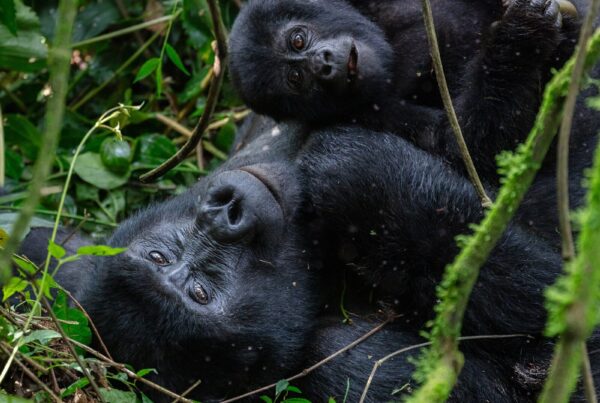
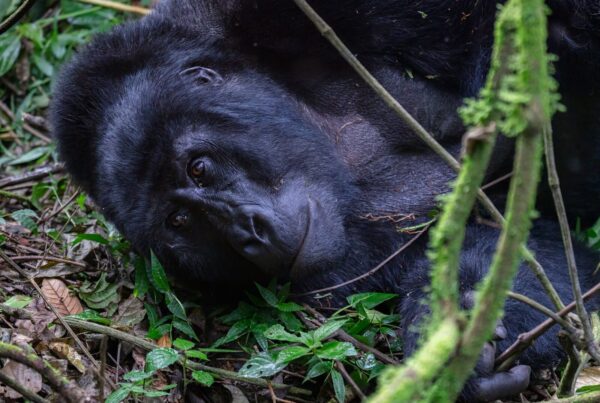
When you look into a gorilla’s eyes in Bwindi’s forest and feel a recognition that transcends the gap between species, you are not being irrational or sentimental. You are responding to genuine biological kinship. The neural circuits underlying that recognition, the emotional responses it triggers, the sense of encountering something familiar and yet profoundly different — these are the experiential consequences of sharing 98% of your DNA with the animal in front of you.
Final Thoughts
The genetic closeness between mountain gorillas and humans is both a scientific fact and an ethical challenge. It explains why gorilla trekking affects people so deeply, why gorilla conservation matters beyond ecology, and why the protection of 1,063 individuals represents the preservation of beings that are, in the most measurable biological sense, our close relatives. That kinship obligation is one of the strongest arguments for the strict protections that gorilla conservation requires.
Frequently Asked Questions
Uganda is home to the mountain gorilla (Gorilla beringei beringei), one of two subspecies of eastern gorilla. They live exclusively in the Virunga volcanic highlands (Uganda/Rwanda/DRC) and Bwindi Impenetrable Forest (Uganda only). Mountain gorillas are the only gorilla subspecies that cannot survive in captivity — every individual you can trek is a wild animal.
The standard gorilla trekking permit gives you exactly 1 hour with the gorilla family. This time begins when you make first contact with the family — the ranger signals the start. The Gorilla Habituation Experience gives 4 hours with a semi-wild family. The walk to find the gorillas can take 30 minutes to 5 hours depending on where the family has moved.
Stay calm, crouch down slowly, avoid direct eye contact, and remain quiet. Do not run — running triggers a chase response. Rangers accompanying your group manage close approaches. Habituated gorillas are accustomed to humans and almost never make contact, but a charging silverback is managed by staying still and following ranger instructions immediately.
A maximum of 8 visitors per habituated gorilla family per day for standard trekking. The Gorilla Habituation Experience has a maximum of 4 visitors per family per day. These limits are set by UWA to minimise stress on the gorilla families and maintain the quality of the experience.
Uganda is home to the mountain gorilla (Gorilla beringei beringei), one of two subspecies of eastern gorilla. They live exclusively in the Virunga volcanic highlands (Uganda/Rwanda/DRC) and Bwindi Impenetrable Forest (Uganda only). Mountain gorillas are the only gorilla subspecies that cannot survive in captivity — every individual you can trek is a wild animal.