Updated
How Gorillas Raise Their Young: Motherhood in the Forest
Birth and the Early Hours
How Gorillas Raise Their Young: Motherhood in the Forest Birth and the Early Hours A mountain gorilla birth is among the most significant events in a gorilla family’s social life. A mountain gorilla birth is among the most significant events in a gorilla family’s social life. Unlike many mammals, gorillas almost always give birth to a single infant, very rarely twins. The newborn weighs approximately two kilograms at birth — less than half the weight of a human infant relative to maternal size — and arrives fully dependent. Within minutes of birth, the mother begins the intensive care that will dominate her life for the next three to four years.
Gorilla births typically occur at night, within the family’s nesting site. The mother manages the birth alone, without the assistance of other group members, though researchers have observed other females showing interest and proximity in the immediate post-birth period. The infant is born with open eyes and a strong grasp reflex — it can cling to its mother’s fur from the first hours of life, an adaptation critical for survival in a species where the mother must remain mobile.
The First Year: Complete Dependence
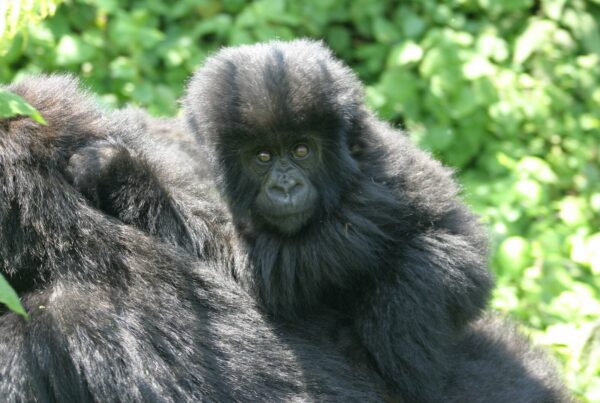
For the first three to six months of life, a gorilla infant is carried continuously. The mother holds the infant to her chest when moving or feeding, and the infant clings to her fur dorsally (on her back) as she knuckle-walks through the forest. The physical burden of carrying an infant for months while maintaining normal foraging activity is considerable, and mothers with young infants spend more time resting and feeding than other group members.
Nursing begins immediately after birth and continues for two to three years. Gorilla milk changes composition over the nursing period, providing appropriate nutrition for each developmental stage. The nursing relationship is not merely nutritional — it provides physical warmth, emotional security, and a hormonal bonding mechanism similar to the oxytocin-mediated bonding in human mothers.
During the first year, infants rarely touch the ground except when the mother places them to adjust her position. They are always within physical contact of the mother, and she responds immediately to any distress vocalisation with comfort behaviour: pulling the infant closer, grooming, or nursing.
Early Socialisation: Six Months to Two Years
As infants gain strength and coordination in their second half-year, they begin to venture short distances from their mothers, exploring nearby vegetation and occasionally engaging with other group members. This cautious exploration is always within the mother’s reach and immediately curtailed if she perceives any threat.
Other group members, particularly juvenile males and female relatives, show intense interest in new infants. A silverback father typically ignores infants until they are mobile, at which point he may allow them to approach and even briefly interact — infants climbing on a resting silverback are a common observation in habituated families. This infant tolerance from the silverback is not random; it reflects his investment in the group’s reproductive success.
By approximately one year, infants are spending brief periods riding dorsally (on their mother’s back) rather than ventrally (against her chest), freeing their hands for exploratory reaching. Motor development accelerates rapidly through the second year, with infants learning to climb, swing, and manipulate objects with increasing confidence.
Play: The Learning Medium
Juvenile gorilla play is the primary mechanism of socialisation and skill development. By 18 months to two years, gorillas are spending significant time playing — both with other juveniles and with patient adult females who tolerate rough-and-tumble interaction. Play wrestling teaches body awareness, strength calibration, and social hierarchy negotiation. Play chasing builds cardiovascular fitness and spatial reasoning. Play climbing develops the upper body strength and balance essential for adult forest life.
Mothers regulate their infants’ play by monitoring interactions and intervening when play becomes too rough or takes the infant too far from the family’s safe zone. This maternal regulation gradually relaxes as the infant’s physical capability and social awareness develop. By age three, most gorillas can navigate the immediate forest environment largely independently, though they remain socially and nutritionally dependent on their mothers.
Weaning and the Transition to Solid Food
Weaning typically occurs between three and four years of age, though some nursing continues past this point. The weaning process is gradual and often contested — infants resist the reduction in nursing access with protest vocalisations that field researchers describe as tantrum-like. Mothers respond with increasing firmness over time, eventually declining nursing requests by turning away or gently removing the infant.
The transition to fully solid food mirrors the weaning timeline. From approximately six months, infants begin tasting the vegetation their mothers eat, initially through stealing food held in their mother’s hands. This food-sharing teaches the infant which plants are edible and safe before independent foraging begins. By age three, most gorillas are competent foragers, capable of selecting and processing the range of leaves, stems, and fruit that makes up the adult diet.
Maternal Investment and Its Costs
Female gorillas invest heavily in each infant and produce very few offspring over a lifetime. The interbirth interval — the time between successive successful births — is typically four to five years, one of the longest of any mammal. A female gorilla who lives to 40 years may produce only six to eight surviving offspring across her reproductive life. This makes each infant enormously valuable, and the intensity of maternal investment reflects that value.
The cost of this investment is that females who lose infants early return to reproductive condition relatively quickly, while those who invest fully in a surviving infant delay reproduction significantly. This creates a delicate trade-off between current and future reproductive success that field researchers have documented in multiple gorilla populations.
What You May Observe on Trek
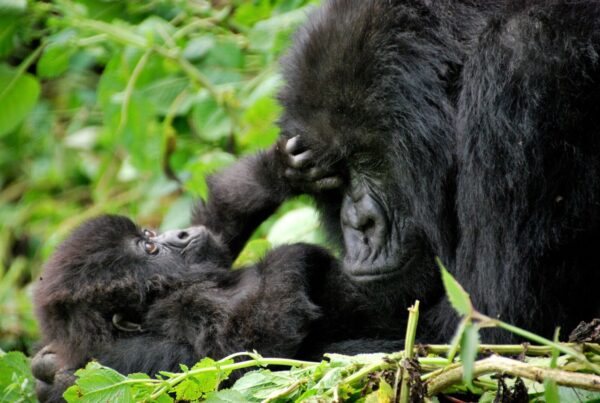
During gorilla trekking encounters, mother-infant interactions are among the most emotionally resonant sights. A mother nursing her infant while calmly feeding, a juvenile attempting to steal food from a patient adult female, an infant taking its first unsteady solo steps on a log — these moments capture the full reality of gorilla family life in ways that no description fully conveys.
The protective behaviour of mothers is also visible: a mother pulling her infant closer when the trekking group approaches too fast, or repositioning to place her body between the infant and the observers. This maternal protectiveness is not hostility toward visitors; it is the same impulse that drives every primate mother, including human ones, to instinctively shield their most vulnerable family members.
Final Thoughts
Gorilla motherhood is intensive, long-lasting, and demonstrably emotionally engaged. The skills of survival — foraging, social navigation, forest movement — are transmitted not through instinct alone but through years of close observation, play, and direct maternal teaching. When you watch a mother gorilla and her infant in Bwindi’s forest, you are witnessing one of the most sophisticated parent-offspring relationships in the animal kingdom, shaped by the same evolutionary pressures that shaped our own.
Frequently Asked Questions
Uganda is home to the mountain gorilla (Gorilla beringei beringei), one of two subspecies of eastern gorilla. They live exclusively in the Virunga volcanic highlands (Uganda/Rwanda/DRC) and Bwindi Impenetrable Forest (Uganda only). Mountain gorillas are the only gorilla subspecies that cannot survive in captivity — every individual you can trek is a wild animal.
The standard gorilla trekking permit gives you exactly 1 hour with the gorilla family. This time begins when you make first contact with the family — the ranger signals the start. The Gorilla Habituation Experience gives 4 hours with a semi-wild family. The walk to find the gorillas can take 30 minutes to 5 hours depending on where the family has moved.
Stay calm, crouch down slowly, avoid direct eye contact, and remain quiet. Do not run — running triggers a chase response. Rangers accompanying your group manage close approaches. Habituated gorillas are accustomed to humans and almost never make contact, but a charging silverback is managed by staying still and following ranger instructions immediately.
A maximum of 8 visitors per habituated gorilla family per day for standard trekking. The Gorilla Habituation Experience has a maximum of 4 visitors per family per day. These limits are set by UWA to minimise stress on the gorilla families and maintain the quality of the experience.
Uganda is home to the mountain gorilla (Gorilla beringei beringei), one of two subspecies of eastern gorilla. They live exclusively in the Virunga volcanic highlands (Uganda/Rwanda/DRC) and Bwindi Impenetrable Forest (Uganda only). Mountain gorillas are the only gorilla subspecies that cannot survive in captivity — every individual you can trek is a wild animal.