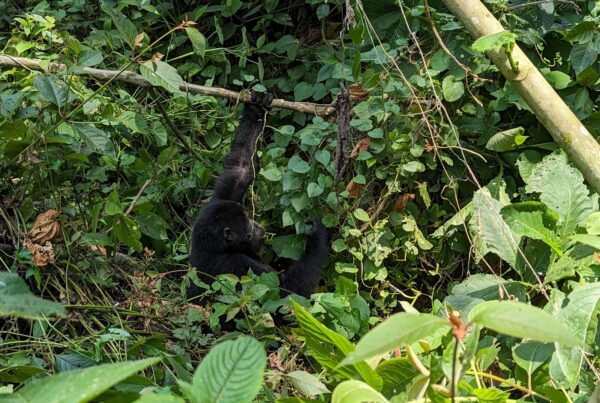
Gorilla Doctors is a veterinary field programme that monitors the health of every habituated mountain gorilla on Earth — roughly 600 individuals across Uganda, Rwanda, and the Democratic Republic of Congo — and intervenes medically when illness or injury is life-threatening and human-caused. Founded in 1986 by the Morris Animal Foundation, the programme operates embedded within the national park systems of all three countries and works alongside Uganda Wildlife Authority in Bwindi. Understanding their role makes it clear how intensively managed mountain gorilla conservation actually is. See the full gorilla families overview and how this connects to Bwindi’s conservation framework.
- Founded: 1986 as Mountain Gorilla Veterinary Project (MGVP), operating as Gorilla Doctors
- Scope: monitors all habituated mountain gorillas in Uganda, Rwanda, and DRC
- Most common intervention: snare removal from gorillas caught in wire traps set for other animals
- Intervention threshold: only when illness/injury is life-threatening and human-caused — natural disease is generally not treated
- Staffing: international and national veterinarians, supplemented by wildlife health training programs
In the forests of Uganda, Rwanda, and the Democratic Republic of Congo, a team of veterinarians, paramedics, and field researchers monitors the health of every habituated mountain gorilla on Earth. Their organisation, Gorilla Doctors, has been operating continuously since 1986, combining wildlife medicine, conservation science, and field logistics in one of the most demanding and consequential veterinary programmes in the world. In a species with a total population of 1,063 individuals, where each death is a measurable fraction of the species’ total viability, the Gorilla Doctors’ work is not supplementary to conservation — it is central to it.
Origins and History
Gorilla Doctors — originally called the Mountain Gorilla Veterinary Project (MGVP) — was founded in 1986 by the Morris Animal Foundation in partnership with the Rwanda government, the International Gorilla Conservation Programme, and a group of committed primatologists and veterinarians who recognised that habituated gorilla populations, by virtue of their regular human contact, required ongoing medical monitoring.
The founding premise was straightforward but unprecedented: wild great apes whose natural disease exposure had been altered by habituation to humans needed veterinary oversight that did not exist anywhere in the world at that time. Developing the protocols, equipment, anaesthesia approaches, and management guidelines required for safely treating wild gorillas in the field required years of learning, collaboration with zoo and captive great ape veterinarians, and a willingness to make and learn from mistakes in one of the most demanding field environments imaginable.
In 2009, the programme was renamed Gorilla Doctors and expanded its operational scope to include both mountain gorilla populations and the critically endangered Grauer’s (eastern lowland) gorillas in DRC, extending the mountain gorilla model of veterinary conservation medicine to the broader eastern gorilla species.
What Gorilla Doctors Actually Do
The programme’s activities span a spectrum from daily health monitoring to emergency intervention. At the routine end, Gorilla Doctors staff monitor habituated gorilla groups daily alongside UWA rangers and research teams, observing individual animals for signs of illness, injury, or behavioural change that might indicate a health problem. These observations feed into a longitudinal health database that tracks the health history of every individual in every habituated group across years and decades.
Monthly faecal sampling — collecting gorilla dung from the forest floor non-invasively — provides biological material for parasite monitoring, hormonal assays, and genetic analysis. These samples are processed at field laboratories and at partner institutions in the United States and Europe, generating health data at a population level that guides intervention decisions and tracks long-term trends in disease prevalence.
Emergency interventions — the visible, dramatic face of the programme — involve physically immobilising affected gorillas using darted anaesthesia, performing medical procedures in the field, and providing post-operative monitoring. These interventions are used for snare removal (when a gorilla has been caught in a wire trap), treatment of serious injuries or infections, respiratory illness management when conditions are severe, and assessment of animals whose condition has deteriorated acutely. Each intervention involves significant preparation, multiple team members, careful post-anaesthesia monitoring, and a risk calculation that weighs the benefits of treatment against the stress and risks of the procedure itself.
The Intervention Decision
Perhaps the most important and difficult aspect of Gorilla Doctors’ work is deciding when to intervene. Not every sick or injured gorilla requires or should receive veterinary treatment. Gorillas have immune systems capable of resolving many conditions naturally, and the stress of capture, immobilisation, and human handling carries its own health risks. The decision to intervene must weigh the severity of the condition, the gorilla’s current health status, the likelihood of natural recovery without intervention, and the risks of the intervention procedure itself.
Cases where intervention is clearly indicated include gorillas with wire snares causing progressive tissue damage, compound fractures or severe lacerations, severe respiratory illness in animals who would die without treatment, and young infants who have been orphaned and require care. Cases where the decision is more nuanced include mild to moderate respiratory illness that may resolve naturally, skin conditions that are uncomfortable but not life-threatening, and older injuries that have partially healed. Gorilla Doctors has developed clinical guidelines for these decisions, but field judgment by experienced veterinarians remains essential.
Notable Cases and Outcomes
Over nearly four decades of operation, Gorilla Doctors has intervened in hundreds of cases and documented outcomes that provide evidence of the programme’s conservation impact. Among the most significant are mass respiratory illness outbreaks affecting multiple individuals in a group simultaneously — events that required multiple sequential interventions and careful management of anaesthesia in animals already compromised by illness. Gorilla Doctors estimates that veterinary interventions have directly prevented dozens of deaths that would otherwise have occurred from treatable conditions.
The 2020 death of Rafiki, the Nkuringo silverback killed by poachers, was an occasion where veterinary response was mobilised but was unable to save the animal — arriving too late after the fatal injury. The incident highlighted both the programme’s rapid response capacity and the limits of what veterinary medicine can do when animals are killed by deliberate human action rather than disease or injury.
Disease Research and Disease Prevention
Gorilla Doctors’ health monitoring has generated a longitudinal disease database that is one of the most comprehensive records of health in any wild great ape population. This database has enabled research on the frequency, causes, and risk factors for different disease conditions in mountain gorillas — findings that directly inform prevention efforts.
The identification of human-origin respiratory viruses (rhinovirus, RSV, metapneumovirus) in sick gorillas has been among the most important scientific outputs, directly informing the trekking protocols that require visitors to maintain seven-metre distance, wear masks in some contexts, and be screened for respiratory illness before participating. This evidence-based approach to prevention, rooted in the programme’s disease research, has likely prevented transmission events that would have caused significant mortality in habituated populations.
Funding and Partners
Gorilla Doctors is funded through a combination of international conservation grants, contributions from gorilla range country governments, and support from zoos, foundations, and individual donors. The programme has historically been dependent on relatively small number of major funders, creating financial vulnerability when funding priorities shift. Post-COVID funding challenges have prompted efforts to diversify the programme’s revenue base and build longer-term funding commitments from range country governments.
For individual donors, Gorilla Doctors offers direct giving options that fund specific programme activities. Supporting the organisation financially is one of the most direct ways an individual can contribute to mountain gorilla conservation beyond visiting and paying for trekking permits.
Final Thoughts
Gorilla Doctors represents the intersection of compassionate medicine and hard-headed conservation strategy. Each life saved by veterinary intervention adds to a population that cannot afford to lose individuals. The programme’s nearly four decades of operation have not only saved individual gorillas but have generated the scientific knowledge that enables smarter prevention, more precise intervention decisions, and the advocacy that keeps gorilla health on the agenda of governments and international conservation organisations. In a species with 1,063 individuals, every one counts. Gorilla Doctors is dedicated to counting them for as long as possible.
What does Gorilla Doctors actually do in the field?
Gorilla Doctors veterinarians accompany ranger and research teams on regular monitoring visits to each habituated gorilla group. They observe gorilla health, record symptoms, and assess whether any individual requires intervention. When a gorilla has a snare injury, wound, or respiratory infection severe enough to threaten its life and where human activity caused the problem, they immobilise the animal, treat it, and monitor recovery. They also respond to deaths, conducting post-mortem examinations that document causes of death across the entire habituated population.
Why is snare removal Gorilla Doctors’ most common intervention?
Wire snares set by poachers to catch bushmeat species — duiker, bush pig, and other small animals — are widespread in the forests around Bwindi and the Virungas. Mountain gorillas trigger these snares accidentally and become entangled. While adult gorillas often break free, juveniles are particularly at risk of severe limb injuries or death from snare wounds that become infected. Gorilla Doctors’ rapid response to snare cases is one of the clearest direct impacts of the programme — limbs that would have been lost to infection are saved by timely intervention.
Can gorilla doctors treat all gorilla diseases?
No — Gorilla Doctors operate under a deliberate non-intervention policy for naturally occurring illness. They intervene only when a condition is human-caused (snare injuries, respiratory illness transmitted by humans) or when a gorilla’s death would otherwise be certain and the intervention is feasible in the field. This policy exists because immobilisation of a wild great ape carries real risk, and repeated medical intervention would undermine the natural immunity and behaviour patterns of wild populations. Gorillas that recover naturally from illness develop immunity; treating every pathogen would create dependency on veterinary care.
How does disease transmission between tourists and gorillas get managed?
Gorilla Doctors coordinate with park authorities on the health protocols that govern gorilla tourism: the 7-metre minimum distance, mask requirements when closer approaches occur, and the policy of turning away visitors who show active signs of respiratory illness. They also monitor gorilla health data for any spike in respiratory illness following periods of high tourist contact, allowing rangers and UWA to adjust protocols if disease transmission is detected. This epidemiological surveillance role is as important as the direct clinical work.
Is the Gorilla Doctors programme funded by gorilla tourism?
Gorilla Doctors is funded through a combination of donor support, grants, and partnerships with institutions including the University of California Davis School of Veterinary Medicine. Gorilla tourism revenue does not directly flow to Gorilla Doctors but creates the broader conservation economy that sustains the political will and park authority cooperation that makes the programme possible. The health of the habituated gorilla population — which tourism makes valuable — is the justification for maintaining the veterinary programme.
- Gorilla veterinary care in Bwindi: the Gorilla Doctors and what they do
- Meet the conservationist protecting mountain gorillas in the heart of the impenetrable forest.
- Why Adult Male Mountain Gorillas Stay Etched in Your Mind After Gorilla Habituation
- Why You Should Do a Golden Monkey Trek Before Your Mountain Gorilla Trek
- Can I Touch a Mountain Gorilla
- Real Difference Between Mountain Gorillas in the Forest and Gorillas in Zoos
- Carl Akeley and the Mountain Gorillas of 1926
- What To Do When a Mountain Gorilla Charges Toward You
- Uganda Mountain Gorilla Tours: A Complete Guide
- The Fastest Way is 1-Day Gorilla Trekking in Uganda to See Mountain Gorillas