The goal-oriented approach to gorilla trekking — treating the encounter as a task to be completed, the 60 minutes as a photography session to be optimised, and the return to the lodge as the point at which the experience becomes real through the images captured — is the approach that most visitors arrive with, and it is specifically the approach that reduces rather than deepens the quality of the gorilla encounter, because it places the observer in a cognitive mode of production (finding, capturing, documenting) rather than the receptive mode in which the encounter’s most extraordinary qualities become perceptible. The gorilla encounter at Bwindi has characteristics that reward stillness, attentiveness, and sensory absorption rather than the task management that most visitors are habituated to in their daily lives: the gorillas’ specific way of occupying space, the sound and texture of the forest during the encounter, the eye contact that becomes available to someone who is not simultaneously managing their camera settings — these are the elements of the encounter that participants consistently describe as most memorable, and they require a specific quality of presence to access. This guide offers a framework for approaching gorilla trekking as a slow, receptive, immersive experience rather than an achievement event. For the practical permit logistics, see the permit guide.
The Slow Gorilla Trek: Approach Notes
- Put the camera down: Designate 10-15 minutes of the encounter as camera-free observation — the images will be better after
- Use all senses: Smell of the forest, sound of the gorilla family’s movement and breathing, texture of the ground
- Observe the ranger: Watch how the ranger reads the family’s behaviour — it reveals the encounter’s invisible dimensions
- Take a position and stay: Resist the urge to move for a better angle — the best encounters happen when the family comes to you
- Breathe and notice: Your own physiological response (quickened heartbeat, heightened alertness) is part of the data
- Post-encounter: write or draw your impressions immediately before the phone and camera review begins — preserve the raw impression
Most people approach gorilla trekking as an achievement task — a physical and logistical challenge with a defined goal: find the gorillas, see them, photograph them, complete the hour. This goal-orientation is understandable given the cost and effort involved in reaching Bwindi, but it creates a mode of engagement that can actually diminish the depth of the experience. The visitors who describe their gorilla encounters as genuinely transformative are often those who brought a quality of presence to the forest that goes beyond goal achievement — a capacity to be fully in the experience rather than managing their way through it.
The attention that the forest demands
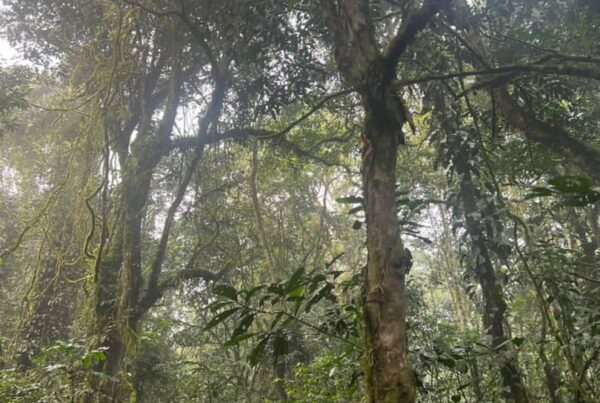
Bwindi Impenetrable National Park is one of the most sensory-rich environments most visitors will ever enter. The density of sound alone is extraordinary — multiple bird species calling simultaneously, insects creating a constant textile of sound beneath the bird calls, the creak and settle of trees in the wind, water moving over stones in hidden streams. The visual complexity is equally dense — layers of vegetation at every scale from the soil mosses at your feet to the canopy crowns forty metres above, movement in the peripheral vision from birds and small mammals, the shifting quality of light through the canopy as clouds move across the sky.
In this environment, the mental tendency to process the world through narrative — to turn experience into a story happening to you rather than something you are fully inside — is a genuine impoverishment. When the mind is occupied with thoughts about how the photographs are turning out, whether the distance to the gorillas is appropriate, what time the lodge will serve lunch, or whether the planned itinerary for tomorrow is correct, the forest is experienced at a fraction of its actual richness. Mindfulness practice in the conventional sense — returning attention to direct sensory experience rather than mental narrative — is not a spiritual practice in this context. It is simply good sense.
Before the trek: arriving in the body
The walk from the lodge to the briefing point and from the briefing point to the forest edge is time worth using intentionally. Most visitors use it for logistics — adjusting pack straps, checking camera settings, listening to guide instructions. All of these are necessary. But if you have five minutes before the briefing begins, or a few quiet moments on the walk to the trailhead, use them to arrive in your body rather than remaining in your head.
Simple attention practices work well. Feel the weight of your feet on the ground with each step. Notice the temperature of the air on your face. Listen to what is audible in the immediate environment — not trying to identify or categorise sounds, just registering them as pure sensory experience. Take a few deliberately slow breaths and let the body’s physical tension — the overnight travel fatigue, the mild altitude adaptation, the excitement and anticipation — soften slightly without trying to eliminate it.
This is not meditation in any demanding sense. It is simply the shift from autopilot mode — moving through space while the mind is elsewhere — to present mode, where movement and environment are actually registered by consciousness rather than filtered through the usual background commentary. In the context of Bwindi, this shift makes an immediate difference to the quality of what is noticed and felt.
The walking meditation of the forest path
Walking in Bwindi’s forest is physically demanding, and for much of the trek the practical demands of terrain management — watching footing on slippery roots, using trekking poles for balance on steep descents, keeping pace with the guide — will occupy the foreground of attention. This is as it should be. But there are moments on every trek — passages through more level ground, brief pauses while the guide checks radio communication, rests at viewpoints — where the physical demands ease and attention can widen.
In these moments of relative ease, allow the senses to spread. Let your vision soften from the narrow-focus attention required for footing to a wider, more diffuse awareness — the panoramic vision that notices movement and depth across a wide field rather than the focused vision that analyses specific objects. This wider visual mode is actually more effective for spotting wildlife than narrow-focus scanning, because it registers movement in peripheral vision that focused attention misses.
Listen not just to the bird calls that the guide is identifying but to the texture of the total sound environment. How far away is the nearest water? How loud is the wind in the canopy compared to the forest floor? When the guide stops and the group goes quiet, what becomes audible that was masked by the sound of footsteps and clothing? The forest reveals itself through sound in layers, and the ability to hear those layers is a function of how quiet the mind is.
The hour with the gorillas: quality of attention
The sixty minutes with the gorilla family is where the quality of attention brings the greatest returns. There is a temptation to spend much of this hour looking through a viewfinder or at a phone screen — documenting the experience rather than having it. Photography is a legitimate and wonderful part of the gorilla encounter, but when the camera becomes the primary mode of engagement for the entire hour, the experience is mediated through a recording device rather than lived directly.
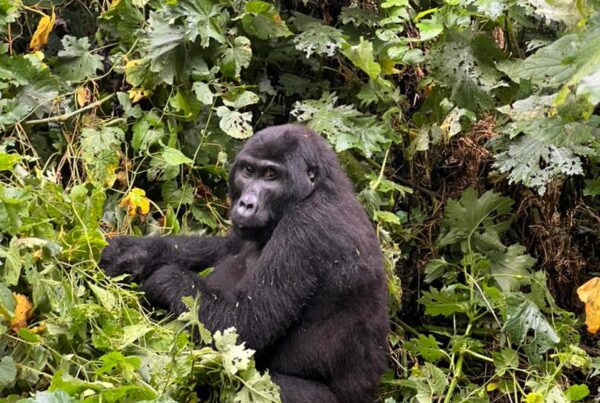
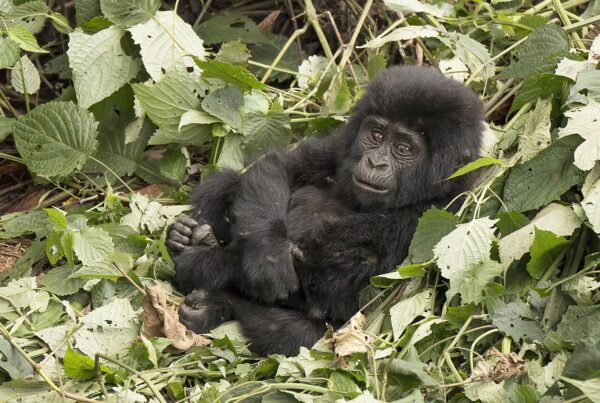
Consider making a conscious choice to put the camera down for some portion of the hour — even five or ten minutes — and simply watch. Watch the silverback’s breathing — the massive rise and fall of the chest, the stillness of deep rest, the sudden alertness when a sound catches his attention. Watch a juvenile climb a sapling, lose grip, fall, and immediately try again with the unconcerned persistence of any young animal learning through play. Watch a mother groom her infant with absolute focused attention, the fingers moving through dark fur with a precision and tenderness that is unmistakably maternal.
When you watch without the camera between you and the gorillas, the experience has a different texture. There is no frame, no composition, no decision about whether to use a wide angle or a tight portrait. There is only the gorilla, at whatever distance the situation provides, being itself in its own forest. This unmediated encounter is what people describe when they say the gorilla trek changed something in them — it is not the photographs that do that, however beautiful they are. It is the direct meeting between human and animal consciousness, across the evolutionary distance that separates us, in a place that has been wild for longer than our species has existed.
Presence as a conservation act
There is an argument that the quality of presence visitors bring to gorilla encounters matters beyond personal enrichment. The gorilla trekking model depends on a continuous demonstration that the gorillas are worth protecting — worth the permit revenue, the community investment, the park management costs, the opportunity cost of land that could otherwise be farmed. This case is made most powerfully not by data but by the experiences of individual visitors who return from Bwindi transformed in their relationship to wild nature and committed to supporting the conservation that made their encounter possible.
A visitor who was fully present in the forest — who actually met the gorillas rather than just photographed them — is far more likely to become a conservation donor, an advocate, a person who tells the story of mountain gorillas to their children and communities in a way that sustains broader public support for the effort. The quality of engagement in those sixty minutes has long-term conservation implications that extend far beyond the individual experience.
After the trek: integration and reflection
The walk back from the gorilla group to the forest edge is worth treating as a transitional space rather than hurrying through. The physical exertion of the outward trek has been expended, and the encounter that the trek was building toward has occurred. The return walk is an integration period — time for the direct experience to settle into memory and meaning before the practical world of lunch, lodge logistics, and plans for the afternoon reasserts itself.
Many people find that the most vivid sense of having been somewhere remarkable arrives not in the moment of the experience but in the hour or two afterward, when the nervous system begins to relax from the heightened alertness of the encounter and the fullness of what happened becomes apparent. A quiet return walk, with minimal conversation and full sensory attention, allows this integration to happen naturally rather than being immediately dispersed by conversation, phone checking, and the forward-moving busyness of travel logistics.
Take ten minutes that evening, before dinner or before sleep, to simply recall what happened. Not to record it or share it — just to replay it in the mind without agenda. The silverback’s face. The quality of light in the clearing where the family was feeding. The sound of the forest around the gorillas. The weight of your boots on the mountain path on the way back down. These details, held lightly in attention for a few minutes, often yield something that photographs cannot: the full sensory texture of having been there.
Gorilla trekking offers one of the rarest things available to modern travellers — a genuinely unrepeatable encounter with non-human intelligence in an environment that has not been built for human comfort or convenience. The forest does not care about your schedule or your photographs or your expectations. It asks only that you arrive, and pay attention. The visitors who do this leave carrying something that lasts far longer than any image in their camera.
Frequently Asked Questions
Making the most of the 60-minute gorilla encounter at Bwindi involves a specific approach to how the time is allocated that differs from the default photography-first mode that most visitors arrive with. The most effective approach, recommended by experienced ranger guides: in the first 5-10 minutes after finding the family, put all cameras down and simply look and listen. The visual processing load of managing a camera — checking settings, framing, reviewing images — occupies the neural resources that would otherwise be registering the encounter’s sensory detail. The initial camera-free period allows the visual system to adapt to the light conditions and the observer to settle into the pace of the encounter rather than rushing immediately into documentation. After the initial orientation period, alternate between photography and pure observation rather than maintaining photography mode throughout. The specific elements worth observing without camera: the silverback’s weight and presence when he moves toward or past the group; the quality of attention a gorilla directs at you when it makes direct eye contact; the family’s internal social dynamics (grooming, infant play, juvenile interactions with adults) that photography captures in isolated frames but observation perceives as continuous narrative. The encounters that visitors describe most vividly years later are almost always encounters during which they spent extended time simply watching rather than primarily documenting. What does it mean to really “see” a mountain gorilla during a trek? The quality of observation that constitutes really seeing a mountain gorilla in the encounter — as opposed to visually registering its presence in the service of photography or checklist completion — involves a shift in attention from the gorilla as subject of documentation to the gorilla as independent subject of its own world. This shift is enabled by spending enough time in genuinely receptive observation that the gorilla’s individuality becomes perceptible: not just a silverback, but this particular silverback, with this specific way of holding his weight, this particular quality of attention directed at the observer group, this idiosyncratic response to the presence of the juveniles. The experienced ranger guides describe this quality of observation as the difference between “seeing the gorilla” and “meeting the gorilla” — the encounter is structured so that meeting is available if the observer is in the right cognitive mode to receive it. The practical access point: look at the gorilla’s face for long enough that the face stops being “a gorilla face” and becomes a specific face, with a specific expression, oriented in a specific direction — this shift, which typically takes 30-60 seconds of uninterrupted face-focused attention, is the entrance point to the full quality of the encounter. How does the forest itself contribute to the gorilla trekking experience? Bwindi Impenetrable Forest is not merely the setting for the gorilla encounter — it is an active dimension of the experience in ways that slow, attentive trekking makes available and rushed, goal-oriented trekking misses. The forest’s sensory texture on a gorilla trek morning: the specific quality of light that filters through the highland forest canopy (not the direct tropical sun of the savannah, but a diffuse green-gold that changes character through the morning as the sun angle changes); the olfactory profile of the forest interior (damp earth, decomposing leaves, living green matter, occasional flowering plant); the layered soundscape (bird calls from multiple canopy strata simultaneously, the rhythmic percussion of rainfall-dripping secondary canopy even on dry mornings, the distant call of a colobus group, the ranger’s soft instructions); and the physical sensation of the forest floor underfoot (root systems, soft earth, occasional muddy section, the resistance of dense undergrowth). Each of these is available to slow, receptive walking and largely unavailable to a trekker focused on pace and positioning. The walk to and from the gorilla family — which most visitors experience primarily as the obligatory physical work before and after the “real” encounter — is itself a forest immersion experience of significant quality for a visitor in the right attentional mode. Should you prioritise photography or the experience during a gorilla trek? The question of photography versus experience in the gorilla encounter is a genuine tension rather than a false choice, and is worth thinking through before the trek day rather than improvising in the moment. The case for prioritising experience: the encounter is unrepeatable in its specific form (this particular family, this morning, this light, this silverback’s proximity) and the photographic documentation, however good, is a reduced version of the encounter rather than the encounter itself; many visitors report that their most vivid gorilla memories come from moments when they were watching rather than shooting. The case for prioritising photography: the images are the primary mode through which the encounter becomes shareable and communicable, and good gorilla photography requires technical attention that cannot be divided with pure observation. A practical reconciliation: allocate the encounter time into distinct phases rather than trying to do both simultaneously throughout. The first phase (10-15 minutes): purely observational, no camera, used for initial orientation to the family’s position and character. The middle phase: primary photography phase — dedicated to systematic coverage of the family with whatever photographic approach you have planned. The final phase (10-15 minutes): return to camera-free observation, used for the specific attention quality — eye contact, movement observation, encounter integration — that photography mode makes unavailable. This three-phase structure produces better photographs (because the observational phase at the start gives your eye better information about what to photograph) and a richer experience than either exclusive mode throughout. What can you do in the days after gorilla trekking to integrate the experience? The day or two following a gorilla trek at Bwindi is a natural integration period that the most engaged visitors use specifically rather than immediately moving on to the next activity. The physical recovery day (the day after the trek) is useful for activities at a gentler pace that extend the Bwindi experience: the Munyaga River Waterfall walk (1.5-2 hours, easy forest trail, bird-rich), the Buhoma Community Walk (cultural, not physical), or simply sitting on a lodge deck with the forest canopy in view. In terms of encounter processing: writing about the experience immediately — journal, email, notes — before the camera review and photo editing begins preserves the raw impression that photographic review subsequently modifies. Photographers specifically note that reviewing and editing images immediately after the encounter changes what they remember seeing in ways that later reviewing does not; a 24-hour gap between the experience and the image review preserves the encounter memory more intact. Some visitors report the gorilla encounter appearing in their dreams in the days following the trek — this is reported across cultures and age groups and seems to reflect the depth of the impression made during the encounter, which the sleeping brain continues processing after the waking day has moved on. Approach your gorilla trekking encounter with intention Gorilla Permit Guide — the permit that creates the 60-minute encounter window this approach is designed to fully inhabit Uganda Gorilla Families — the individual families whose character determines the specific encounter you will experience Bwindi Sector Guide — sector terrain and forest character that shapes the walk to and from the family Full Safari Cost Guide — planning the full experience that this guide is designed to maximise Safari Itineraries — Uganda itineraries that build in sufficient Bwindi time for the slow, immersive approach Further Reading Mindfulness in the forest: the mental health benefits of a gorilla trek Mindful travel in Uganda: slowing down to fully experience the gorilla forest The practice of deep listening in the forest: what a gorilla trek teaches about presence Mindfulness and the gorilla encounter: how to be fully present in the forest Bwindi Impenetrable Forest – Gorilla Trekking in Uganda’s UNESCO Jungle Meet the conservationist protecting mountain gorillas in the heart of the impenetrable forest. 2020 Gorilla Baby‑Boom in the Impenetrable Forest Gorillas and Their Fascinating Social Structures: The Heartbeat of the Forest Uganda Primate Safaris: Journey Into the Forests Where We First Belonged The Towering Presence of a King: How Tall Is a Silverback Gorilla? <
The quality of observation that constitutes really seeing a mountain gorilla in the encounter — as opposed to visually registering its presence in the service of photography or checklist completion — involves a shift in attention from the gorilla as subject of documentation to the gorilla as independent subject of its own world. This shift is enabled by spending enough time in genuinely receptive observation that the gorilla’s individuality becomes perceptible: not just a silverback, but this particular silverback, with this specific way of holding his weight, this particular quality of attention directed at the observer group, this idiosyncratic response to the presence of the juveniles. The experienced ranger guides describe this quality of observation as the difference between “seeing the gorilla” and “meeting the gorilla” — the encounter is structured so that meeting is available if the observer is in the right cognitive mode to receive it. The practical access point: look at the gorilla’s face for long enough that the face stops being “a gorilla face” and becomes a specific face, with a specific expression, oriented in a specific direction — this shift, which typically takes 30-60 seconds of uninterrupted face-focused attention, is the entrance point to the full quality of the encounter. How does the forest itself contribute to the gorilla trekking experience? Bwindi Impenetrable Forest is not merely the setting for the gorilla encounter — it is an active dimension of the experience in ways that slow, attentive trekking makes available and rushed, goal-oriented trekking misses. The forest’s sensory texture on a gorilla trek morning: the specific quality of light that filters through the highland forest canopy (not the direct tropical sun of the savannah, but a diffuse green-gold that changes character through the morning as the sun angle changes); the olfactory profile of the forest interior (damp earth, decomposing leaves, living green matter, occasional flowering plant); the layered soundscape (bird calls from multiple canopy strata simultaneously, the rhythmic percussion of rainfall-dripping secondary canopy even on dry mornings, the distant call of a colobus group, the ranger’s soft instructions); and the physical sensation of the forest floor underfoot (root systems, soft earth, occasional muddy section, the resistance of dense undergrowth). Each of these is available to slow, receptive walking and largely unavailable to a trekker focused on pace and positioning. The walk to and from the gorilla family — which most visitors experience primarily as the obligatory physical work before and after the “real” encounter — is itself a forest immersion experience of significant quality for a visitor in the right attentional mode. Should you prioritise photography or the experience during a gorilla trek? The question of photography versus experience in the gorilla encounter is a genuine tension rather than a false choice, and is worth thinking through before the trek day rather than improvising in the moment. The case for prioritising experience: the encounter is unrepeatable in its specific form (this particular family, this morning, this light, this silverback’s proximity) and the photographic documentation, however good, is a reduced version of the encounter rather than the encounter itself; many visitors report that their most vivid gorilla memories come from moments when they were watching rather than shooting. The case for prioritising photography: the images are the primary mode through which the encounter becomes shareable and communicable, and good gorilla photography requires technical attention that cannot be divided with pure observation. A practical reconciliation: allocate the encounter time into distinct phases rather than trying to do both simultaneously throughout. The first phase (10-15 minutes): purely observational, no camera, used for initial orientation to the family’s position and character. The middle phase: primary photography phase — dedicated to systematic coverage of the family with whatever photographic approach you have planned. The final phase (10-15 minutes): return to camera-free observation, used for the specific attention quality — eye contact, movement observation, encounter integration — that photography mode makes unavailable. This three-phase structure produces better photographs (because the observational phase at the start gives your eye better information about what to photograph) and a richer experience than either exclusive mode throughout. What can you do in the days after gorilla trekking to integrate the experience? The day or two following a gorilla trek at Bwindi is a natural integration period that the most engaged visitors use specifically rather than immediately moving on to the next activity. The physical recovery day (the day after the trek) is useful for activities at a gentler pace that extend the Bwindi experience: the Munyaga River Waterfall walk (1.5-2 hours, easy forest trail, bird-rich), the Buhoma Community Walk (cultural, not physical), or simply sitting on a lodge deck with the forest canopy in view. In terms of encounter processing: writing about the experience immediately — journal, email, notes — before the camera review and photo editing begins preserves the raw impression that photographic review subsequently modifies. Photographers specifically note that reviewing and editing images immediately after the encounter changes what they remember seeing in ways that later reviewing does not; a 24-hour gap between the experience and the image review preserves the encounter memory more intact. Some visitors report the gorilla encounter appearing in their dreams in the days following the trek — this is reported across cultures and age groups and seems to reflect the depth of the impression made during the encounter, which the sleeping brain continues processing after the waking day has moved on. Approach your gorilla trekking encounter with intention Gorilla Permit Guide — the permit that creates the 60-minute encounter window this approach is designed to fully inhabit Uganda Gorilla Families — the individual families whose character determines the specific encounter you will experience Bwindi Sector Guide — sector terrain and forest character that shapes the walk to and from the family Full Safari Cost Guide — planning the full experience that this guide is designed to maximise Safari Itineraries — Uganda itineraries that build in sufficient Bwindi time for the slow, immersive approach Further Reading Mindfulness in the forest: the mental health benefits of a gorilla trek Mindful travel in Uganda: slowing down to fully experience the gorilla forest The practice of deep listening in the forest: what a gorilla trek teaches about presence Mindfulness and the gorilla encounter: how to be fully present in the forest Bwindi Impenetrable Forest – Gorilla Trekking in Uganda’s UNESCO Jungle Meet the conservationist protecting mountain gorillas in the heart of the impenetrable forest. 2020 Gorilla Baby‑Boom in the Impenetrable Forest Gorillas and Their Fascinating Social Structures: The Heartbeat of the Forest Uganda Primate Safaris: Journey Into the Forests Where We First Belonged The Towering Presence of a King: How Tall Is a Silverback Gorilla? <
Bwindi Impenetrable Forest is not merely the setting for the gorilla encounter — it is an active dimension of the experience in ways that slow, attentive trekking makes available and rushed, goal-oriented trekking misses. The forest’s sensory texture on a gorilla trek morning: the specific quality of light that filters through the highland forest canopy (not the direct tropical sun of the savannah, but a diffuse green-gold that changes character through the morning as the sun angle changes); the olfactory profile of the forest interior (damp earth, decomposing leaves, living green matter, occasional flowering plant); the layered soundscape (bird calls from multiple canopy strata simultaneously, the rhythmic percussion of rainfall-dripping secondary canopy even on dry mornings, the distant call of a colobus group, the ranger’s soft instructions); and the physical sensation of the forest floor underfoot (root systems, soft earth, occasional muddy section, the resistance of dense undergrowth). Each of these is available to slow, receptive walking and largely unavailable to a trekker focused on pace and positioning. The walk to and from the gorilla family — which most visitors experience primarily as the obligatory physical work before and after the “real” encounter — is itself a forest immersion experience of significant quality for a visitor in the right attentional mode. Should you prioritise photography or the experience during a gorilla trek? The question of photography versus experience in the gorilla encounter is a genuine tension rather than a false choice, and is worth thinking through before the trek day rather than improvising in the moment. The case for prioritising experience: the encounter is unrepeatable in its specific form (this particular family, this morning, this light, this silverback’s proximity) and the photographic documentation, however good, is a reduced version of the encounter rather than the encounter itself; many visitors report that their most vivid gorilla memories come from moments when they were watching rather than shooting. The case for prioritising photography: the images are the primary mode through which the encounter becomes shareable and communicable, and good gorilla photography requires technical attention that cannot be divided with pure observation. A practical reconciliation: allocate the encounter time into distinct phases rather than trying to do both simultaneously throughout. The first phase (10-15 minutes): purely observational, no camera, used for initial orientation to the family’s position and character. The middle phase: primary photography phase — dedicated to systematic coverage of the family with whatever photographic approach you have planned. The final phase (10-15 minutes): return to camera-free observation, used for the specific attention quality — eye contact, movement observation, encounter integration — that photography mode makes unavailable. This three-phase structure produces better photographs (because the observational phase at the start gives your eye better information about what to photograph) and a richer experience than either exclusive mode throughout. What can you do in the days after gorilla trekking to integrate the experience? The day or two following a gorilla trek at Bwindi is a natural integration period that the most engaged visitors use specifically rather than immediately moving on to the next activity. The physical recovery day (the day after the trek) is useful for activities at a gentler pace that extend the Bwindi experience: the Munyaga River Waterfall walk (1.5-2 hours, easy forest trail, bird-rich), the Buhoma Community Walk (cultural, not physical), or simply sitting on a lodge deck with the forest canopy in view. In terms of encounter processing: writing about the experience immediately — journal, email, notes — before the camera review and photo editing begins preserves the raw impression that photographic review subsequently modifies. Photographers specifically note that reviewing and editing images immediately after the encounter changes what they remember seeing in ways that later reviewing does not; a 24-hour gap between the experience and the image review preserves the encounter memory more intact. Some visitors report the gorilla encounter appearing in their dreams in the days following the trek — this is reported across cultures and age groups and seems to reflect the depth of the impression made during the encounter, which the sleeping brain continues processing after the waking day has moved on. Approach your gorilla trekking encounter with intention Gorilla Permit Guide — the permit that creates the 60-minute encounter window this approach is designed to fully inhabit Uganda Gorilla Families — the individual families whose character determines the specific encounter you will experience Bwindi Sector Guide — sector terrain and forest character that shapes the walk to and from the family Full Safari Cost Guide — planning the full experience that this guide is designed to maximise Safari Itineraries — Uganda itineraries that build in sufficient Bwindi time for the slow, immersive approach Further Reading Mindfulness in the forest: the mental health benefits of a gorilla trek Mindful travel in Uganda: slowing down to fully experience the gorilla forest The practice of deep listening in the forest: what a gorilla trek teaches about presence Mindfulness and the gorilla encounter: how to be fully present in the forest Bwindi Impenetrable Forest – Gorilla Trekking in Uganda’s UNESCO Jungle Meet the conservationist protecting mountain gorillas in the heart of the impenetrable forest. 2020 Gorilla Baby‑Boom in the Impenetrable Forest Gorillas and Their Fascinating Social Structures: The Heartbeat of the Forest Uganda Primate Safaris: Journey Into the Forests Where We First Belonged The Towering Presence of a King: How Tall Is a Silverback Gorilla? <
The question of photography versus experience in the gorilla encounter is a genuine tension rather than a false choice, and is worth thinking through before the trek day rather than improvising in the moment. The case for prioritising experience: the encounter is unrepeatable in its specific form (this particular family, this morning, this light, this silverback’s proximity) and the photographic documentation, however good, is a reduced version of the encounter rather than the encounter itself; many visitors report that their most vivid gorilla memories come from moments when they were watching rather than shooting. The case for prioritising photography: the images are the primary mode through which the encounter becomes shareable and communicable, and good gorilla photography requires technical attention that cannot be divided with pure observation. A practical reconciliation: allocate the encounter time into distinct phases rather than trying to do both simultaneously throughout. The first phase (10-15 minutes): purely observational, no camera, used for initial orientation to the family’s position and character. The middle phase: primary photography phase — dedicated to systematic coverage of the family with whatever photographic approach you have planned. The final phase (10-15 minutes): return to camera-free observation, used for the specific attention quality — eye contact, movement observation, encounter integration — that photography mode makes unavailable. This three-phase structure produces better photographs (because the observational phase at the start gives your eye better information about what to photograph) and a richer experience than either exclusive mode throughout. What can you do in the days after gorilla trekking to integrate the experience? The day or two following a gorilla trek at Bwindi is a natural integration period that the most engaged visitors use specifically rather than immediately moving on to the next activity. The physical recovery day (the day after the trek) is useful for activities at a gentler pace that extend the Bwindi experience: the Munyaga River Waterfall walk (1.5-2 hours, easy forest trail, bird-rich), the Buhoma Community Walk (cultural, not physical), or simply sitting on a lodge deck with the forest canopy in view. In terms of encounter processing: writing about the experience immediately — journal, email, notes — before the camera review and photo editing begins preserves the raw impression that photographic review subsequently modifies. Photographers specifically note that reviewing and editing images immediately after the encounter changes what they remember seeing in ways that later reviewing does not; a 24-hour gap between the experience and the image review preserves the encounter memory more intact. Some visitors report the gorilla encounter appearing in their dreams in the days following the trek — this is reported across cultures and age groups and seems to reflect the depth of the impression made during the encounter, which the sleeping brain continues processing after the waking day has moved on. Approach your gorilla trekking encounter with intention Gorilla Permit Guide — the permit that creates the 60-minute encounter window this approach is designed to fully inhabit Uganda Gorilla Families — the individual families whose character determines the specific encounter you will experience Bwindi Sector Guide — sector terrain and forest character that shapes the walk to and from the family Full Safari Cost Guide — planning the full experience that this guide is designed to maximise Safari Itineraries — Uganda itineraries that build in sufficient Bwindi time for the slow, immersive approach Further Reading Mindfulness in the forest: the mental health benefits of a gorilla trek Mindful travel in Uganda: slowing down to fully experience the gorilla forest The practice of deep listening in the forest: what a gorilla trek teaches about presence Mindfulness and the gorilla encounter: how to be fully present in the forest Bwindi Impenetrable Forest – Gorilla Trekking in Uganda’s UNESCO Jungle Meet the conservationist protecting mountain gorillas in the heart of the impenetrable forest. 2020 Gorilla Baby‑Boom in the Impenetrable Forest Gorillas and Their Fascinating Social Structures: The Heartbeat of the Forest Uganda Primate Safaris: Journey Into the Forests Where We First Belonged The Towering Presence of a King: How Tall Is a Silverback Gorilla? <
The day or two following a gorilla trek at Bwindi is a natural integration period that the most engaged visitors use specifically rather than immediately moving on to the next activity. The physical recovery day (the day after the trek) is useful for activities at a gentler pace that extend the Bwindi experience: the Munyaga River Waterfall walk (1.5-2 hours, easy forest trail, bird-rich), the Buhoma Community Walk (cultural, not physical), or simply sitting on a lodge deck with the forest canopy in view. In terms of encounter processing: writing about the experience immediately — journal, email, notes — before the camera review and photo editing begins preserves the raw impression that photographic review subsequently modifies. Photographers specifically note that reviewing and editing images immediately after the encounter changes what they remember seeing in ways that later reviewing does not; a 24-hour gap between the experience and the image review preserves the encounter memory more intact. Some visitors report the gorilla encounter appearing in their dreams in the days following the trek — this is reported across cultures and age groups and seems to reflect the depth of the impression made during the encounter, which the sleeping brain continues processing after the waking day has moved on. Approach your gorilla trekking encounter with intention Gorilla Permit Guide — the permit that creates the 60-minute encounter window this approach is designed to fully inhabit Uganda Gorilla Families — the individual families whose character determines the specific encounter you will experience Bwindi Sector Guide — sector terrain and forest character that shapes the walk to and from the family Full Safari Cost Guide — planning the full experience that this guide is designed to maximise Safari Itineraries — Uganda itineraries that build in sufficient Bwindi time for the slow, immersive approach Further Reading Mindfulness in the forest: the mental health benefits of a gorilla trek Mindful travel in Uganda: slowing down to fully experience the gorilla forest The practice of deep listening in the forest: what a gorilla trek teaches about presence Mindfulness and the gorilla encounter: how to be fully present in the forest Bwindi Impenetrable Forest – Gorilla Trekking in Uganda’s UNESCO Jungle Meet the conservationist protecting mountain gorillas in the heart of the impenetrable forest. 2020 Gorilla Baby‑Boom in the Impenetrable Forest Gorillas and Their Fascinating Social Structures: The Heartbeat of the Forest Uganda Primate Safaris: Journey Into the Forests Where We First Belonged The Towering Presence of a King: How Tall Is a Silverback Gorilla? <