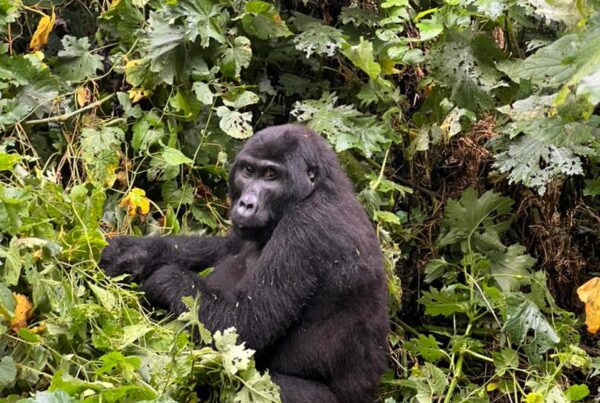
Most gorilla trekking accounts focus on what you see: the silverback’s imposing form, the infant’s curious eyes, the green density of the forest. Fewer accounts address what you hear — and yet sound is among the most powerful components of the Bwindi experience, accessible long before any visual encounter and persistent long after one ends. The acoustic world of Bwindi Impenetrable Forest is complex, layered and deeply informative once you begin to listen with attention rather than simply reacting to sounds as background.
The dawn chorus: Bwindi’s morning announcement
Arriving at the trek departure point in the early morning — typically 7am, often preceded by a lodge breakfast in darkness — means encountering Bwindi at its most acoustically alive. The dawn chorus in a tropical montane forest has a quality unlike temperate equivalents: it is denser, more layered and sustained for longer as different species reach their peak vocal activity at different hours. In Bwindi, the dawn chorus includes the extraordinary fluting phrases of the African broadbill, the persistent whistling of sunbirds competing for flowering trees, the calls of the various turaco species and the background chatter of weaver and starling species. The silence between calls, in that pre-dawn stillness, is itself a sound — the sound of intact, undisturbed forest.
What gorilla sounds tell trackers
Gorilla vocalisations are the primary acoustic tools that trackers use to locate and monitor groups. The belch vocalisation — a low, rumbling sound produced by contented feeding gorillas — carries through dense vegetation further than visual cues do. A tracker who hears belch vocalisations from fifty metres away knows the group is settled and feeding, not alarmed or moving. The pig grunt — a series of short, sharp vocalisations — indicates social tension or mild alarm. The chest beat — performed by silverbacks in display sequences — is audible from several hundred metres in still forest and signals dominance assertion or response to a perceived threat. Learning to recognise these vocalisations before your trek, through the audio sections of gorilla research websites, transforms your experience in the forest from passive observation to informed listening.
The forest’s physical acoustics
Dense tropical forest has distinctive acoustic properties. The multiple layers of vegetation — ground cover, understorey, mid-canopy, emergent trees — create a complex sound environment where direct sound and reflections overlap. High frequencies are absorbed more quickly by vegetation than low frequencies, which is why the distant rumble of gorilla belch vocalisations carries further than the higher-pitched calls of small birds. Sound travels differently in the valley bottoms than on the exposed ridgelines, and early morning air — denser and calmer before wind develops — carries sound more clearly than the rustling, wind-disturbed atmosphere of afternoon. Trackers learn these acoustic properties intuitively over years in the forest; visitors who understand them can better interpret what they are hearing and where it is coming from.
The tree hyrax: the forest’s most startling voice
Nothing prepares most first-time Bwindi visitors for the tree hyrax’s call. Beginning as a series of short, escalating screams and building to a sustained, intense shrieking that carries across the entire valley, the call is produced by an animal roughly the size of a rabbit that lives in tree cavities and is almost never seen. The call typically begins at dusk or during the night, and visitors who hear it for the first time often sit upright in alarm, convinced that something dramatic is happening outside their lodge room. Knowing it is a hyrax — a harmless small mammal related, distantly, to elephants — reduces the alarm but does nothing to make the call less extraordinary. Guides take evident pleasure in the moment when visitors first encounter it.
Listening as a practice: acoustic attention in the forest
The experience of Bwindi’s acoustic world rewards a deliberate practice of listening — pausing on the trail with eyes closed, allowing the sound landscape to become the primary sensory input rather than the visual field. This is not a standard trekking activity, but experienced guides in Bwindi are generally willing to pause for two or three minutes in good forest to allow the group to listen rather than walk. The process of identifying distinct sound layers in the acoustic mix — the high-pitched contact calls of a bird species directly overhead, the deeper rustling movement of a larger animal in the understorey, the distant belch of the gorilla group the trackers have already located ahead — builds a richer map of the forest than eyes alone can construct.
Sound recording as an alternative to photography
For visitors who find photography more frustrating than rewarding in Bwindi’s difficult light, acoustic recording offers a compelling alternative way to bring the forest experience home. A smartphone with a directional microphone attachment, or a dedicated field recorder, captures the dawn chorus, the gorilla vocalisations during the encounter and the particular ambient sound of walking in old-growth forest in ways that later become extraordinary memory triggers. Playing back a recording of a silverback’s chest beat or belch vocalisation — sounds that are physically felt as much as heard at close range — returns the visceral dimension of the encounter in ways that photographs of black-furred animals in dark forest rarely achieve.
- World Wildlife Day 2026: Protect Medicinal and Aromatic Plants – Conserving Health, Heritage and Livelihoods in Uganda’s Gorilla Forests
- The History of Bwindi Impenetrable National Park: From Forest to World Heritage Site
- Night sounds of Bwindi: what to listen for after dark in the gorilla forest
- Uganda’s Bwindi Impenetrable Forest: a UNESCO World Heritage Site explained
- Kibale Forest National Park: the primate capital of the world
- The sounds of the Bwindi forest: a sensory guide to what you will hear
- Gorilla vocal communication: what the sounds in the forest mean
- Night sounds of Bwindi: what the forest says after dark
- Mountain gorilla vocalisations: what the sounds in the forest mean
- The practice of deep listening in the forest: what a gorilla trek teaches about presence