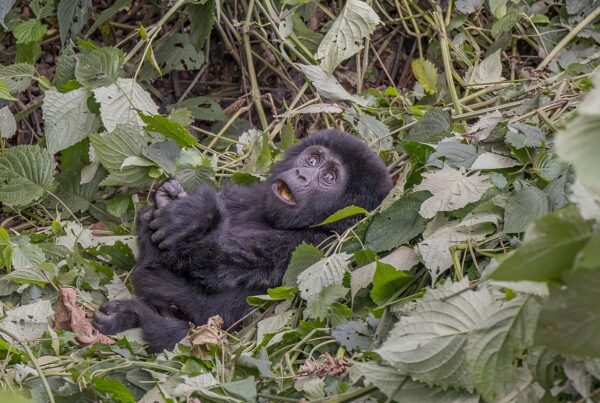
Children who visit Bwindi Impenetrable Forest carry the encounter with them for decades. Adults who trekked as children — those rare few whose parents made that choice — consistently describe it as a formative experience that shaped their relationship with the natural world. But even children who cannot make the trip can be meaningfully engaged with gorilla conservation in ways that go beyond documentary watching. The concepts are accessible, the stakes are real and the story has genuine heroes, villains and a hopeful trajectory that children respond to intuitively.
Starting with numbers that children can grasp
There are approximately 1,000 mountain gorillas left in the world. All of them live in two forest areas: the Virunga volcanoes straddling Rwanda, Uganda and the Democratic Republic of Congo, and Bwindi Impenetrable Forest in Uganda. These are not abstract statistics — they are the kind of numbers a child can hold in their head and compare meaningfully to things they know. One thousand gorillas is fewer than the number of children in many primary schools. Explaining this concrete scarcity — and then explaining that the number is growing because of conservation work — gives children a real story with measurable progress.
Why mountain gorillas cannot live in zoos
Children often ask why mountain gorillas cannot simply be moved to zoos if the forest is dangerous for them. The answer illuminates something important about biological adaptation and conservation philosophy. Mountain gorillas are specialised for montane forest conditions — specific food plants, altitude, social group dynamics — that captive environments cannot replicate. Unlike eastern lowland gorillas or western gorillas, no mountain gorilla has ever survived in long-term captivity. This is a key teaching point: conservation for this species must happen in the wild, in the specific forest habitat where they evolved. There is no captive backup plan. What exists in Bwindi and the Virungas is all there is.
Dian Fossey as a story children understand
Dian Fossey’s story translates well to young audiences because it has the structure of a story they already know: someone chose to dedicate their life to protecting something they loved, against the opposition of people who wanted to exploit it. Her eighteen years at Karisoke Research Centre, her method of habituating gorillas through patient presence, and her eventual murder — attributed to poachers or those who profited from them — provide a narrative that children can engage with emotionally. The age-appropriate version omits the murder and focuses on the dedication; the science of how she gained gorilla trust by imitating gorilla vocalisations and behaviours is genuinely fascinating to most children.
The poaching problem explained without trauma
Children can understand that people sometimes harm gorillas without framing poaching in ways that cause distress. The explanation that some people set snares in the forest to catch other animals for food — and that gorillas sometimes get caught accidentally — is accurate and comprehensible. The important follow-on is that veterinary teams from organisations like the Gorilla Doctors remove snares and treat injured gorillas, and that rangers patrol daily to find and destroy snares before they harm animals. The system of protection — patrol, monitoring, veterinary intervention, community outreach — is a story about organised human effort solving a real problem. Children respond well to the idea that adult humans are working hard to fix something important.
How tourists help: connecting the visit to the outcome
For families actually visiting Bwindi, one of the most powerful things a parent can explain to a child is the direct link between the permit fee and what it funds. The ranger who led your trek this morning — his salary comes partly from your permit. The school in the next village — it was built partly with gorilla tourism money. This is not abstract charity; it is a system where choosing to visit, choosing to pay and choosing to care translates into a village school and a protected forest. Making this connection explicit for a child visiting Bwindi transforms the experience from observation to participation in something larger than the sixty-minute encounter itself.
Books and media for continued engagement at home
The interest sparked by a visit to Bwindi — or by a parent’s account of one — can be extended through age-appropriate resources. Ivan: The Remarkable True Story of the Shopping Mall Gorilla by Katherine Applegate explores captivity and freedom through a gorilla’s perspective. National Geographic’s Mountain Gorillas documentary series provides visually extraordinary footage of Bwindi gorillas in the forest. The Dian Fossey Gorilla Fund’s website includes educational materials designed specifically for school children. These resources maintain engagement beyond the visit and connect the child’s curiosity to the ongoing conservation story rather than treating the experience as a closed chapter.
- How to explain endangered species to children: lessons from the mountain gorilla
- Gorilla adoption programmes for children: how symbolic adoption supports real conservation
- Endangered Animal Species in Uganda
- Gorilla Conservation Success Story: How Tourism Saved the Species
- Red Colobus Monkey Uganda: Endangered Kibale Forest Species
- Rothschild’s Giraffe Uganda: The Most Endangered Giraffe Subspecies
- How gorilla tourism funds conservation in Uganda: the economics of saving a species
- How children learn conservation values through wildlife encounters in Uganda
- Why mountain gorillas were declared no longer Critically Endangered: a conservation milestone
- Explaining gorilla trekking to children: age-appropriate descriptions and ways to prepare kids