Updated
Gorilla trekking is easy to explain to children once you break it into simple facts: a small group walks into a mountain forest with rangers to find one wild gorilla family, stays with them for one hour, then walks back. Only people aged 15 and over can go, so younger children need to understand why they will do other activities while older siblings or parents trek. Here is how to describe it at different ages, what to say about safety, and how to prepare teenagers who are joining the trek.
The basic explanation
Start with the core story. Mountain gorillas live only in a few mountain forests in Uganda, Rwanda and Congo, and there are just over 1,000 of them. Some gorilla families have spent years getting used to people, so they stay calm when visitors come. Each morning, rangers lead groups of up to eight visitors to one family. Trackers go ahead to find where the gorillas slept, and the group follows, sometimes for an hour, sometimes for most of the day. Visitors then watch quietly for one hour and leave.
Children under 8
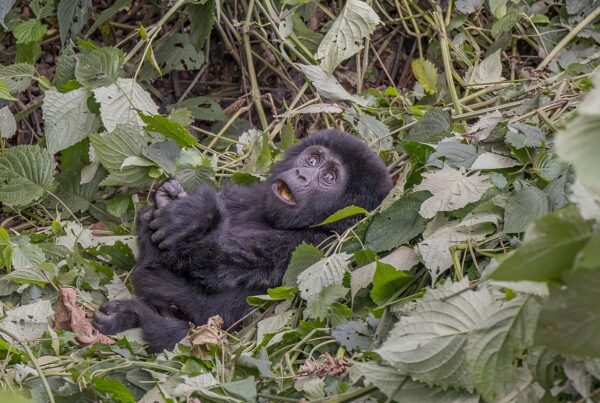
Keep it short and visual. Show photos or short videos of gorilla families and point out the baby, the mother and the big silverback “dad” who keeps the family safe. Explain that gorillas eat leaves, sleep in nests of leaves and like to be left in peace, so visitors must be quiet and stay back. If a parent is trekking, explain where you are going, how long you will be, and what they will do meanwhile, such as a guided nature walk.
Children aged 8 to 14
This age can understand the rules and the reasons behind them. The minimum age is 15 because the walk can be long, steep and muddy, because children catch colds more often and gorillas can catch human illnesses, and because visitors must stay calm if a gorilla comes close. Explain the seven-metre distance rule, the masks, the one-hour limit and why the permit costs US$800, or US$600 in April, May and November: the money pays for rangers and helps nearby communities. See our guide to the gorilla trekking age limit.
They can also have their own wildlife goals: chimpanzee walks are open from 12 in some places, golden monkey tracking in Mgahinga, game drives, boat trips and nature walks are all suitable. Giving them a role, such as keeping the family wildlife journal or bird list, helps them feel part of the trip. See our guide to wildlife journals for children.
Teenagers who are trekking
Teens aged 15 and over need a realistic picture. The walk may take 30 minutes or six hours, often off the trail, through thick, wet vegetation on slopes. There is no guarantee of what the gorillas will be doing; they may be resting, feeding or moving through dense bush. Explain that a silverback may chest-beat or make a short mock charge, and that the right response is to stay still, look down and follow the ranger. Habituated gorillas are used to people, and serious incidents are very rare.
Agree on phone use before the day: a few photos, then put it away and watch. Practical preparation helps too: walking on hills for a few weeks beforehand, broken-in boots, gloves for grabbing vegetation, a rain jacket and plenty of water. Hiring a porter makes a long day much easier. See our guide to taking teenagers gorilla trekking.
Good ways to prepare
Books and films help at every age: photo picture books for young children, “The One and Only Ivan” for middle readers, and Dian Fossey’s “Gorillas in the Mist” or the documentary “Virunga” for older teens, though the latter includes violence. A map of where Uganda and Bwindi are, a look at the gorilla families in your chosen sector, and a simple family discussion of what the money from permits does all make the trip more meaningful. See our guide to gorilla books and films for children.
Frequently asked questions
Only from age 15. Younger children can do nature walks, game drives and other activities.
The walk is long and hard, gorillas can catch children’s colds, and visitors must stay calm close to wild animals.
Usually not. Habituated gorillas are calm; explain chest-beating and mock charges in advance.
Guided nature or community walks near the lodge, often arranged by the lodge or your operator.